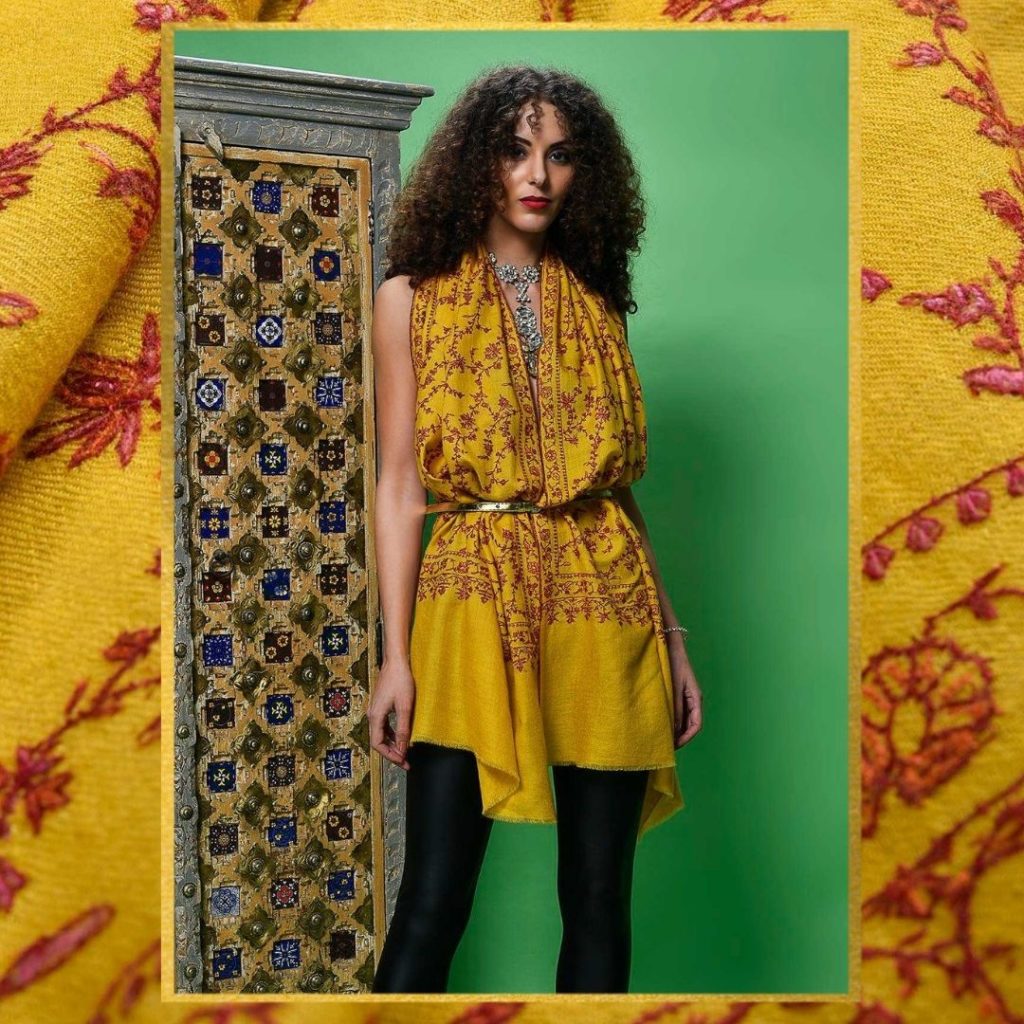
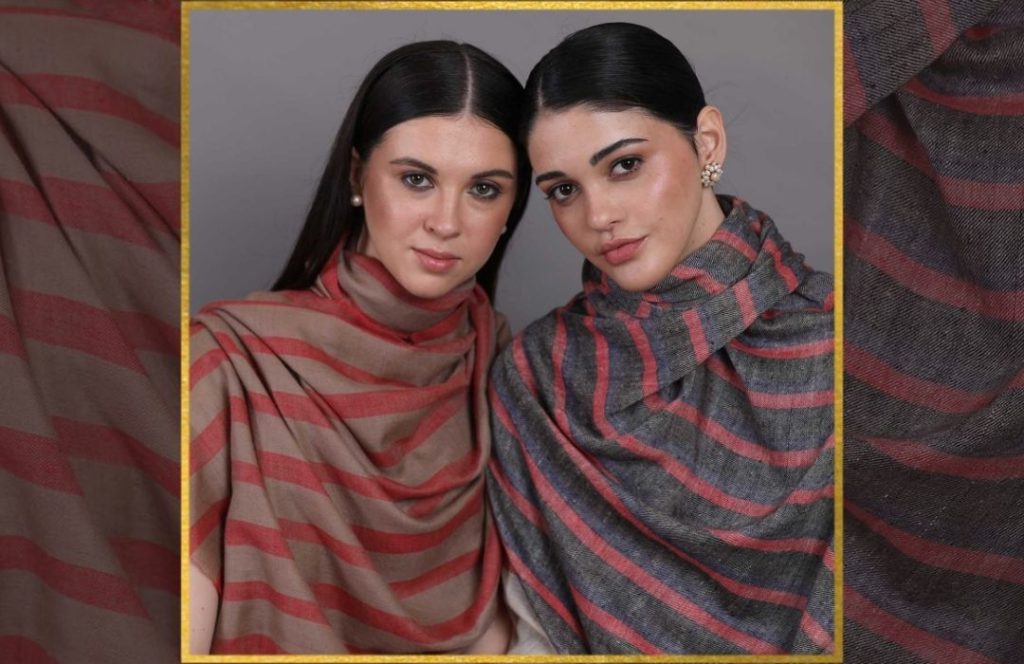
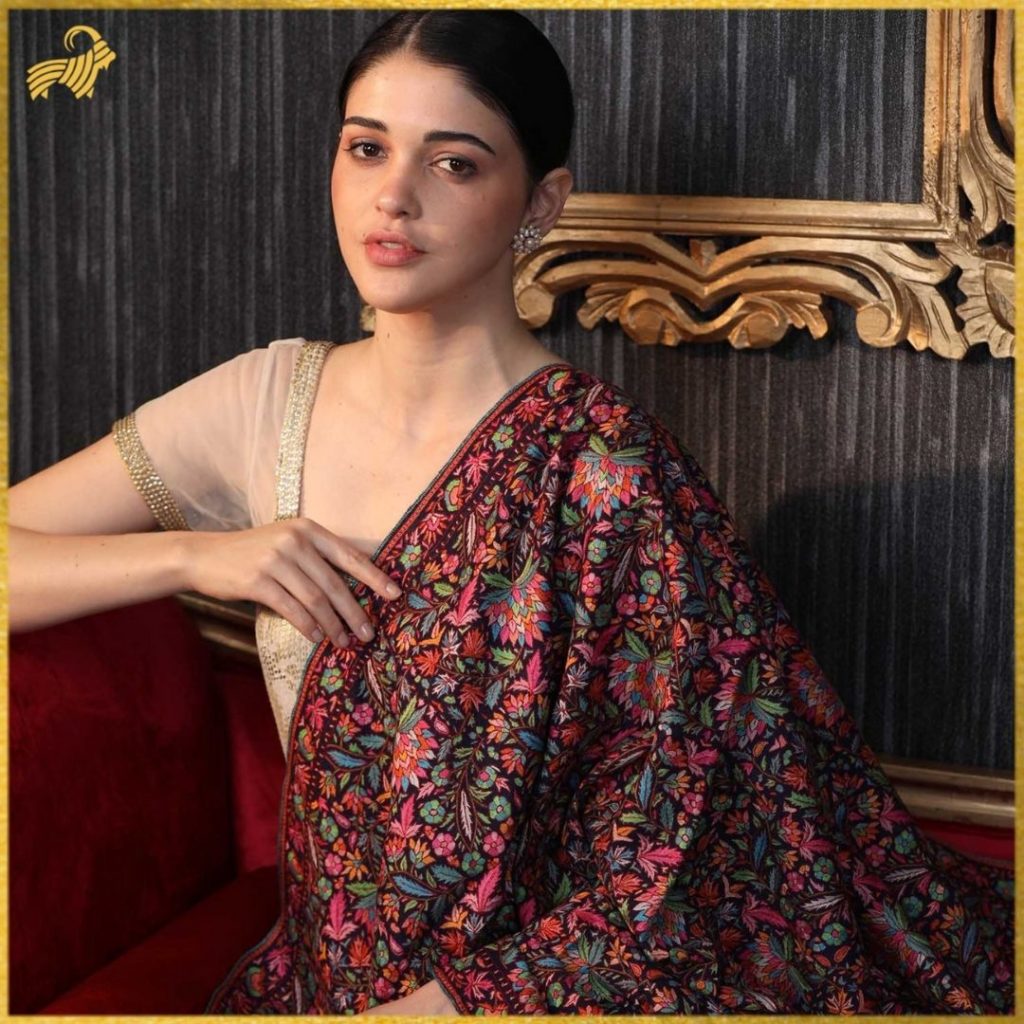
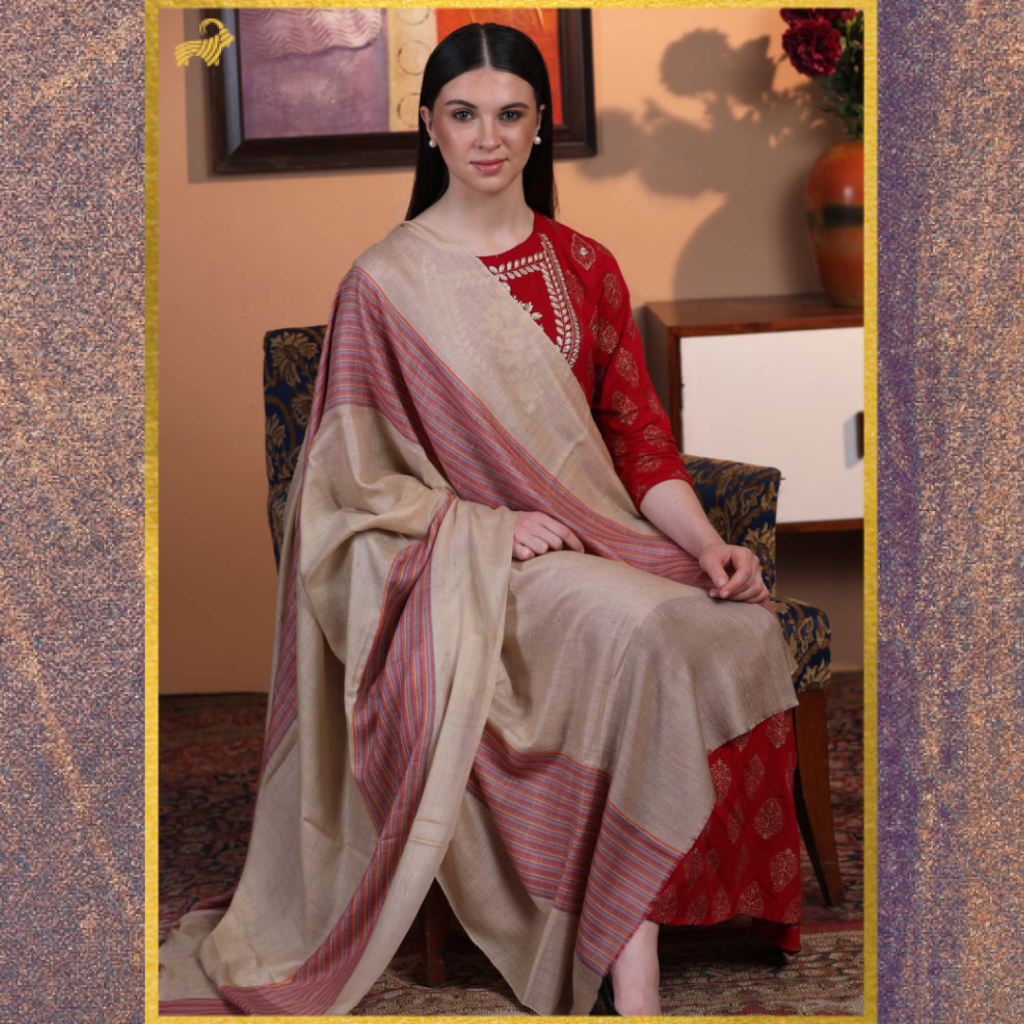
Even though a Pashmina or Cashmere scarf is a timeless ultimate accessory and is primarily draped in a traditional style, there are multiple ways to style a Pashmina to look trendy and accentuate any outfit. It gives you an edge over others and enhances your product’s luxurious nature. The downy fleece of the Capra hircus goats that has often been called the ‘soft gold of Asia’ or the ‘diamond fibre’ is rightly so, because of its great demand and limited supply, truly making it priceless.
And while women love to wear Pashmina scarves, but they often don't know how to. Pashmina is versatile and would love to style you up in the most sophisticated fashion. So how do you wear a Pashmina wrap? Have a look at some styles Pashmina scarf can be worn.
Without much ado, here is how to wear a Pashmina scarf:
1. Waterfall style
Tie the Pashmina scarf around your neck, with one end significantly longer than the other. Loop the longer end of this scarf around your neck one time, and then take the end you used to loop and secure it by the top corner. Fit the top corner into the loop at the side of the neck. When draped properly, the unattached side drapes like a waterfall.
Wrap the Pashmina scarf behind your neck. Take one end and wrap it around your hand. Pull it through to make a loose knot. Take the other scarf end and pull it through the side knot, going under the knot loop and then over. That’s how you get a perfect knotted necklace look! See this turquoise cashmere scarf that will add elegance to your style.
Women often ask us " how to wear a Pashmina with a belt" Here it is. Sartorially safe for dressier occasions - simply wear the Pashmina scarf over your neck and the front of your chest. No actual tying happens in this one, so it’s a loose way of wearing a scarf meant more for ornamentation than actual warmth. Wear the scarf around the neck and let ends fall in front. Add a thin belt to keep the scarf in place and show off your waist.
4. The Braided Style - Cashmere Scarf
Fold a Cashmere scarf in half, lengthwise. Drape folded scarf over the neck and slide the two ends through the loop made by the fold. Grab loop again and twist to create a second, smaller loop, then slide the loose ends from between that loop, too. Buy this exclusive brown pashmina scarf to match the occasion.
5. The Toss - how to wear a Pashmina scarf in a basic style
Tie your Cashmere scarf around your neck. Toss one side of the scarf across the opposite shoulder so it falls behind you. Don’t overthink this style, it’s meant to be casual. It’s a great way to rock any outfit on a day out!
6. European Loop - Modish style to wear a Cashmere scarf
How to tie a Pashmina in a loop? Simply fold the Pashmina scarf midway, lengthwise. Drape folded scarf around your neck and slide the two ends from inside the loop created by the fold. Slide to adjust the knot.
7. The Bunny Ear Style - Cashmere
Wrap your scarf twice around your neck. Then put one end under neat the loop of the wrapped scarf. This way you will have both ends on the same level. Simply tie a knot with the ends and you are ready to go. Look at this burgundy pashmina scarf to feel the exclusiveness.
If you are a fashionista and like to always make a statement, here is how to wear a Pashmina that makes you look edgier. In case you are trying to make that foray into fashion, do not forget to experiment with our styles and fall in love with the products. We have given you so many styles. So how do you wear a Pashmina wrap now?
The past few decades have witnessed an interest in the shawls or wraps. Earlier used just as a piece of wrap to protect oneself from the biting cold. But today it is also about making a style statement. The word ‘shawl’ comes from the Indo-Persian word shal. This was basically a fine woven woolen fabric people used as a drape. In 1623, the Italian traveler Pietro della Valle observed that the shawl was primarily worn as a girdle. However, in India, people draped it across the shoulders.
The shawls are one of India’s best products. It is unique in that while it offers the intimacy of a warm garment, it leaves you free and unencumbered.
~Kamaladevi Chattopadhyay
Pashmina - Then and Now
The origins of shawls traces back to the medieval period. But archaeological findings and literary references suggest that the tradition of shawls in India existed right from Indus Valley Civilization.
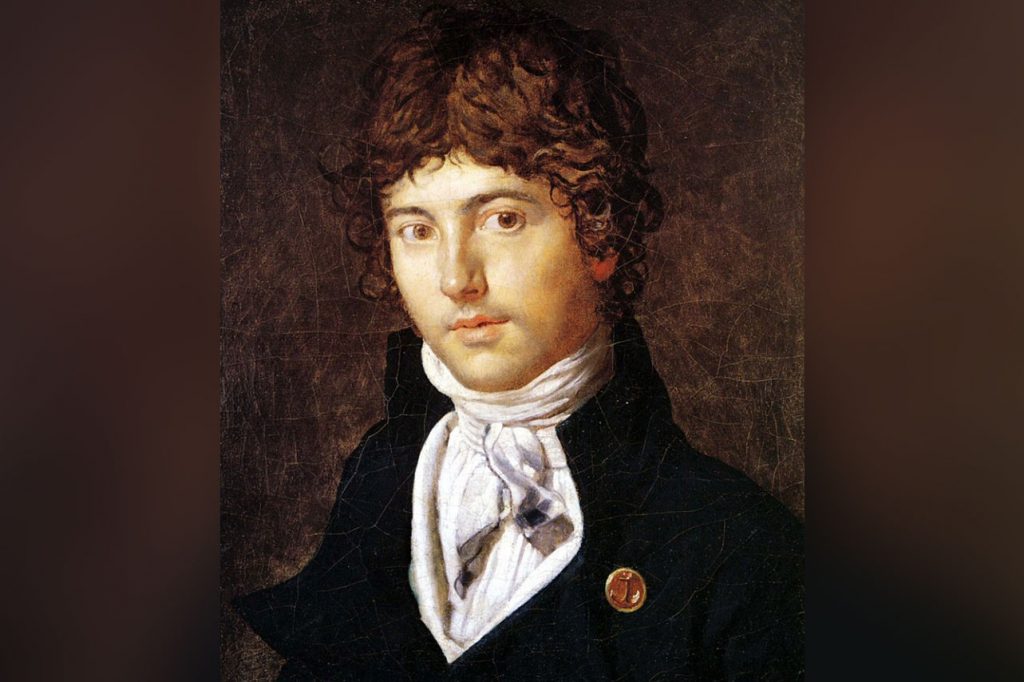
Empress Joséphine with her Kashmiri Pashmina Shawl
Even Though these wraps have a rich legacy and speak volumes about their past, today these are wardrobe must-haves. In addition to this, comfy wrap accessories have the power to notch up your style, reflect opulence. Worn during weddings in winter, it is a sight to behold when women turn up in stunning colourful pieces with exquisite embroidery. Besides, experts consider these as great gifts that blend both style and utility in the best manner.
1. Modern Design Pashmina Shawls
Nothing epitomizes the glorious history of Kashmiri craftsmanship as warmly and beautifully as Pashmina. In fact, Pashmina once spelled exclusivity and security for Kashmiri women. It is said that if they fell upon bad days, they cut up a shawl length of Pashmina and sold it to the shawl peddler for cash!
A legacy of the Mughals, the romance of Pashmina reached its zenith when it cast its spell over European royalty. In fact, the great Napolean Bonaparte found the shawl fit to adorn the shoulders of his beloved, Josephine.
In an attempt to modernize the traditional art of Pashmina making, the artisan finds stripes the most effortless way to achieve this
Originally in the natural buff, artisans weave Pashminas today in myriad colours and textures. While plain Pashminas have a huge market with the western clientele, craftsmen have introduced a number of modern designs into the art. Now Pashmina shawls aren't just the traditional embroidery ones but come with chic abstracts, stripes, checks, plaids, embellished with French chantilly laces and original Swarovski crystals, exquisite prints, and ombre patterns. These are must-haves for those who love comfort as well as put their style on point.
In the cold climes of Kashmir, in a village called Kanihama, a chosen few spend their lives weaving a magic spell of warmth and colour. It is indeed the famous Kani shawl. This exquisite wrap was once coveted by Mughal kings, Sikh maharajas, and British aristocrats. Not only this but even the Ain-i-Akbari records that Emperor Akbar was an avid collector of Kani shawls.
Delicate & graceful; elegantly exquisite; are our intricately woven cashmere Kani shawls that are hand woven on the historic wooden looms. Artisans use Pure fine Himalayan cashmere of the Capra Hircus goat in vibrant colors
Making of a Kani shawl
These warm wraps involve one of the most laborious techniques used in shawl weaving. Numerous kanis (little wooden stick used as spool) or shuttles led with rich coloured threads are moved around even in a single weft line. An intricately designed shawl may use as many as 50 Kanis with different coloured threads and may take several months to complete. To start with, designs are codified on paper, known as talim, and sung out as two weavers work on a shawl together.
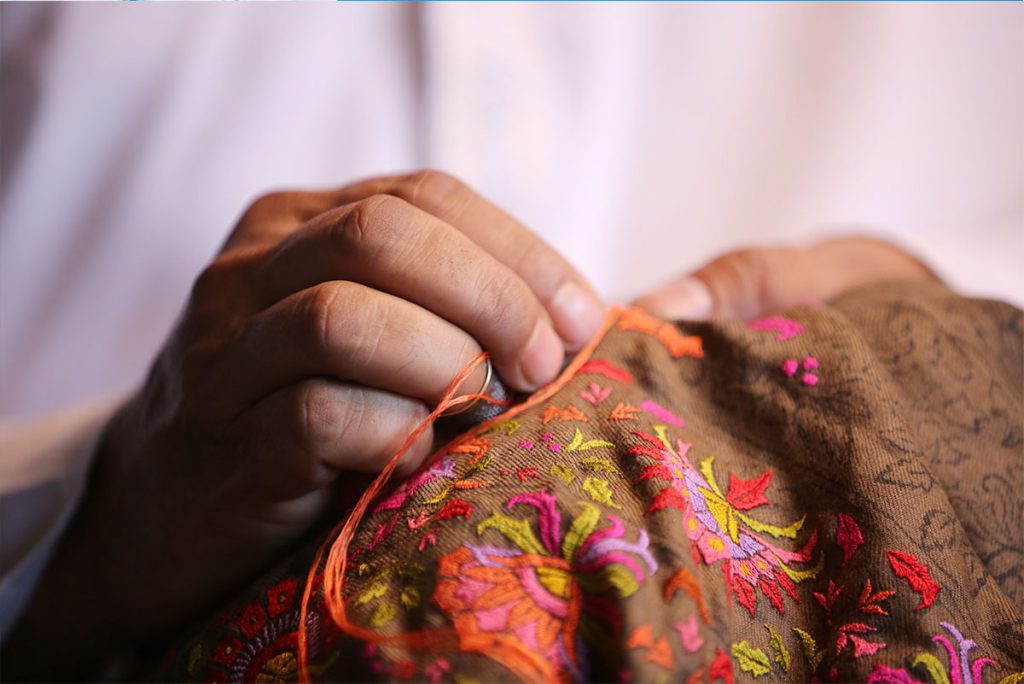
Embroidered Pashmina shawls look nothing less than pieces of art. The delicate base fibre doesn't allow a thicker version of the same to be used. As such, fine embroidery patterns have to be done by hand, and the result is purely magical.
Kashmiri Pashmina shawl gathers every single blooming flower from the Mughal garden of Kashmir and exhibits them in a way that is overwhelming
Three types of hand embroideries are done on Pashmina. The mostly used Sozni Kari uses fine threads and needles to cover the shawls in lovely motifs. Papier Mache embroidery uses brilliant colourful threads for the shawl to spruce up exquisitely. Tilla Dozi is the least use embroidery, as it is heavier on the shawl. Tilla uses metallic threads dipped in gold or silver to make the shawls look regal and the most cherished.
Most of the designs today feature floral motifs or paisleys and add a touch of elegance to the wearer. Historically, this type of Pashmina shawls was a prized possession of the aristocrats. They used to buy woven fabric by the yard and wear it as a shawl or wrap. Undoubtedly, Akbar was one of its most popular patrons.
A twill-woven body in the grey, off-white, fawn, or brown shades of natural wool & tapestry woven borders in kaleidoscopic forms is characteristic of Kinnauri shawls. Originating in Kinnaur, Himachal Pradesh, this style became popular in Kullu with the migration of the Kinnauri Bhushahra community here.
Kinnauri Shawls from Himachal Pradesh, India
Locally, these mesmerizing wraps are used as drapes. The ones worn by women are called pattu and those used by men, chandru.
5. Gujarati Shawls
The tangalia weavers in Surendranagar and Chotila, Gujarat, make black and off-white coloured shawls in thick coarse sheep’s wool. A characteristic feature is the use of beads and mirrors. Popular motifs are derived from their immediate surroundings, such as peacocks, camels, trees, and houses. Traditionally, men wear these on special occasions and women wear them as sarongs.
Gujarati shawl embroidered in colourful threads
These beautiful drapes are all different from each other but stand apart due to their unique personality. Winter weddings are the best time to flaunt your collection of wrap accessories and make head turns with your classy demeanour. Make sure you stock up on these by then!
For the grass that you’ve just eaten, oh goat, Give us some good pashm, For the water that you’ve just drunk, oh goat, Give us some good pashm, Sit down on the grass and be still, oh goat, So that we can take out your pashm
These lines penned by Monisha Ahmed in her book Pashmina: The Kashmir Shawl and Beyond succinctly summarize the worth and value of a Pashmina goat in the eyes of the herder. Metaphorically, even the world is at the behest of this goat that produces pashm, which is an objectde art in the elite circles and rightly so.
What is the above song about?
This song is characteristic of Changpas, who reside in the cold mountains, and are nomadic pastoralists. Changpas are inhabitants of either Tibet or the Changthang region of Ladakh. This vast terrain is scattered with mountains and valleys and is a sight to behold. However, it is desolate and cut off from civilization. For centuries, these men have been herding these prized goats, who run Kashmir’s famed shawl industry.
The Changpas are habituated to extreme temperatures and reside at high altitudes, ranging from 3,600 to 4,500 metres. Here temperatures can easily plummet to minus 50 degrees Celsius. According to estimates, they are not more than 9000.
Though they are commonly referred to as Changpas, don’t assume that they are a single community. Their groups are divided basis their place of origin and each unit has a chief and marked grazing areas. Some accounts suggest that there are 14 such groups residing in Ladakh and these vary from 20 to 176 families.
It is intriguing to know that each of these units has a specific name. For instance, there’s one that’s called Rupshu, which consists of roughly 120 families. While there are some variations, most of them lead the same living and their practices do not differ as such.
Though pastoralism is the mainstay for most of them, there are some who are also involved in agriculture and are the owners of some of the highest arable lands in the world. Generally, the livestock comprises sheep, pashmina goats, and at times, yaks. According to official records, in 2007, the number of pashmina goats kept by these Changpa men was about 170,590. These goats were shredded to make handmade Handmade Cashmere Scarf and other Pashmina Products.
Till the 1960s, Ladakh was not in the limelight and it was western Tibet that supplied pashm for the shawl industry in Kashmir. Later, due to conflicts between China and Tibet and greater accessibility to the Indian plains, the trading patterns witnessed a shift. Today, the scenario is completely different, since it is these Changpas, because of whom the industry in Kashmiri land is thriving.
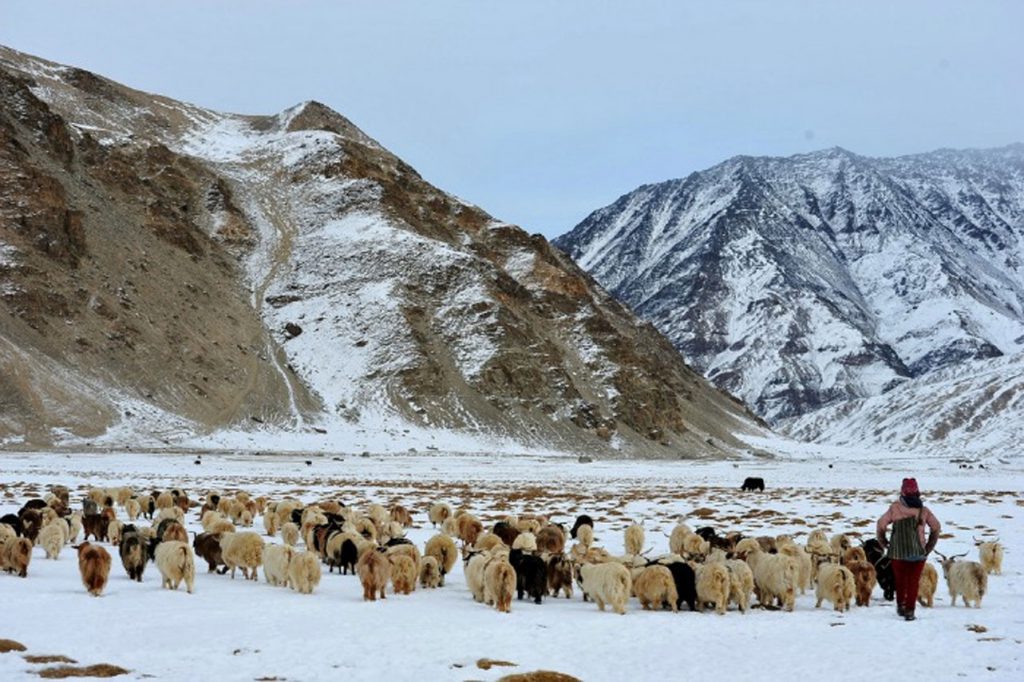
- Photograph by Manish Lakhani
Are Changpas from Tibet?
Since the early days, the Changpas move along with their herds from one grazing pasture to another. There are some accounts that suggest that the Changpas might also be of Tibetan origin, who herded sheep and cattle in eastern Central Asia all the way up to the northwest borders of China.
As far as their origin is concerned, there doesn’t exist much documentation apart from local accounts and folklore. There are several monasteries in Ladakh dotted with wall paintings as well as rock carvings that give out information that the Changthang region was inhabited by hunters and courtly men.
These Changpas follow Tibetan Buddhism and mostly belong to the Drukpa sect. Generally, each family sends their son to become a monk at any of the monasteries in the region. They are supporters of the cosmic structure that are separated into three tiers. The uppermost level is inhabited by the gods, the lowest by spirits of the aquatic and subterranean worlds. Some say that people and animals live between the gods and spirits, which as lore suggests, is also inhabited by demons. There are different colours defined for each set: white for heaven, red for the earth, and blue for the aquatic world.
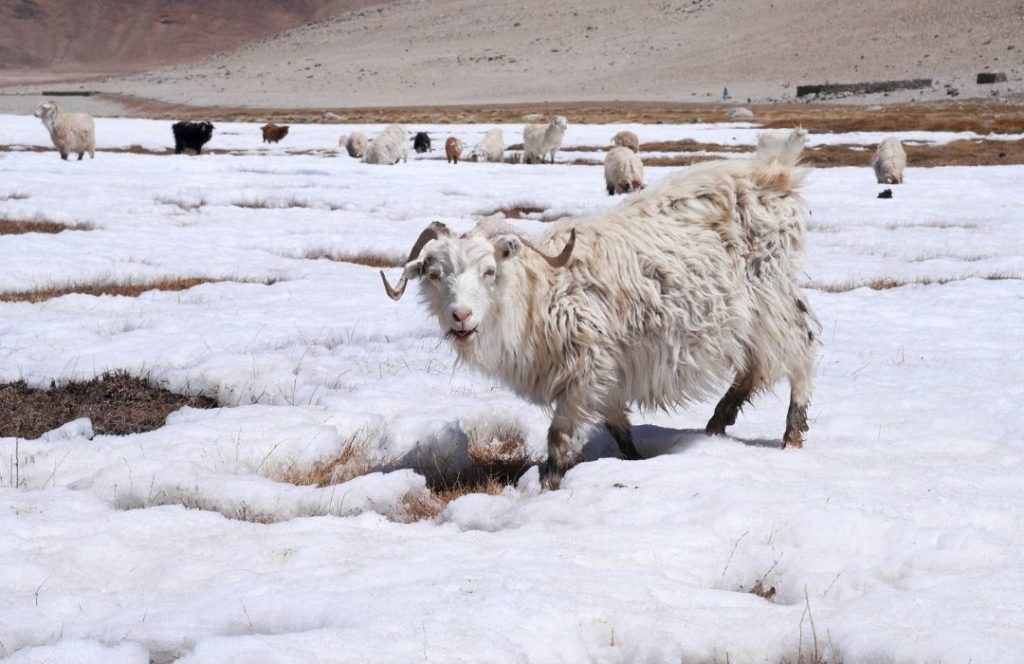
Pashmina goats out for the day at high altitudes: through most of the year, the animals graze in pastures located at a height of more than 4,500 metres.
For the Changpas, their animals are sacred, and they believe that it is God who has showered them with these species. Each flock has some animal representations who are selected for the different colour sets. They are chosen basis their strength and colour. For example, the white animal is dedicated to the gods, the one with a hint of blue to the spirits and brown to the demons.
They aren't just Goats
Among the Changpas, their wealth is defined basis the number of animals they own in their herd. Earlier, they preferred to keep more sheep than goats, since they could barter wool for grains. Gradually, the situation has changed. The Pashmina goats are now considered a symbol of economic prosperity. The yaks were earlier given the highest status, but with their number declining, the spotlight is now on the goats.
As a practice, earlier sheep and yak were offered during religious ceremonies to gods, demons, and spirits. This has changed now, and these goats are held in high regard.
Though the world has changed beyond words, the life of these Changpas remains sheltered till today. They go about their daily work just as a ritual and this is the way they function. Untouched by modernity, little do they know that the world is literally at their feet. No wonder, pashmina is known as the diamond fiber and the herders are as special!
Traveling is no longer a luxury today, it is more about investing in an experience. Contrary to how travel plans were in the past, where families would plan months in advance to set out on that holiday, it is about unleashing your go-getter attitude and soaking yourself in wanderlust at every opportunity you get. Your Instagram feeds might be pleading you to take that next holiday, but not without mastering the perfect airport look! Yes, you heard it right. Popular tabloids and social media websites have been for a while featuring celebrities rocking the airport look and making each of one us want to emulate them! Don’t worry, we’ve got you a checklist of the perfect accessories you’d need to make head turn. These are not only chic, but comfortable at the same time. Isn’t that a win-win situation?
Let’s have a look at these 7 Airport Essential Accessories
1. Cashmere Scarf - Airport essential
Scarves are often a girl’s best friends, they are versatile, chic and up your outfit game like no other. These luxurious accessories hand-crafted from pure Himalayan cashmere is warm and toasty to beat those flight chills and at the same time, adds that touch of elegance and opulence. In fact, Victoria’s Secret Model Alessandria Ambrosio too swears by it and is seen wearing this timeless Cashmere accessory every time she’s snapped at the airport. The Cashmere scarf adds a little formal yet classy touch to her usual jeans and T-shirt avatar and doubles as a wrap under the air-conditioner, adding to the utility aspect as well!
We, at Pashmina.com, are one of the world’s largest curators of pure and handcrafted Himalayan cashmere scarves and Pashmina shawls. Each of our wraps epitomizes the highest levels of quality and royalty and will make you feel no less than nobility yourself. Our range of Cashmere scarves and Pashmina wraps will enrapture the world with its beauty and sublime softness. It’s not just the beauty and exquisiteness that we are concerned about; credibility is what sets us apart from the rest. Our Pashmina pieces are first painstakingly handcrafted with the finest designs and reflect the highest quality of craftsmanship. After this labour of love sees the light of the day, it is sent for quality assurance to the Crafts Development Institute, Ministry of Textiles as part of Govt of India that certifies each Pashmina product. After all, you deserve a product that’s as warm and real as you!
2. Oversized Handbag - Airport Essentials
No airport look can ever be complete without the quintessential oversized handbag that is flaunted by most celebrities. Not only is it a functional accessory, since it allows you to store all your essentials, but it also makes a style statement in few words. They are a blend of style, class and practicality and honestly that’s a great combination to have. You will not regret investing in a good, sturdy one!
3. Sunglasses
Add a pair of stylish sunglasses for that added oomph or even hiding those tired eyes and dark circles. They serve both purposes and well enough, if we may add! Earlier used only as protection of eyes, today you can find sunglasses and shades in all shapes and sizes and you can pick one that suits your face structure and personality. If it’s cat eyes or reflectors, choose what you like and rock that look in style!
4. A stylish hat
We always turn to celebrities for some sartorial inspiration and why not if it’s the airport look? The royals have always carried it with élan, be it Meghan Markle or Queen Elizabeth II and there’s something about the hat that exudes royalty! We think the airport look is incomplete without this accessory, what do you think?
5. Chic sneakers - An airport essential for all seasons
Sneakers spell athleisure and comfort both at the same time. In fact, all through last year, the rage has been white sneakers, which celebrities all over the world have worn with anything, be it jeans or a shift dress. There are infinite ways to wear the season’s best kicks. If white is not your choice, then a sneaker in some bold colour or floral ones would also do the trick. Try it to believe it!
6. DIY beauty kit - An airport essential for the year round
When boarding a flight, the last thing you want to appear is clumsy and touch up your makeup at the last moment. To save embarrassment and effort, keep a small pouch ready with some makeup essentials to freshen up before you land. You’ll feel great once you step out. Celebrities do this all the time, since they have paparazzi stalking them all the time to get a few snapshots. We know you are not a celebrity but being well-groomed with makeup on point never hurt anyone!
7. A passport holder - An Airport essential 24*7*365
Even if you travel light, a stylish passport holder is an absolute essential. You don’t have to get a dull one, there are so many options available today, be it in vibrant colours or quirky prints. Believe it or not, this accessory takes your airport look a notch higher since many fashion-conscious people might even miss out on this one. After all, there isn’t everyone who pays so much attention to detail.
Remember to stock up on these essentials before you set out for your next trip. You never know you could be mistaken for a celebrity and snapped by the paparazzi!
Ever imagined a fabric so fine that wrapping it around you feels warm & luxurious all at the same time? Appropriately known as the “soft gold of Asia” or the “diamond fabric”, Pure Pashmina has been around over more than 5 centuries. From being draped by the European nobility to now being the ultimate fashion accessory, pure Pashmina has gone through a whirlwind of a ride in the last few decades.
Empress Joséphine with her Pashmina Shawl
There’s a flood of fast fashion today and most brands have jumped on to this bandwagon. The focus is much more on variety than the quality aspect and some of the biggest names are feeding this trend. Even when it comes to Pashmina, most brands are selling “affordable handmade cashmere wraps” in the name of machine-made and blended varieties. Since Pashmina is regal and a symbol of opulence, consumers go in for such tall claims. But they later pay a heavy price for their choices and realize their lack of awareness.
This is where we’ve stepped in to revive the lost glory of handmade Cashmere. This royal art has its roots in the picturesque valleys of Kashmir and for us, maintaining its pristine beauty is paramount. At Pashmina.com, we believe in the adage ‘less is more'. So we propagate sustainable luxury through all our offerings. Each of our products is painstakingly hand-crafted and hand-embroidered by the gifted artisans of the land of Kashmir. It might baffle you that some of the most exquisite designs take several years to create. Hence, it is no child’s play. Our portfolio of products showcases the rich legacy of this art as narrated by the Kashmiri weavers, seekers, and keepers of pure Pashmina.
Weaving a pure Pashmina is a labour of love. It is a process that requires high levels of patience and perseverance. Centuries ago, it was the Kashmiri herders who discovered the soft under-fleece of the Changthangi or Capra hircus goats. Interestingly, these goats grow this dense fibre to keep themselves warm in the cold climes of Ladakh. During spring, the herders comb this hair or collect it when they shed this undercoat to make some of the most opulent masterpieces ever heard of. The ethereal beauty of the land reflects in every single piece that tells stories; the stories of blood, sweat and toil. You’ve got to see it to believe it!
For a piece so timeless, which has always been the character of pure Pashmina, we believe that it should stand the test of time. Because of all the efforts that go towards quality assurance, each of our pieces goes through stringent testing by the Crafts Development Institute It is under the aegis of the Ministry of Textiles, Government of India. Here, the piece goes through a quality check at the Institute’s Pashmina lab, the first-ever in India, to get certified. In fact, this is the case with all our pieces, so that the customer knows that he’s made the right office. We follow the highest standards of quality and live by the principles of authenticity and credibility.
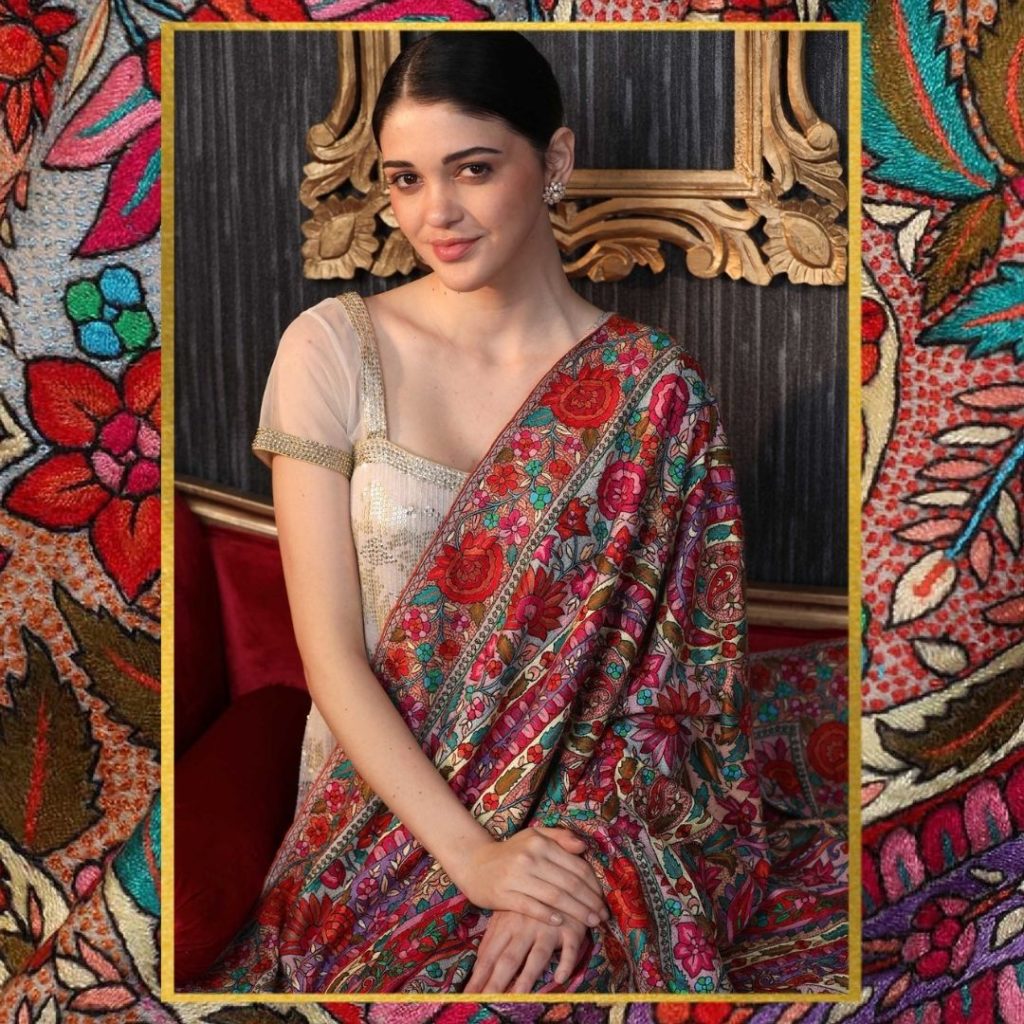
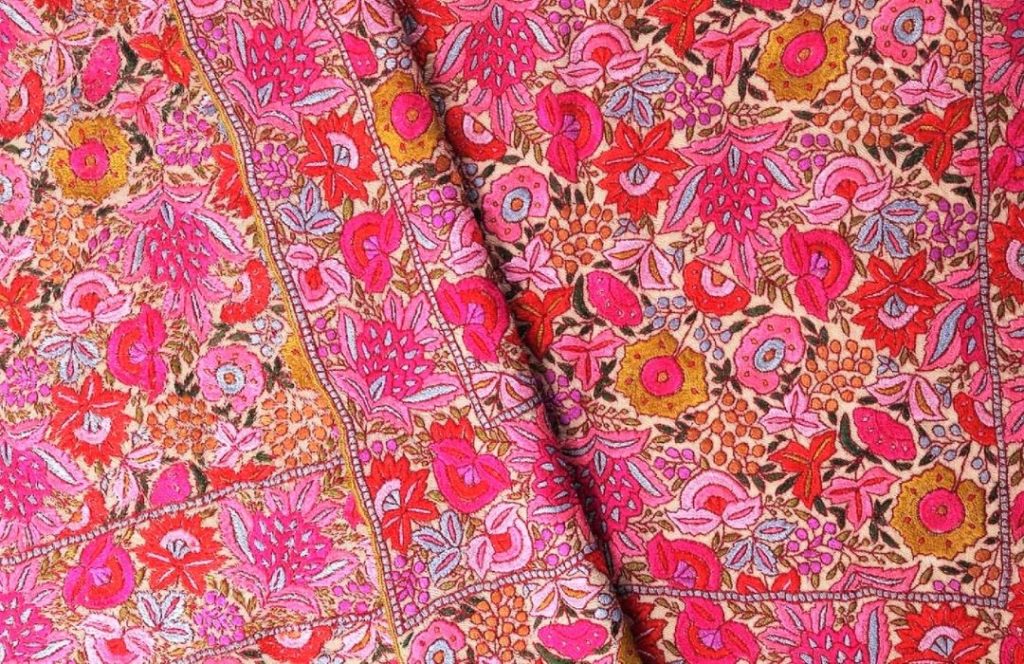
Kashmiri Pashmina shawl dipped in warm red and bright gold shades
Our brand is in every way committed to preserving its limitless heritage and we ensure sustainable methods are adopted. Our hand-embroidered pieces or even the plain and magic weaves are no less than a collector’s item! They are splendid and intricately woven!
Artisans' Handmade Luxury
Though there is a rich history of pure Pashmina, it is the artisans who are the real stars. They painstakingly create masterpieces that reflect the highest level of craftsmanship. Our brand, Pashm, believes in rewarding these craftsmen for their exquisite work by empowering them and helping them in their growth. We contribute 5% from every sale towards the upliftment of women artisans and educating their children.
An ivory Pashmina Shawl with colorful roses and paisley in Kashmiri Papier Mache embroidery
The artisans’ craftsmanship reflects in our bouquet of offerings - be it classic timeless or contemporary & trendy, shawls, scarves, or hijabs. To cater to the varied tastes of our consumers, there are also hand-crafted pure cashmere stoles, which are hand-woven on wooden looms. One can opt for the solids, the funky Ombres; the beautiful Swarovski & Chantilly laces, or the classic embroidered ones. There are also handmade cashmere scarves and hijabs. Our pashmina collection also extends to throws and blankets that are luxurious in feel and are available in neutral tones. These products serve as the perfect gifts for all occasions, be it weddings, anniversaries, birthdays, or just as a symbol of affection.
Light, soft and warm, Pashmina is world-famous but the process of creating it is long and tedious
Gulzar Hussain
There is a land far away from the noise of civilization, where biting, chilly winds make their headway. It is much like the Arctic wastes of Siberia and Alaska. These are the highlands of Kashmir. Here resident mammals reside and spend their lives in the harsh weather. Thanks to their natural hair that shelters them like a warm cocoon and warms up humans as pashmina wraps made from this luxurious pashm fibre.
Be it goats, antelopes, camels, or yaks, these animals grow an undercoat that is coarse but superfine. At the same time, it also protects them from plummeting temperatures as low as -40 degrees Celsius. These dark, winter days soon turn into long and pleasant environs. With the onset of spring, the temperatures rise, and the days lengthen. This triggers hormonal changes in these animals and they start to gradually shed this undercoat, which now doesn’t really serve any purpose.
The luxurious fibers that are procured from these undercoats are collected and combed out by local communities. These are generally recycled by them for their own use. Several species have been domesticated for time immemorial and harvested sustainably for local use.
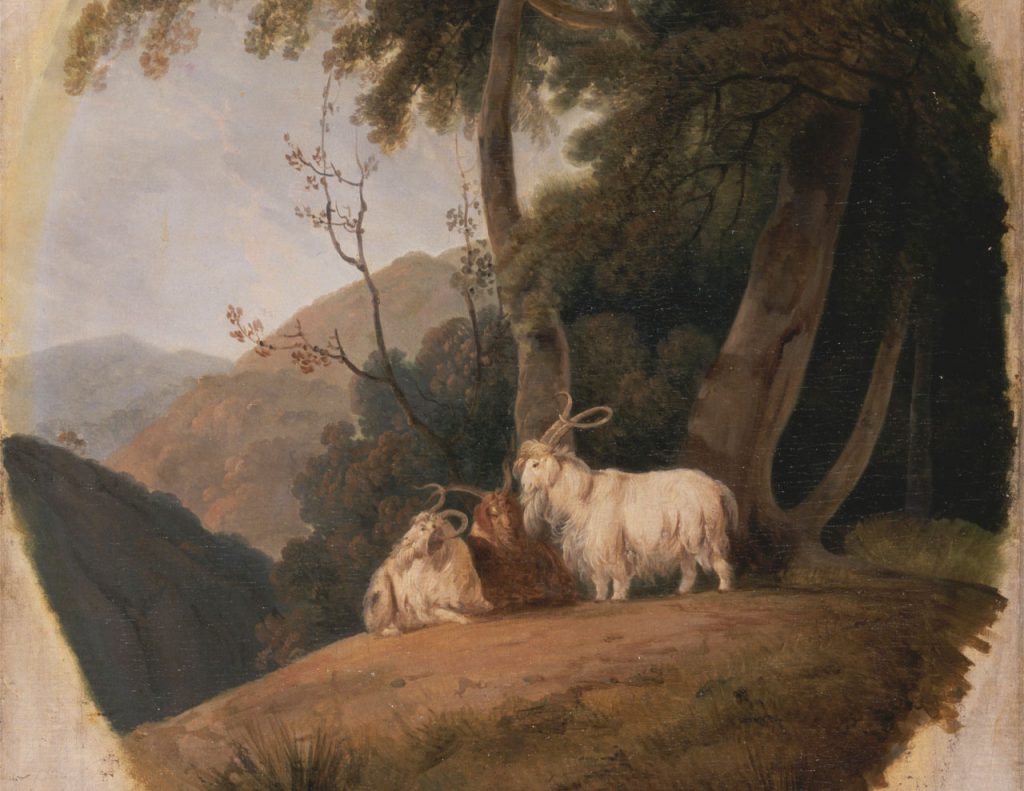
Pashmina Goats, William Daniell, 1769-1837
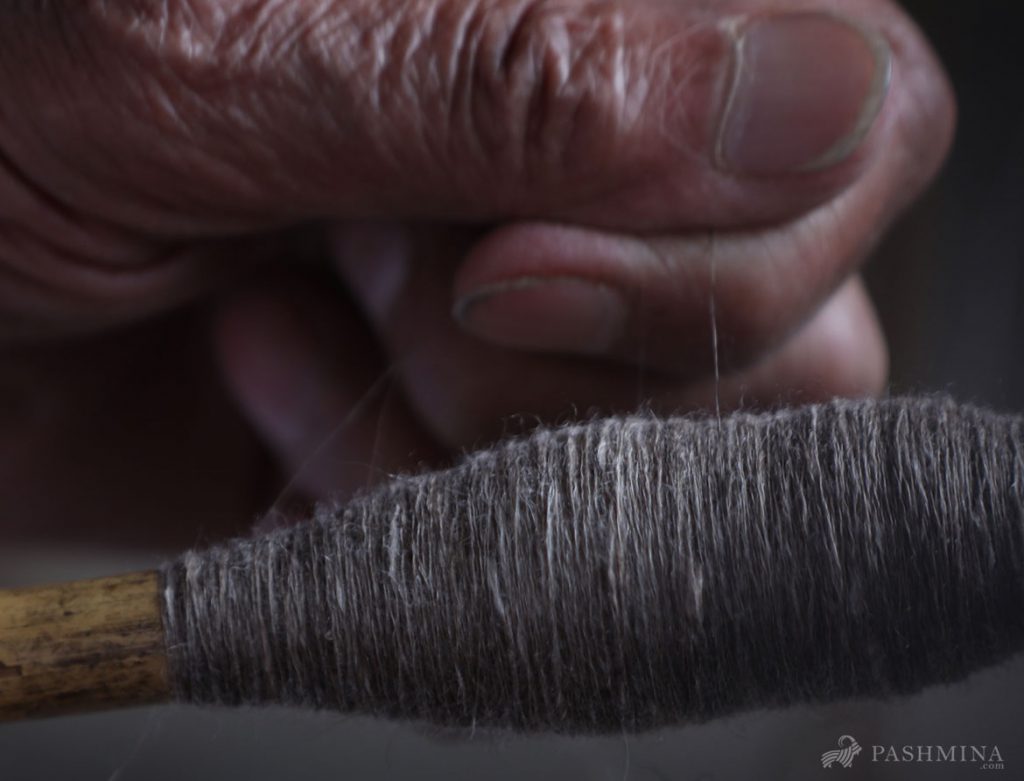
Of all these animal fibres, it is Pashm that is the most famous, which is internationally known as Cashmere. In India, the fleece of the Tibetan goat, from which the classic Kashmir shawl is woven, is called pashm and is derived from an Urdu word that means raw fibre. However, Pashmina is the yarn spun and the material that is woven from pashm.
The Prized Pashmina Goat of Ladakh
The earliest animal to be domesticated for human needs, in fact as long as tens of thousands of years are goats. These animals primarily provided for milk and meat, essential for survival in this desolate land. Almost all goats, be it wild or domestic, grow a downy undercoat which is hidden beneath their shaggy overcoats. Only a few breeds are habituated to this extreme cold and produce this ‘soft gold’ that is worth harvesting. There are certain regions, apart from Kashmir in India that propagate the growth of this fibre. And that includes parts of Russia, China, and Mongolia.
The stunning land of Ladakh had long been cut off from all kinds of civilization. But little did the world know that this would be the home of the prized Tibetan or Changthangi goat, who has taken the world by storm with its diamond fibre. The herdsmen who raise it locally call it changra or the Pashmina goat. It is the fibre of this Pashmina goat that is considered par excellence and has assumed the name of cashmere all over the globe.
For millennia, nomadic herdsmen have spun and woven goat hair into cloth for their personal use. In fact, several historical accounts recount that fine materials were woven from goat fleece in India and West Asia in ancient and medieval times. Even though the origin was not much known. From at least the 16th century until the early 19th, Kashmir was the only region where the locals had the skills to fully utilize the qualities of pashm. This means not just its warmth and fineness, but also to weave the fibre into a textile of superlative quality became an object of desire for nobility as well as the social elites.
From the third decade of the 1900s, cashmere emerged as a premium fibre. It was known for the highest quality of woven fabrics in the developed world. This led to the production in staggering volumes of Pashmina wool and later led to selective breeding. This led to evidence that both genetic as well as environmental factors lead to the growth of the undercoat, which did raise the possibility of producing this fibre in temperate climates.
How Cashmere whispers tales of quality
Textile fibre is generally judged as two distinctive factors. Firstly the fineness and secondly, its length and both together reflect the quality of a finished product. At times, colour is also considered significant. For the sake of information, fibre diameter is measured by the micron, which is 1/1000 of a millimetre. It is intriguing to know that the micron count for pashm or Pashmina wool somewhere falls between 13 and 19, while a human hair is close to 70 microns. Can you now imagine the fineness of this fibre? When these fine fibres are spun, a range of air pocket forms, which is what lends it an extraordinary warmth and finesse.
For the artisans of Kashmir, it is believed that the length of the fibre is dependent on the extremity of harsh conditions the Pashmina goat withstands. This is the reason why earlier the goats from western Tibet were preferred.
As far as the colour of Pashmina goes, it is the colour white that is desired by most since it can be dyed in a barrage of shades. For this reason, these breeds commonly produce white fibre. The browns and grey, which are also a part of the palette of natural colours, are considered self-coloured. These form the mainstay of most antique and contemporary Pashminas.
We, at Pashmina.com, are one of the world’s largest curators of pure and handcrafted Himalayan cashmere products. Each of our pieces epitomizes the highest levels of quality and royalty, making you feel no less than nobility yourself. Our range of shawls, stoles, scarves, and hijabs will enrapture the world with its beauty and sublime softness. It’s not just the beauty and exquisiteness that we are concerned about; credibility is what sets us apart from the rest. Our pieces are first painstakingly handcrafted with the finest designs and reflect the highest quality of craftsmanship. After this labour of love sees the light of the day, it is sent for quality assurance to the Crafts Development Institute, Ministry of Textiles as part of Govt of India that certifies each product. After all, you deserve a product that’s as warm and real as you!
Two decades ago, Pashmina was the ubiquitous choice of most elites. But no one knew that there would be unscrupulous counterfeiting and fake Pashminas in the market. As with any other fashion piece, whenever there is mass churning of a product, those who are conscious of their fashion choices would not like to buy it. That's because there would be far too many pieces of the same kind. This art of the royals is precious. We understand that, which is why we have unique pieces that you will only find on Pashmina.com. These handwoven, handcrafted wraps made from pure Himalayan Cashmere are the epitome of authenticity and sheer luxury. And believe us, just buying a single product wouldn’t satiate your appetite!
What are Pashmina scarves made of?
It is really important to answer this question "What is a Pashmina scarf made of", as it has created mass confusion among the admirers of pure Pashmina scarves. Pashmina scarves are made of Cashmere wool which is sourced from Ladakh. Here an exotic rare goat grows Cashmere over its underbelly to survive freezing cold. This Wool is naturally gotten rid of in summers by the goat. It is later cleaned, spun, woven, and handcrafted into luxury Pashmina scarves, shawls, and other wrap accessories.
But before, you spend those bucks on buying a Pashmina, it’s best you understand how to identify a genuine one. However, the question is
"How to check the original Pashmina?"
There are certain properties of a Pashmina that help you to check the original Pashmina scarf which is authentic and real, and not fake. How to know real Pashmina can be a challenge, but only if you follow these, you will be saved from owning a fake piece. Pure Pashmina scarves are also called 100 Pashmina, owing to them being 100% pure. Here is a list of some features of a 100 Pashmina scarf.
1. A 100% original Pashmina scarf is soft
Pashmina fibre is hypoallergenic, which means it does not cause any allergic reaction
This is the first and the most basic way to identify pure Cashmere. So, in case your luxury wrap doesn’t feel as soft and itches once you wrap it, you’ve got your hands on a fake one! This is because Pashmina is a hypoallergenic fibre, which does not cause any allergic reaction. It is generally smooth and soft as butter, because it is made up of fibres of fine diameter. Besides, it is not straight and bumpy, which means the fibres stick to themselves but do not stick out at all.
2. A 100% genuine Pashmina scarf will carry a label
Every Pashmina wrap is legally bound to display its quality composition on its label, i.e. its percentage of cashmere.
Your luxury wrap, if it’s genuine, is likely to have a label calling it out. There are times that it may have one and yet lack authenticity. But in case there isn’t at all, that should raise a red flag. At Pashmina.com, we are ahead of the curve. We understand how our customers deserve the quality and authenticity they invest in. So each of our pieces comes with a quality assurance certificate from the Crafts Development Institute, Government of India.
3. A 100% genuine Pashmina scarf is not transparent
Hold the luxury Cashmere under a light. If it’s transparent, then it’s not real Pashmina, because it does not transmit light. Besides, it isn’t shiny at all, so that’s another catch for you to notice. Check out these amazing Real Pashmina Shawls Prices.
4. Genuine Pashmina is uneven
A genuine handcrafted Pashmina will always be uneven in the weave like this.
You certainly need to get even with a seller, if he’s sold you fake Pashmina for the price you paid. Jokes apart, the texture of your Pashmina will only be even if it’s machine-made or a mixed blend instead of a pure one. A 100 Pashmina scarf that has been painstakingly handcrafted will show some form of irregularities since it’s done by hand. At Pashmina.com, our artisans painstakingly work for days and months to create a masterpiece that’s fine and accentuates your personality and your outfit.
5. Original Pashmina won't generate static electricity
This might sound odd to you, but it’s the right step! When you rub the fabric, you will know what the animal fibres are made up of. Synthetic fibres like acrylic and polyester when rubbed together generate massive static electricity as well as little sparks. In the case of Pashmina, none of this happens, so you’d have your proof right there!
6. Original Pashmina will Pill
This is another test you must not miss. Pashmina is an animal fibre and is likely to pill, however much you try. Pilling can be reduced to an extent but won’t completely go. If you don’t spot any pilling, it means that there is some synthetic mixed.
The test involves burning a tiny fringe of a Pashmina to check if it’s genuine. You need to be really careful while doing this as you wouldn't want to burn down that precious piece. Once you lit up that scrap, notice how it smells and looks. A 100 Pashmina scarf will leave a burnt hair smell and there’ll be some powdery residue behind. If it’s a synthetic fibre, you may smell burnt leaves and it will burn more brightly and leave a small bump behind.
7. 100% genuine Pashmina scarf gives a burnt smell
These are some of the most common and simple ways to know if your Pashmina is a genuine one. These are mostly fail-proof and help in buying the right Pashmina and prevent you from getting fleeced. Phew! Not only is there pain of having lost your money, but it also turns you against such beautiful works of art because of an unpleasant shopping experience.
How to tell if Pashmina is real or fake?
If you already own a Pashmina and doubt whether you have invested in a real or fake Pashmina, here at some at-home tests that can prove the originality of your scarf.
Burn Test
Pick a thread of your Pashmina scarf from the fringes. This should be enough for the burn test.
2. Place this thread on a surface, and burn it.
3. Carefully smell the burnt thread, as well as touch the ashes with your fingers.
4. If you smell a burnt hair smell and if the ashes turn to powder, your scarf has a higher chance of being original. Pashmina scarves are made from natural hair and hence give the same odour.
5. Post this process, and check on the burnt Pashmina thread again. If it has acquired a matte appearance, there is a greater chance of it being original.
Rubbing Test
Take a corner of the scarf, and rub it against its own surface
If your Pashmina is fake, it will produce static electricity. That is what polyester fabric does.
Fake Pashminas which generate electricity will even attract dust particles towards themselves.
Shine Test
Check the surface of your Pashmina scarf
If the appearance is too much shiny, chances are that this piece is fake.
Pashmina scarves are made from natural fibre, and hence have a matte appearance.
What is Faux Pashmina?
While a number of fake Pashmina copies have filled up markets, a category of the same is faux Pashmina. But what is Faux Pashmina? Let's find out
When commoners could not afford Pashmina scarves, traders started to manufacture false Pashmina scarves, calling it by different names. One such type is faux Pashmina scarves. These are cheap scarves, which are made of synthetic fibre like viscose. These are super soft and plush like a Pashmina scarf, but are one of the fake variants which just feel like Pashmina.
100% pure Pashmina scarf & Pashmina.com
We, at Pashmina.com, are one of the world’s largest curators of pure and handcrafted Himalayan cashmere. Each of our pieces epitomizes the highest levels of quality and royalty and will make you feel no less than nobility yourself. Our range of shawls, stoles, scarves, and hijabs will enrapture the world with its beauty and sublime softness. It’s not just the beauty and exquisiteness that we are concerned about; credibility is what sets us apart from the rest. Our pieces are painstakingly handcrafted with the finest designs and reflect the highest quality of craftsmanship. After this labour of love sees the light of day, it is sent for quality assurance to the Crafts Development Institute, Ministry of Textiles as part of Govt of India that certifies each Pashmina. After all, you deserve a product that’s as warm and real as you!
Since time immemorial, Kashmir has been referred to as the cradle of several crafts. According to Kashmir ruler, Mirza Haider Dughlat, “in Kashmir, one meets with all those arts and crafts which are in most cities uncommon.” French physician & traveller, Francis Bernier, who visited Kashmir in 1665, believed that “it is due to special properties of water available there.”
Francis Bernier, who came to Kashmir in 1665
The Dogra period (1846-1885) witnessed the sharp rise of certain crafts that reached their climax. In the words of H.W.Bellew who visited Kashmir sometime in 1873, praised the artisans of Kashmir, their Kashmiri shawls and embroideries. Also, silver work, paper mache paintings, stone engraving & wood carving all exhibited work of wonderful delicacy & minute details. In fact, this was reiterated by Lawrence, a settlement officer in Kashmir in 1889. He said, “Every Kashmiri is a weaver and the home spun cloth woven by the villagers was highly appreciated by many Europeans.” It was actually during this period that the Kashmiri shawl making employed a large number of people, which in turn generated revenue for the state.
Kashmiri shawl manufacturing has its roots in the picturesque state of Jammu and Kashmir. Here the air is crisp and art runs in the veins of its people. In the 1800's, the Kashmiri shawl was considered a symbol of imperial prestige. Infact no fashionable woman’s wardrobe was complete without this luxurious piece. It enjoyed name and fame across the world, owing to its softness, warmth, brilliance of colours and sublime fineness.
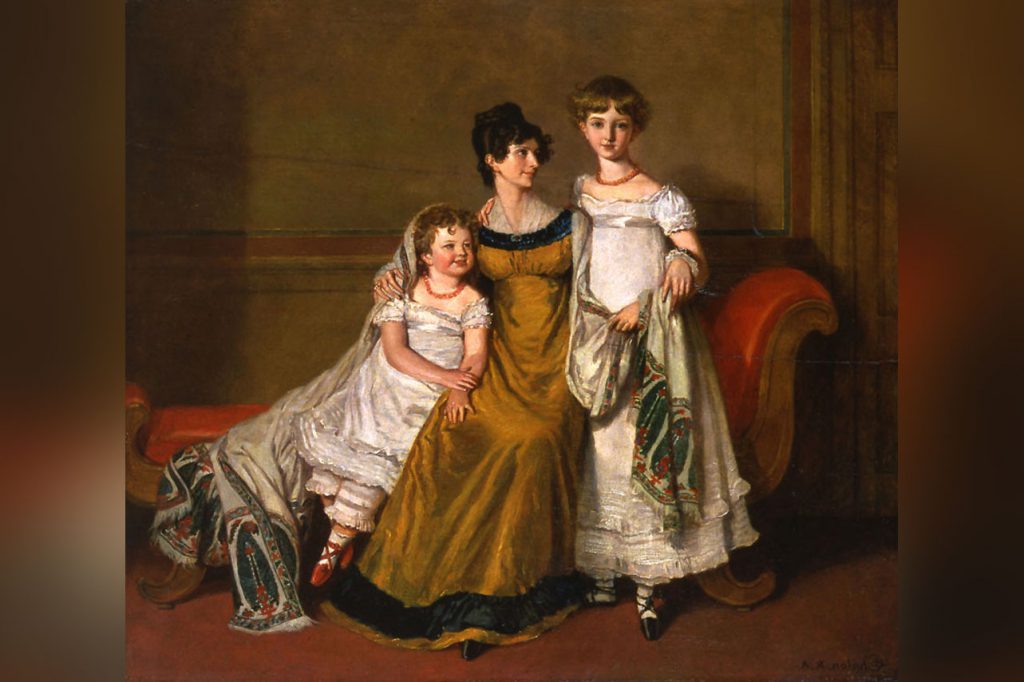
Mother and Two Children by A E Chalon, c. 1812. (courtesey of the Geffrye Museum)
Under the Mughals, shawl making made several strides, with karkhanas creating new social groups among its craftsmen. In the text Tuzk-i-Jahangiri, Emperor Jahangir expresses fondness for Pashmina shawl and calls it one of his “favourite items.” It was considered a status symbol in the Empire and was gifted as part of imperial festivals.
In the Afghan period, shawl making grew further and in 1796, these Kashmiri shawls were sent to Europe. These objects of desire reached Napolean during the Egyptian campaign, who then gifted it to his wife Empress Josephine. At that time, many French soldiers returned with plundered Pashmina shawls worn as belts over their uniforms. It became severely popular in Europe and as the demand rose, merchants traveled all the way to Kashmir to purchase them.
During the Sikh period, shawl making continued to receive consistent patronage. Now it became fashionable even in Punjab and also popular in Lahore. During the reign of the last two Sikh rulers, the Kashmiri shawl manufacturing witnessed a decline from 1841-45. This was also due to some political disturbances in the region.
When Gulab Singh became the Maharaja of Kashmir, the shawl trade began to revive. In 1846, the total number of looms reached 7,000 with 17,000 weavers working at that time. The same year, there were 3,500 karkhandars in the Valley. However, in 1847, several shawl weavers migrated to Punjab and the number of looms reduced.
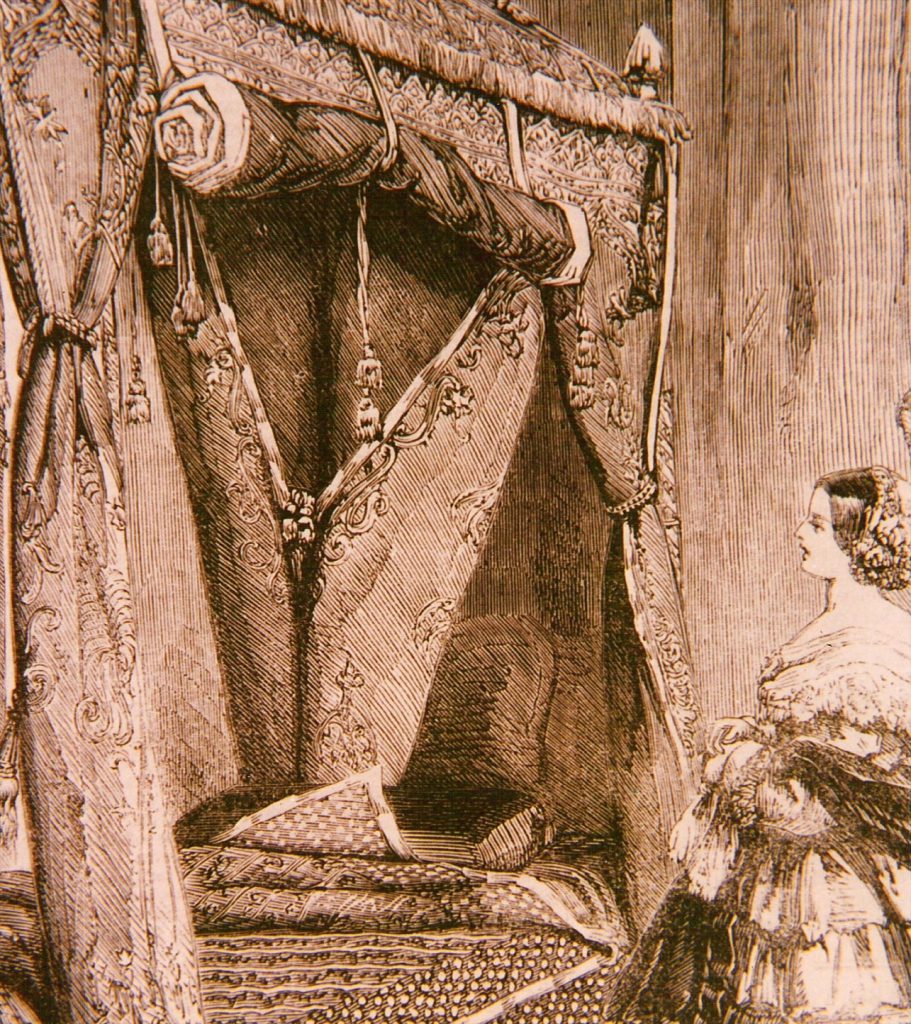
Queen Victoria with the gold and Pashmina/kani bedspread presented by Maharaja Gulab Singh
Compensation to Weavers
In early 1847, the weavers put out certain demands. These were early enumeration of workers, reduction of nazarana , fixing length of a work day, & framing proper regulations for their welfare. More than 4,000 weavers migrated to Lahore and this worried Gulab Singh. He announced the following regulations:
The salary was fixed at four annas
Taxes were reduced
The weaver was allowed to change his master and was no longer restricted to work under one
The tax would be levied on woven shawls as per the market price
Weavers would be paid on the basis of actual work on the loom
Though these regulations pacified the weavers, but only for a short while.
Later, in the 1950s, French agents came all the way to Kashmir to deal with the manufacturers. This way, Kashmiri shawls became more popular in Europe and trade flourished. According to a Frenchman Larouosse, “In spite of heavy duty levied by the French government, whatever its value, the trade flourished.”
Flourishing of Kashmiri Shawl in Europe & Invention of Do Rukha
In 1850, the annual shawl production reached Rs 40 to 50 lakhs and there were about 40,000 to 50,000 workers engaged in the manufacturing. During the second half of the 19th-century, it became a coveted fashion item in England, France and America. It was during this time that Kashmiri shawls became prestigious and the favourite of elites and nobles.
In the concluding year of Maharaja Gulab Singh’s reign, there were about 8,000 shops of shawl weavers in Kashmir. Post his reign, Maharaja Ranbir Singh tried to bring about reforms to further provide an impetus to the manufactory. During this juncture, a new type of shawl called dorukha was manufactured in the Valley. They were excellent in texture, soft, colourful and were most celebrated. Among countries across the world, it was France that shared 80% of shawl trade between Kashmir and Europe.
Do-Rukha Embroidered Pashmina Shawl has earned global acclaim for its fine Cashmere base and magically profuse embroidery that makes it a symbol of superior craftsmanship and a piece of art
What are Kashmiri Shawls made of?
The manufacturing of the shawl happens from what is called pashm. It was obtained from a goat found in western Tibet, Baltistan and Ladakh. It was brought to Kashmir via Ladakh. The pashm fibre is first removed by combing. During winter, it is a protective layer of soft fleece that provides insulation to the goats in the biting cold. The Changpas say that only when the winter comes to an end and the goat eats the first new grass that the pashm rises above the surface of the goat’s body. It can then be combed out.
The pashm that is combed out is not really clean and has dirt and bodily secretions. The women who sift through this raw mixture say that only 35% of this pure fibre can be used. Once the hair is combed, the animal’s shaggy coat is then cut with metal shears. A few goats are combed at the same time, generally before they head out to their pasture lands. They may be again combed in the evening, only if there’s adequate light by the time they return after grazing.
This is a painstaking process. Starting from sourcing the fleece to crafting products from Himalayan cashmere is a long tough journey. It takes months and years for the gifted artisans of Kashmir to create the masterpiece Pashmina shawls. It is a sorry state of affairs when imitation pieces flood the market. This dilutes the labour of these weavers, who shed all their blood, sweat and tears to this "Art of the Royals”.
Pashmina.com and Pashmina Shawls
We are Pashmina.com, the largest curator of pure and handcrafted Pashmina products in the online space. We are on a mission to revive this dying art of Pashmina by spreading our wings throughout the world through our online platform. Our website serves as a window to our range of Pashmina shawls and Cashmere wraps and scarves that are luxurious and have the highest quality. We offer the widest range, certified quality of Pashmina with luxurious packaging and free shipping to over 250 countries. Explore our range now!
Cashmere, as the word suggests, evokes a sense of sheer luxury, be it through images of its softness, warmth and toastiness. It is a rage in high fashion circles and owning a piece of this luxurious fabric is a mandate, if you are conscious of the way you dress. Unlike how we revamp our wardrobes every few months, since our clothes wear out, once you own a Cashmere product, it will keep rewarding you. But there’s a condition here as well – it will stay in mint condition only if you invest in a pure, hand-crafted piece instead of falling for the budget ones available at most apparel stores.
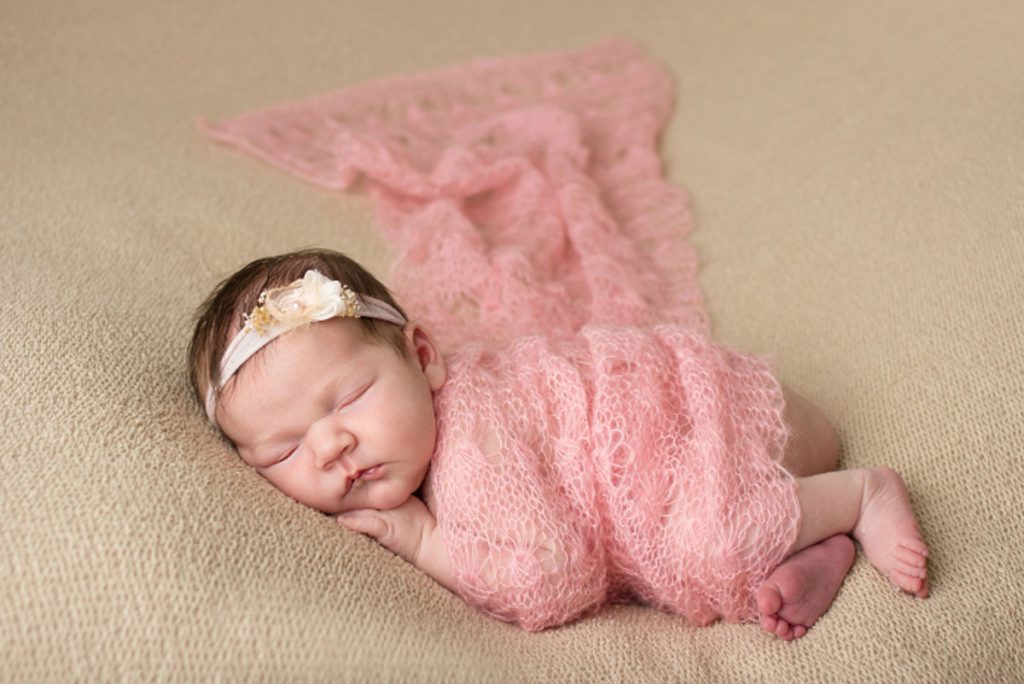
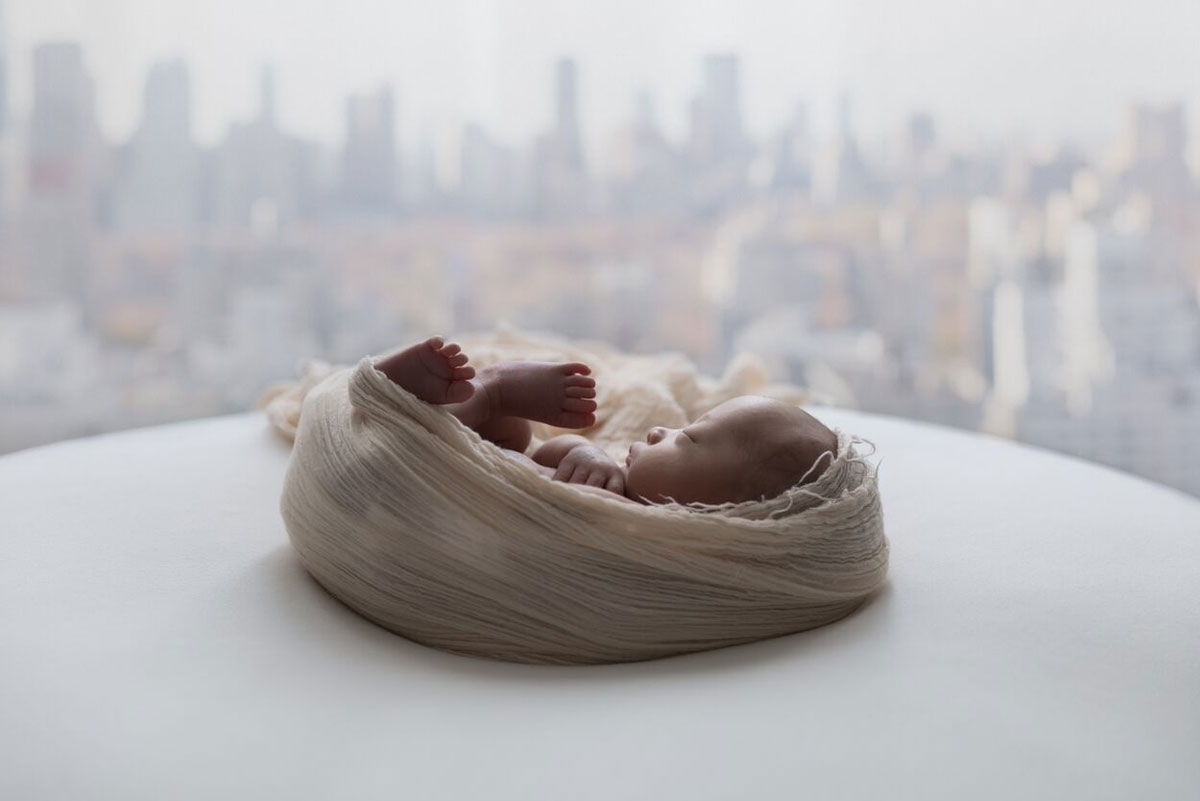
Why do babies love Cashmere blankets?
As we are so particular about comfort, class and the feel of the fabric, so are babies. In fact, babies are even more sensitive and delicate, since the womb is their shelter for nine months and they crave that comfort once they come into this world. This is the reason why Cashmere blankets top the list for baby accessories, since they are reminiscent of the mother’s womb, thanks to its several desirable qualities.
You can checkout variety of Monogrammed Cashmere Throws for your baby.
Since Cashmere is exceptionally soft, lightweight, breathable and warm, it is ideal for all climates, without making your baby uncomfortable.
Here’s why Cashmere blankets are the best choice for your little bundle of joy
If your newborn is feeling a little under the weather, there’s no better cure than a Cashmere baby blanket. It soothes and comforts him/her and reduces stress and restless movement, putting the child at rest and calming him down.
Researchers have found that when babies lay directly on cashmere, their rate of activity is significantly reduced and leads to more deep and restful sleep. Some also say that it promotes growth, but this is yet to be proven.
Cashmere, as most of us know, is the perfect insulator, which means it keeps you warm in winter and cool in summer and is also lighter than wool. It lets the baby’s skin breathe and regulates the temperature to stay comfortable in all seasons.
Cashmere is water-resistant and can absorb excess moisture, among all other fibres. Interestingly, it can take in up to 35% of its weight in water without feeling messy or wet to touch. It then releases this moisture into the atmosphere to keep the wearer warm and dry. This way, the baby’s skin stays dry and regulates the temperature.
Another property of Cashmere that sets it apart from the rest is its odour-resistant characteristic. This fibre can repel the bacteria that lead to odour, which means your baby will keep feeling fresh and not sweaty.
Lastly, this fibre does not cause any allergy or itchiness, making it soft on the skin. This is the biggest concern for most parents, which is taken care of by Cashmere. Generally, most fabrics irritate the baby’s skin and cause rashes or any such infection.
With such qualities, there’s no doubt why Cashmere baby blankets are the preferred choice for newborns. Though these products stand you in good stead, you need to make sure you take all the care you can to keep these in great condition. They are generally durable but can last you even longer if you make a little effort.
TLC for Cashmere Baby Blankets
Like all products, your Cashmere baby blanket requires some Tender Love and Care to protect your child in all seasons. When you wash the blanket, make sure you wash it by hand, unless you have a hand-wash setting on your washing machine. Use lukewarm water and a small amount of mild detergent or baby shampoo to clean it. There are some who say even hair conditioner works wonders to make Cashmere super soft!
The next step is to ensure you don’t rub, wring or twist the fabric while washing. Instead, gently squeeze the water through the fibre. Lastly, use lukewarm water again to rinse your product. The temperature is of high significance here!
It’s the same in the case of drying, one needs to be gentle and tumble drying is a big no-no. Make sure there’s no wringing or twisting of Cashmere to remove excess water. Instead, it’s best to layout your product on a towel, gently roll it up, and lightly press. Later, you can un-roll and re-shape it.
Dry your Cashmere blanket in a flat manner. If you hang it, the weight of the water will stretch it out of shape. You must keep it away from heat sources like radiators, hairdryers, or even sunlight since it needs to air-dry naturally.
With the right approach, your baby blanket will last you for a long time. Give it some love and it will you lots back in return!
We, at Pashmina.com, are one of the world’s largest curators of pure and handcrafted Himalayan cashmere products. Each of our pieces epitomizes the highest levels of quality and royalty and will make you feel no less than nobility yourself. Our range of shawls, stoles, scarves, and hijabs will enrapture the world with its beauty and sublime softness. It’s not just the beauty and exquisiteness that we are concerned about; credibility is what sets us apart from the rest. Our pieces are first painstakingly handcrafted with the finest designs and reflect the highest quality of craftsmanship. Once this labour of love the light of the day, it is sent for quality assurance to the Crafts Development Institute, Ministry of Textiles as part of the Govt of India that certifies each product. After all, you deserve a product that’s as warm and real as you!
Step into our world and explore the entire range HERE
The very touch of Cashmere on your skin feels so luxurious. Its velvety soft and like a wisp of fresh air. It evokes poetry in all our minds; it’s a warm, comforting hug in the biting cold. Yes, it’s exactly that. No wonder, its warm and luxe nature has been patronized since time immemorial by nobility and the upper social strata. Cashmere is like wine, it gets better with age and intoxicates you with its sublime softness and dreaminess.
What is Cashmere?
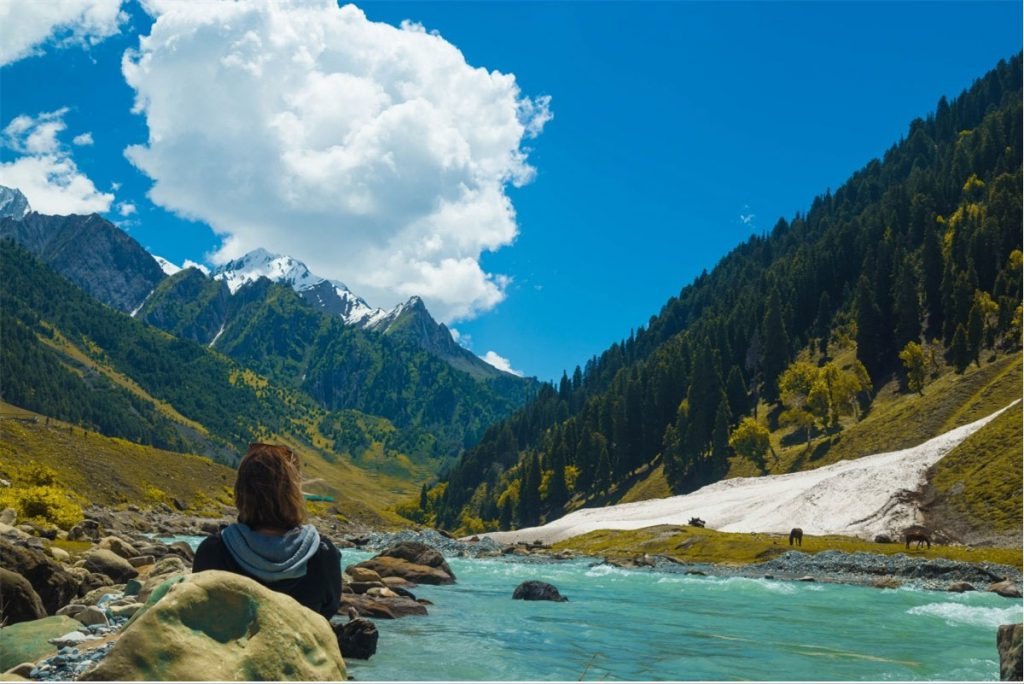
Cashmere is something we would love to define. Its beauty and grace are far from defining in words. Yet it needs to be elucidated to the common man, who is unaware of this treasure around him. Cashmere is the fine and soft down fibre of a rare species of goat which is found in the Ladakh area of Jammu and Kashmir. It is found at a place called Changthang, which lies in the Himalayan mountain ranges. This place lies at an altitude of over 15000 feet above sea level.
The place offers the harshest conditions because of its distance from the main city. Also, the freezing temperature it witnesses in winters. The herders somehow manage their survival in this area, but the goats would not have if nature wouldn't have blessed them with Cashmere. It is this warm and exceptionally comfortable wool that protects their bodies from the temperature of -40 degrees.
Processing Cashmere in Kashmir
Seeing the softness and luxurious demeanour of Cashmere, in the 16th century, Shah E Hamdan ordered socks to be made for the then king of Kashmir. The king was highly impressed by the gift. He immediately ordered manufacturing and processing units to be set up in the valley. It is from that time that Cashmere wool was transported from Ladakh to Kashmir, where skillful hands awaited. Kashmiri artisans had been trained by Persian craftsmen in various crafts, including Pashmina shawl making. Pashmina is the art of transforming raw Cashmere wool into luxury shawls and scarves. Ladakh lacked resources and labour. Hence Kashmir took the responsibility to own the processing and honour of producing opulent Pashmina shawls till now.
The Glory
As soon as the news spread all over the world, Europeans visited Kashmir in groups to have a look at this newly discovered wool type and fell in love instantly with its fine texture, lightweight and immense warmth. They took some pieces to their own countries and soon Pashmina shawls became world-famous. In the beginning, Pashmina shawls could only be afforded by kings, nobles, and the royal members of the courts. Affluent individuals as well as the ardent patrons of art too invested in at least one Pashmina shawl, and its fame rose to an all-time high when Napoleon gifted his wife a Kani Pashmina shawl, and she wore and owned a few hundred, setting it to a timeless fashion. The entire world was swooned by Pashmina art, and everyone wanted to see if not own one.
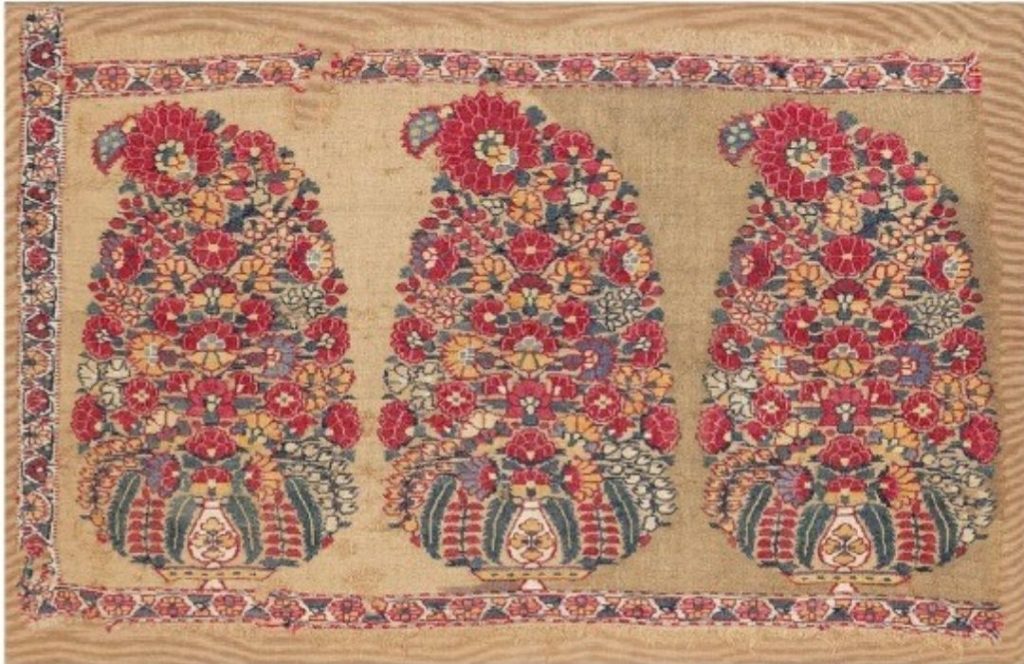
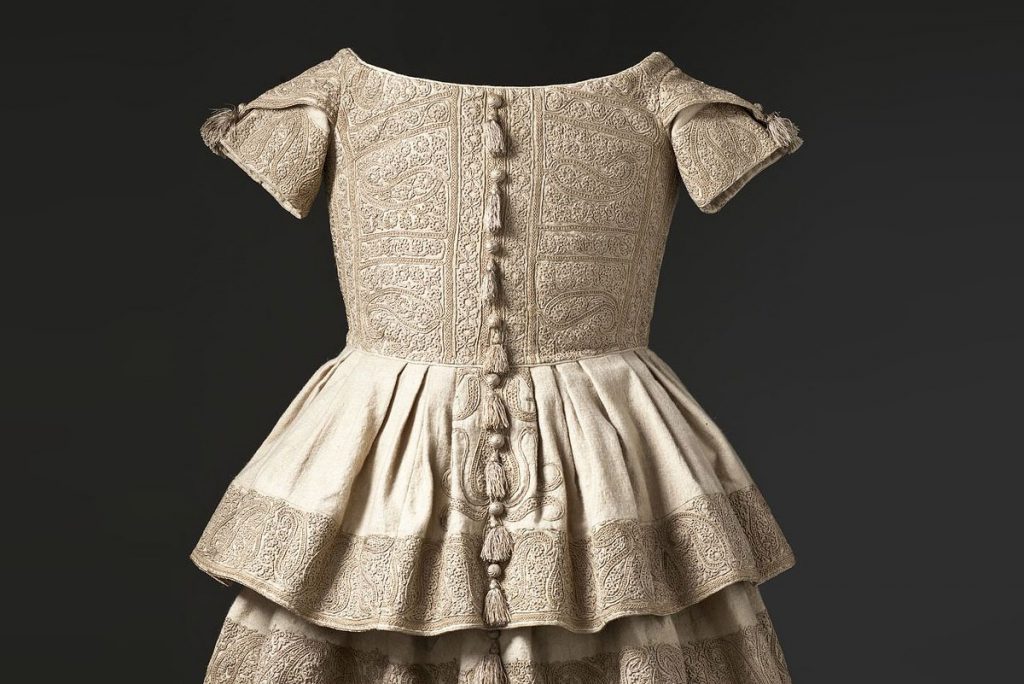
Fragment of a Kashmiri Shawl from the late 18th century on display at Ashmolean Museum, University of Oxford
Seeing the entire world fascinated by its glory made some traders use deceptive techniques to make money. They made Pashmina shawls over machines which included mixing Cashmere fibre with strengthening nylons and sold the same as pure Pashmina shawls. Besides these shawls were cheaper and featured an artificial shine, which they claimed is because of the finest quality of the shawl. Customers fell for this trick, but reality hit them hard when these shawls weathered within a year. As a result, customers believed that it is the art that has lost its grace and hence never purchased Pashmina shawls again. The art lost relevance, and cheaper alternatives took over.
Where to buy pure Pashmina from
However, there still are a number of Pashmina promoters who manufacture pure Pashmina and sell the same at comparatively high prices. And its true admirers do invest in the same. But customers are in a dilemma. Should they buy Pashmina? Should they invest in this long forgotten traditional asset? Why is so special about Cashmere fibre?Some believe that Cashmere isn’t expensive and can be bought off the shelves of fashion brands that are selling it at economical prices. If you’re one of those who’ve been lured by this practice, there’s a bubble about to be burst. You do own a Cashmere wrap, but not a genuine one.
Let’s get this straight. Cashmere is expensive and rightly so. It is a work of art through and through and nothing less than a labour of love. It ticks all the right boxes when it comes to sustainability and unlike a lot of other apparel won’t wear out for a lifetime if you take good care of it.
Here are five reasons why Cashmere is genuinely expensive
1. The King of Fibres
Cashmere has been called the ‘king of fibres’ for a reason, since it is the most luxurious and treasured of all yarns. The journey of Cashmere begins in the highlands of Kashmir, where indigenous capra hircus goats reside. The sub-zero temperatures, soaring altitudes, and harsh winds trigger the growth of the diamond fibre, which comes from the downy undercoat of these rare species of goats.
The name cashmere comes from the old spelling of Kashmir, which is the source of origin for this luxurious yarn. According to the historian Michelle Maskiell, who is also the author of “Consuming Kashmir: Shawls and Empires, 1500-2000,” describes that from the 1500s to as late as the early 1900s, Iranian and Indian emperors used Kashmiri shawls in political and religious settings. For instance, in a Mughal Indian court, presenting a Cashmere shawl represented a hierarchy.
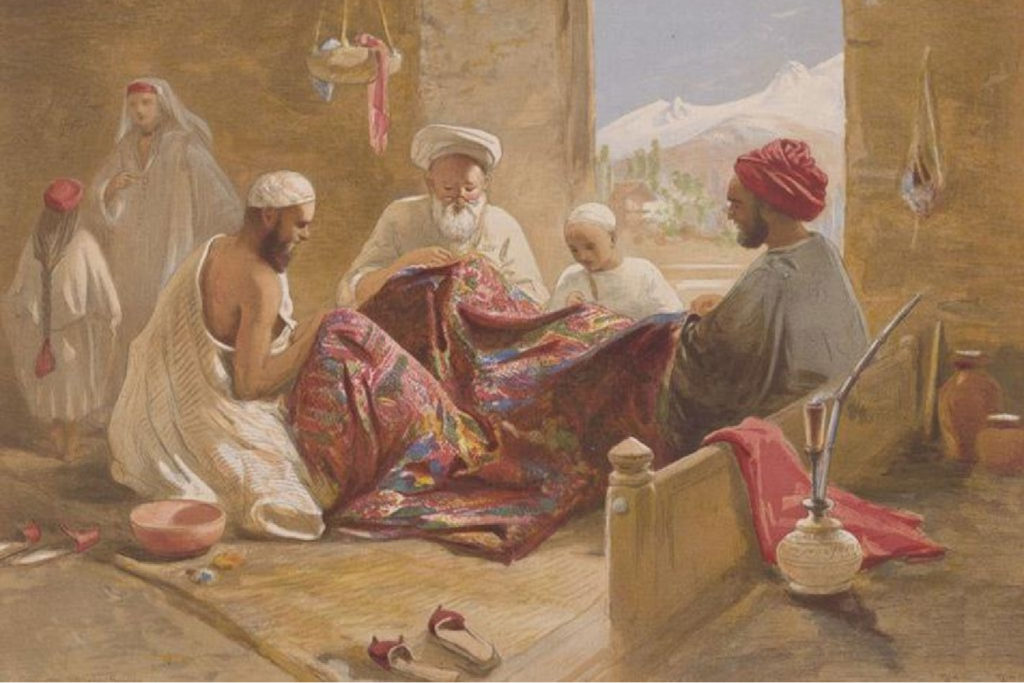
A Muslim shawl-making family shown in Cashmere shawl manufactory, 1867, chromolith., William Simpson.
2. The prized capra hircus goats
As we already know these goats are rare and found in the higher climes, but what’s even more rare is the limited quantity of the fleece it produces. A single cashmere goat does not produce this sheer fibre in bulk. You can get anywhere between six and eight ounces from a cashmere goat initially, but once the fibre is processed, you are not likely to get more than four ounces back. It takes 3-4 goats to produce wool enough to make one shawl. The goat grows this precious fleece after 6 months of harsh winter.
The Capra Hircus goat or the Cashmere goat as commonly known
In comparison to yearly production of sheep wool, which is over 2,000,000 metric tons, the production of Cashmere in a year is about 6,500 metric tons annually.
Rarity a big reason why this fibre is so expensive!
3. Blood, sweat, toil
Cashmere fibres are manually sorted, cleaned and hand spun before the weaving process begins. The undercoat of these coats that is sheared or collected is a greasy mess and has dandruff and other impurities. To clean it and sort out these unwanted elements, it takes longer than you can imagine. The local herders carefully comb the hair to harvest the undercoat and then the good fibre is separated from the bad, which then completes the sorting procedure.
It is only then that the weaving begins, which is equally demanding and painstaking. It takes several months to a year for these gifted artisans to work their magic on wooden looms and weave a masterpiece.
4. Superb quality and exceptional warmth that’ll win you over
Now that you already know its origin and how labour-intensive the process is, you can assume the quality of this fibre. Did you know? A cashmere fibre is less than 15 microns in diameter. Yes, you heard it right. Let’s put things into perspective now; the human hair is about 80 microns, so cashmere is five times finer than human hair. Besides, the fiber isn’t straight, so when it’s woven, it doesn’t itch. This is the reason why it is also preferred as a baby blanket, who feel comfortable in its warmth and softness.
Oh, and there’s another interesting fact! Cashmere is up to 8 times warmer than clothes made from sheep wool. We did know it’s a natural insulator, but this does come as a surprise. What’s best is that it’s much lighter than wool!
Pashmina is spun by womenfolk of Kashmir
5. As timeless as ever
When you buy a Cashmere wrap, you know you are buying it for a lifetime. It’s a timeless fashion choice and will never get old, since it exudes elegance and class like no other. It’s the epitome of sustainable fashion, so you know your money is going in the right place, since it’s the blood, sweat, tears of the artisans that has gone into making your product. And like we earlier said, it’s like wine. Why? Because it gets softer with each wash, just like wine gets better with age. Isn’t that a valid comparison?
Shop a Cashmere wrap and reap rewards for life. After all, as John Varvatos, an American contemporary designer puts it, ‘style is timeless. It transcends generations - it's enduring. If you're thinking about fashion, it's of the moment. And that doesn't mean that it's not important at times to embrace trends and that type of thing, but style is less about trends than it is about how you carry yourself’.
Limited Production
The Pashmina goat wool is acquired in Spring and summer season and the sale has to start in winter. As the moulting is season specific, manufacturers have to wait for an entire year to receive the raw material. Hence its limited production makes it more valuable.
This delay is carried forward to customers, as they too have to wait for their custom made shawls to reach them. Sometimes elaborate embroidery shawls are completed in a few years. As soon as such pieces reach the market, they sell at a gallop. Hence customers have to be really quick to buy, or else it would take a few more years to manufacture certain heritage pieces. Kani shawls, Embroidered Jamawar shawls, and Tilla dozi pieces are a few examples of unique, and exclusively made shawls.
Beware of Fake Cashmere
More than pure Cashmere, fake Cashmere has been doing rounds amongst sellers and customers. But the audience has to remain alert and amass as much knowledge as is possible.
If you already own a Pashmina, get it checked, there are several tests which can be done at home.
If you are buying a new wrap, ask the seller for is certification or look fir the GI mark on the shawl.
We, at Pashmina.com, are one of the world’s largest curators of pure and handcrafted Himalayan cashmere wraps. Each of our pieces epitomizes the highest levels of quality and royalty and will make you feel no less than nobility yourself. Our range of Cashmere shawls, stoles, scarves, and wraps will enrapture the world with its beauty and softness. It’s not just the beauty and exquisiteness that we are concerned about; credibility is what sets us apart from the rest. Our pieces are first painstakingly handcrafted with the finest designs and reflect the highest quality of craftsmanship. After this meticulous craftsmanship sees the light of the day, it is sent for quality assurance to the Crafts Development Institute, Ministry of Textiles as part of Govt of India that certifies each product. After all, you deserve a product that’s as warm and real as you!