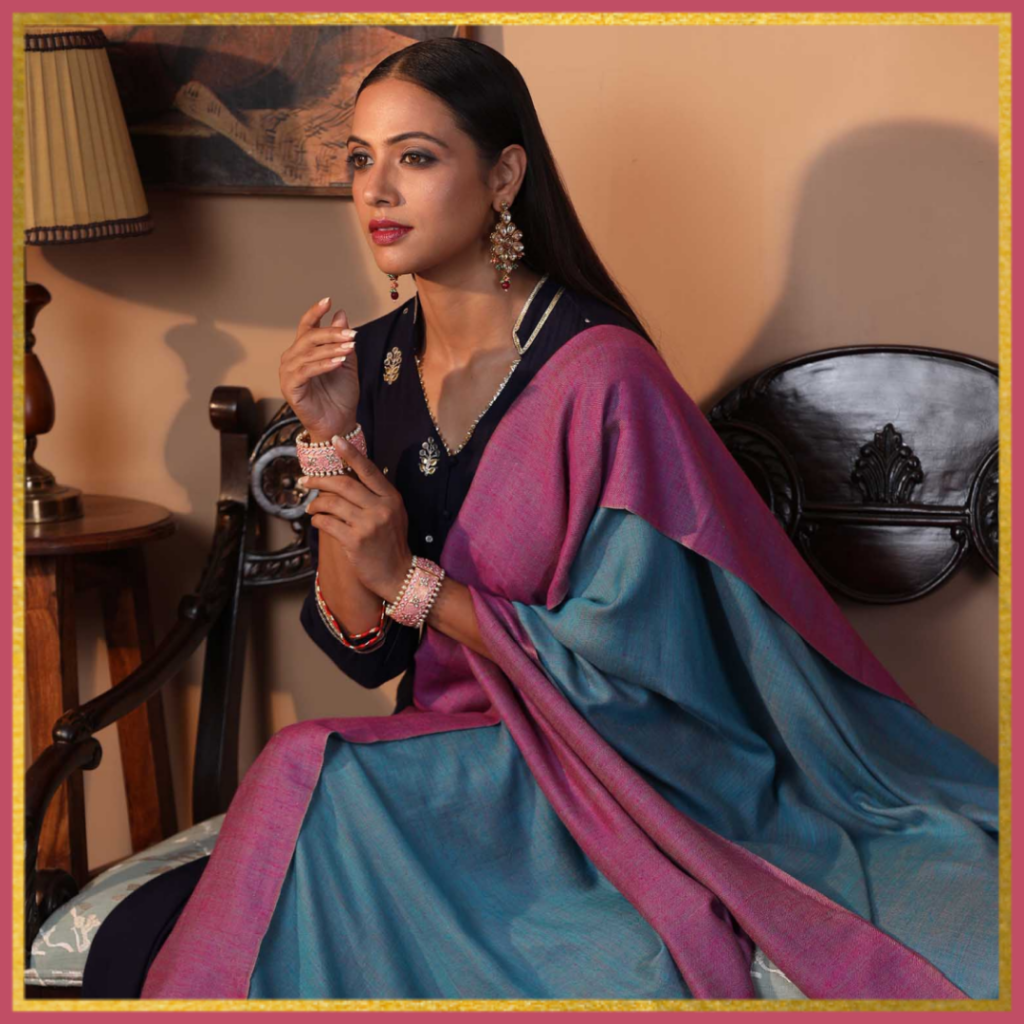
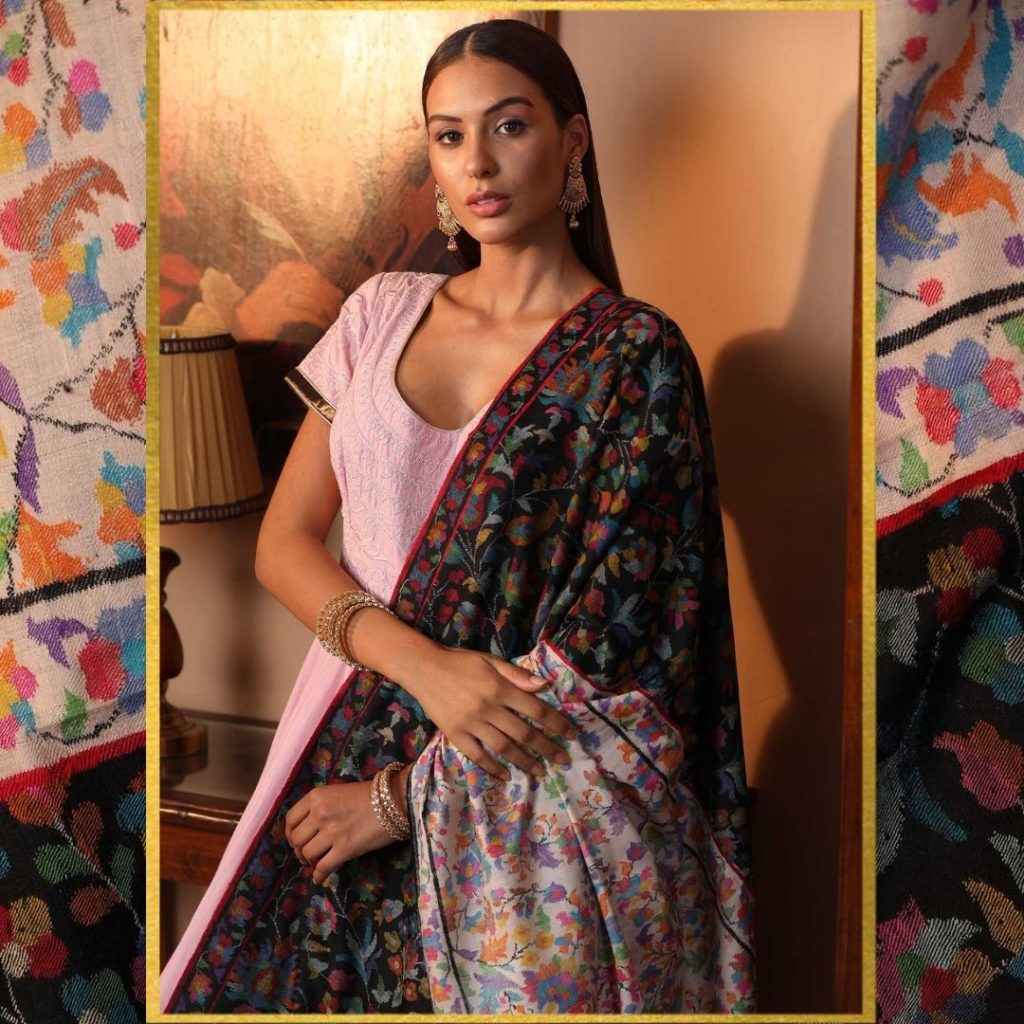
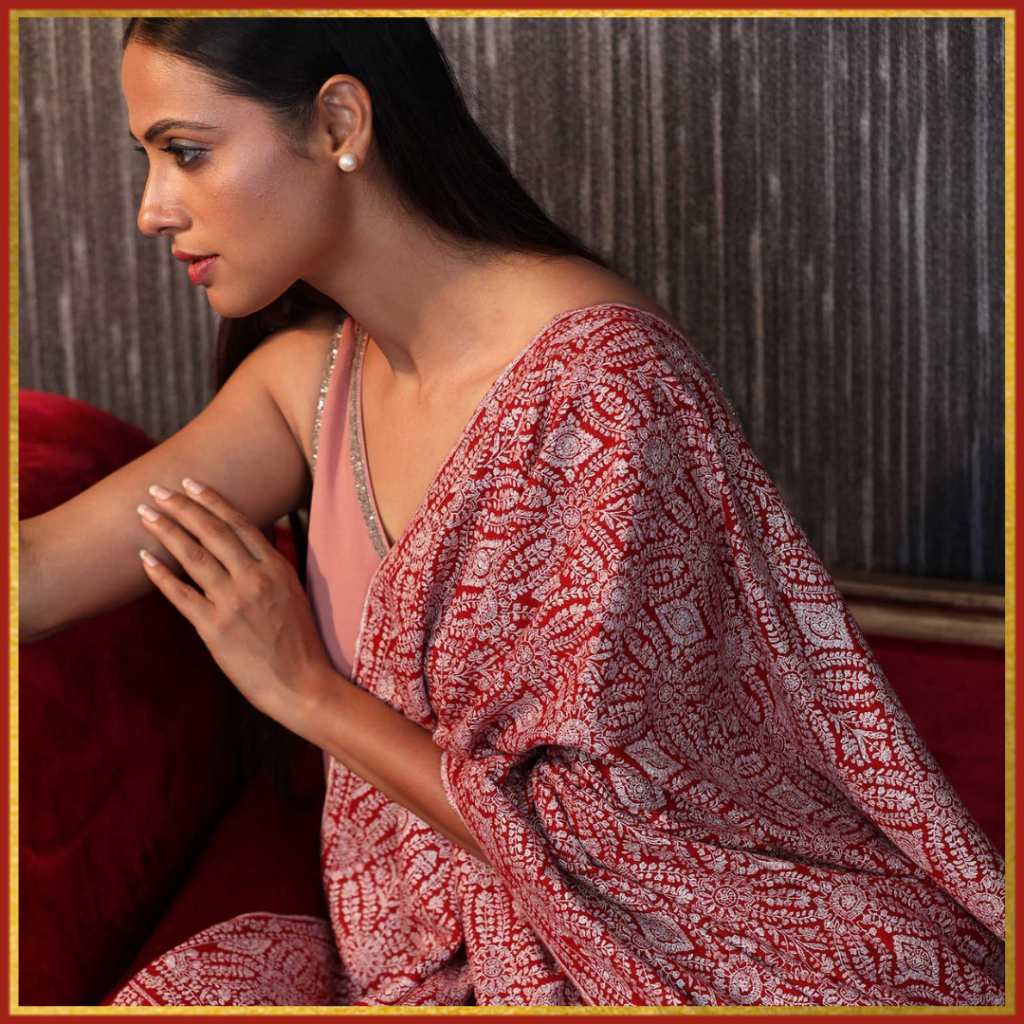
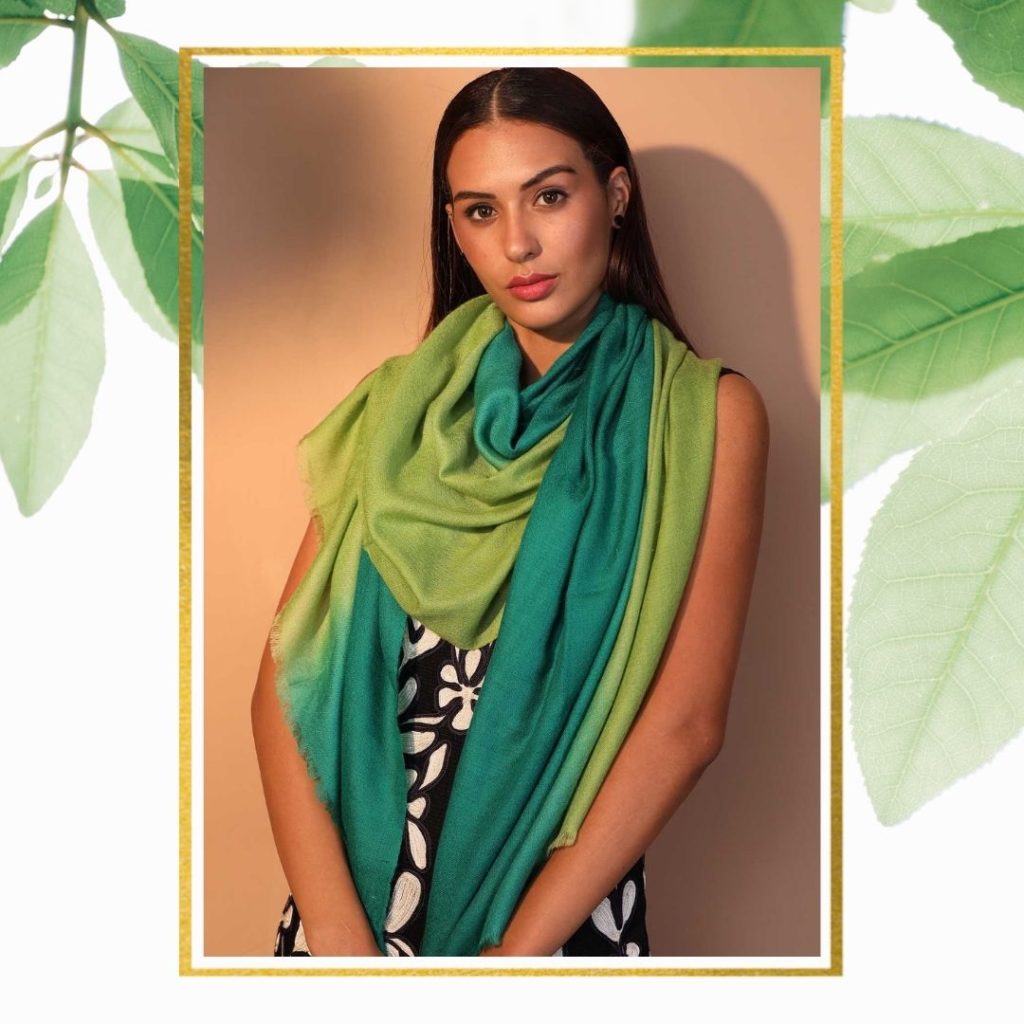
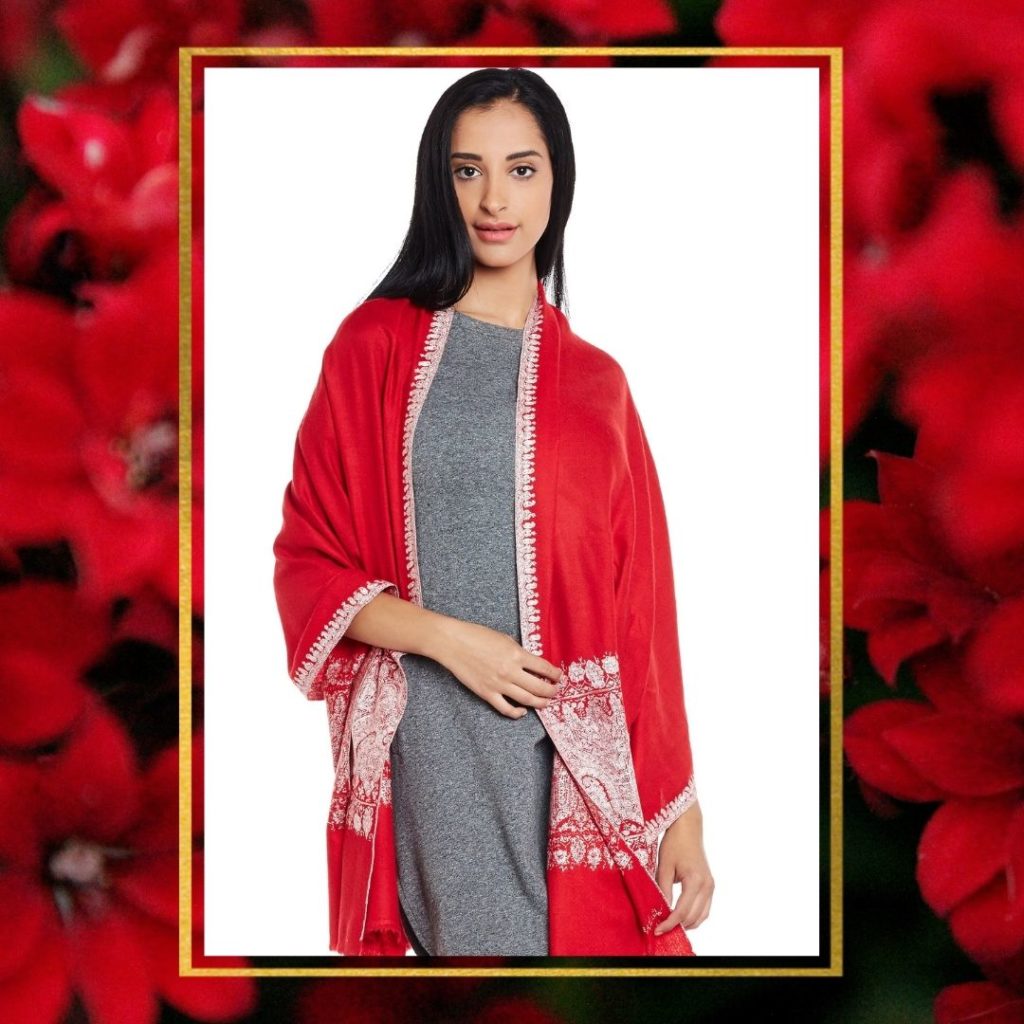
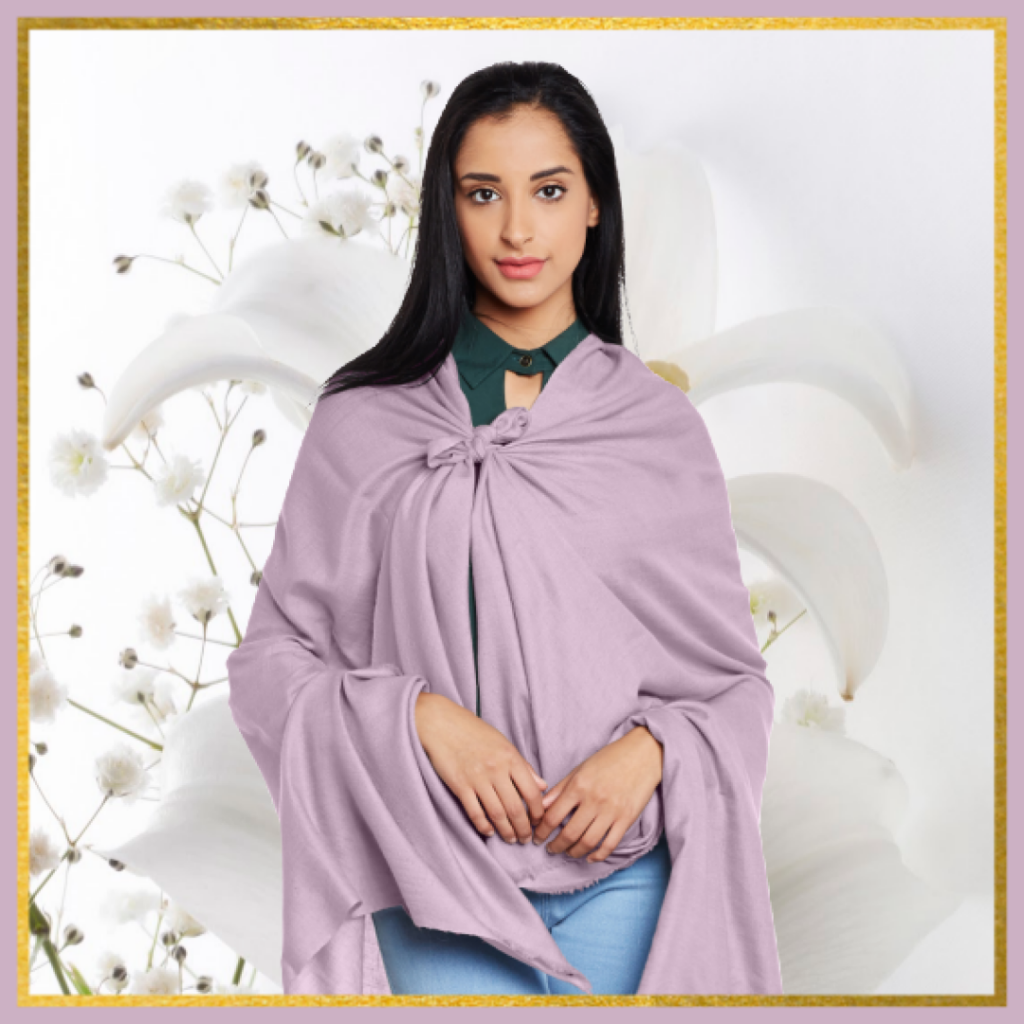
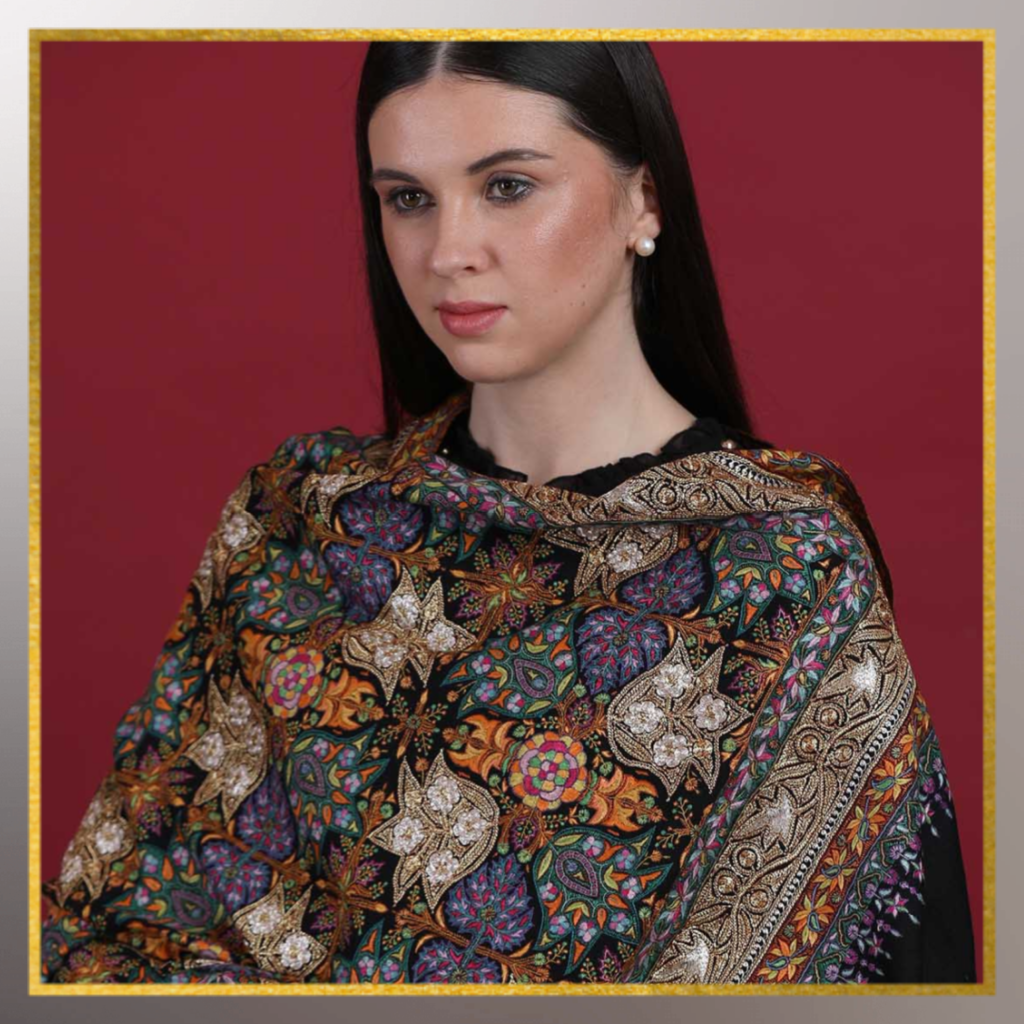
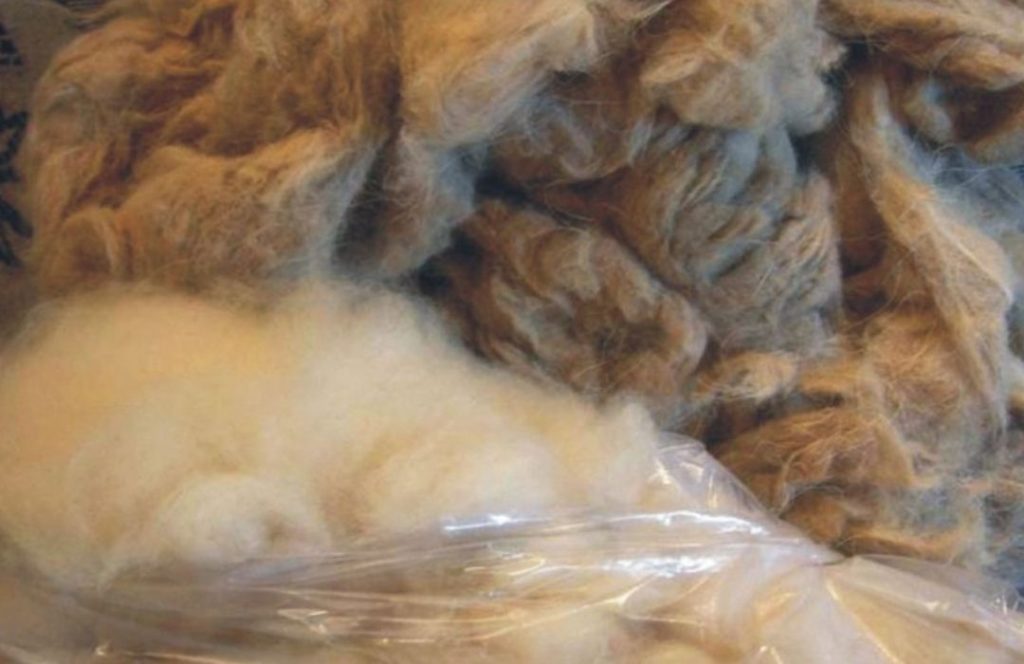
Pashmina scarves are exceptionally warm, soft, and timelessly elegant winter wraps that are handcrafted to keep an individual warm and stylish in colder seasons (fall and winter primarily). These scarves are made from a natural fibre Cashmere, which is acquired from the undercoat of Ladakhi goat. Cashmere has some features which are rare to find and which makes it revered all over the world. Perhaps that is the reason why it was and still is revered in almost all parts of the world.
Pashmina scarves have enjoyed royal patronage since the 16th century when they were discovered for the first time. It was Empress Josephine, who wore a Pashmina scarf for the first time, and made it a timeless fashion accessory. Ever since Europeans are fascinated by the sheer grace and gossamer finesse of Pashmina, and still want to own at least one piece of it. And even though many nations around the world offer Cashmere, but it is Kashmir, the Cashmere of where remains the most enshrined and treasured of all
Here are some amazing qualities of a Pashmina scarf, for which it is cherished by every admirer of traditional art.
Pashmina scarves - made from exceptionally warm Cashmere
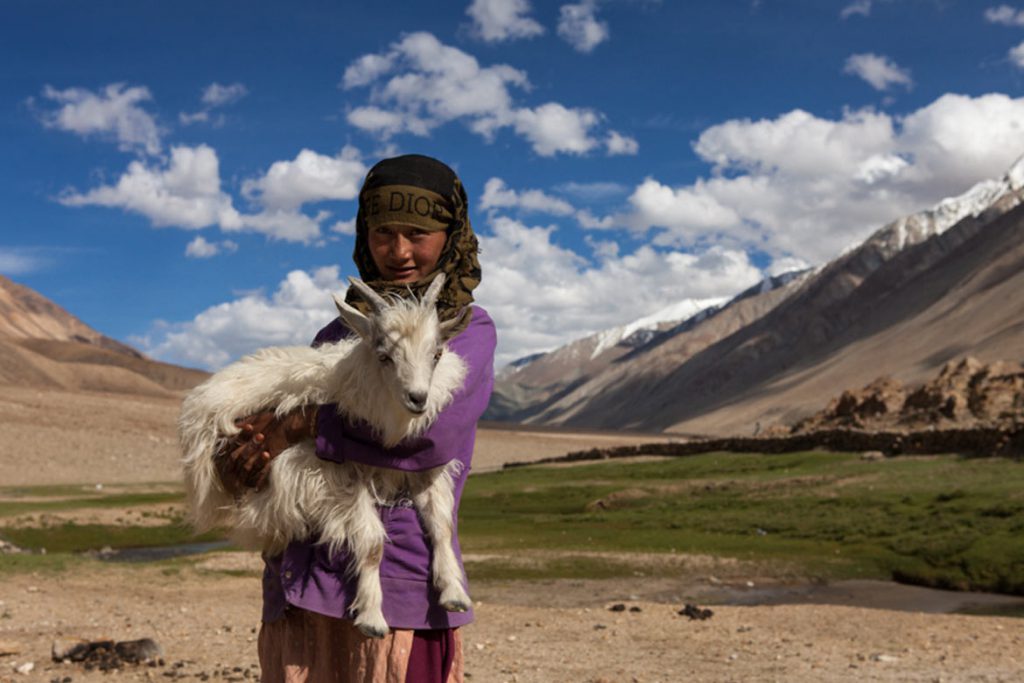
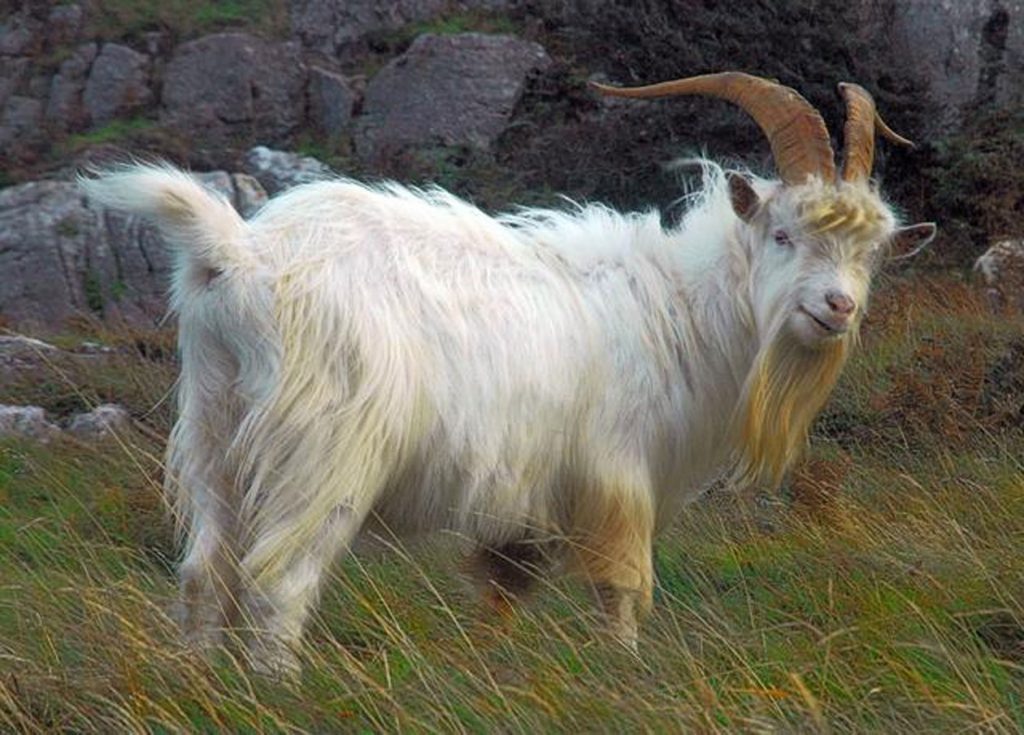
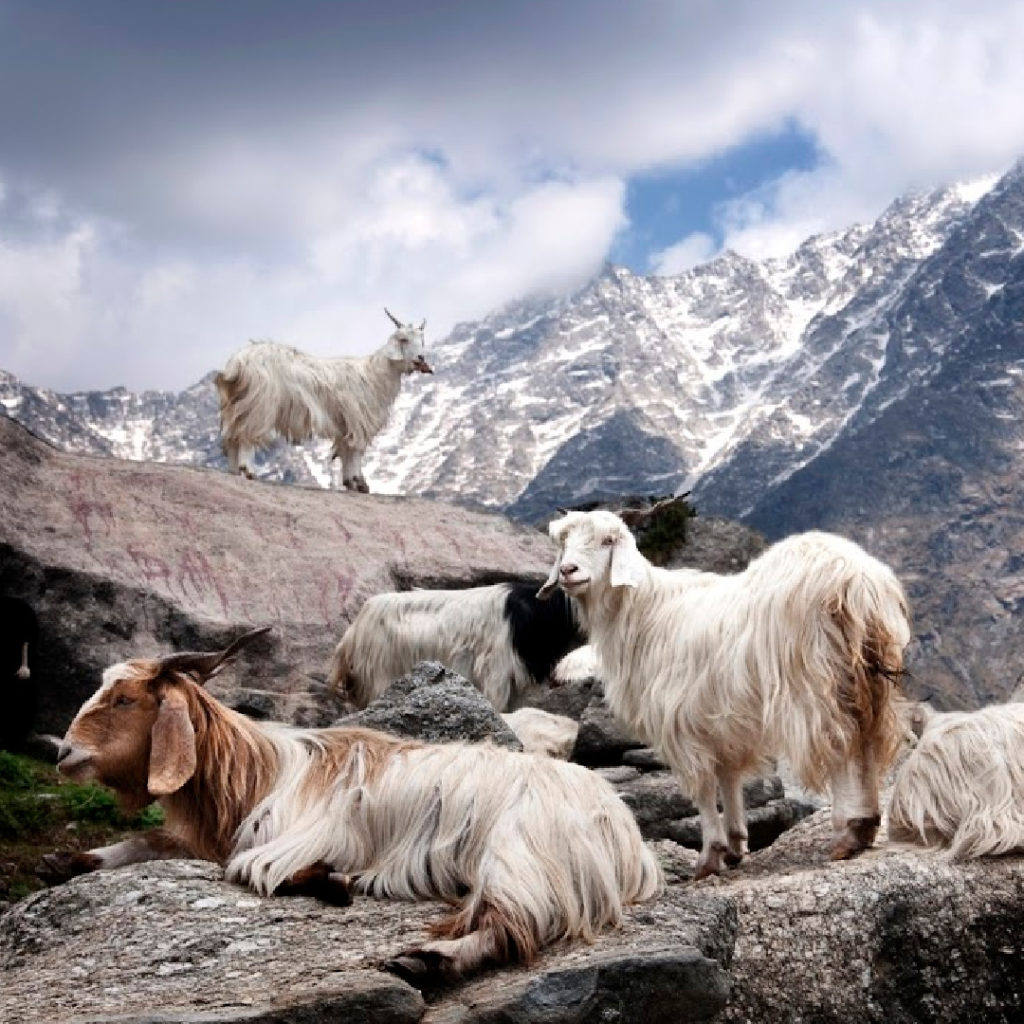
The Ladakhi goat is found in Ladakh, in a region called Changthang. This region is situated 14000 feet above sea level and experiences harsh weather conditions. It grows Cashmere as a down fibre, which is extra smooth and warm, and this downy fleece helps the goat to withstand a temperature of- 40 degrees. It is the exceptional warmth of this fibre that makes this possible. Hence the fibre is considered special, as it is feathery light, yet so warm that it survives the animal at the harshest of temperatures.
Pashmina scarves are totally handmade
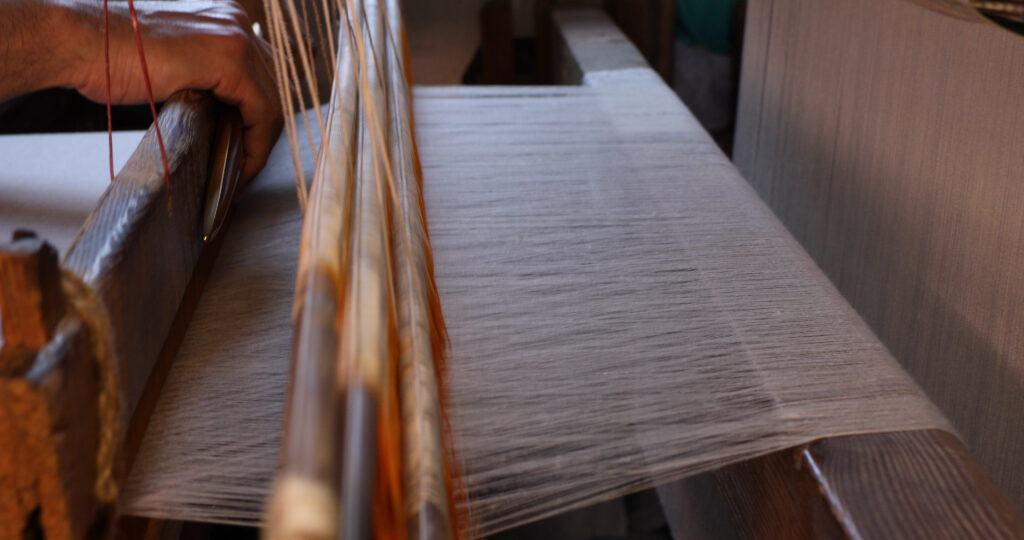
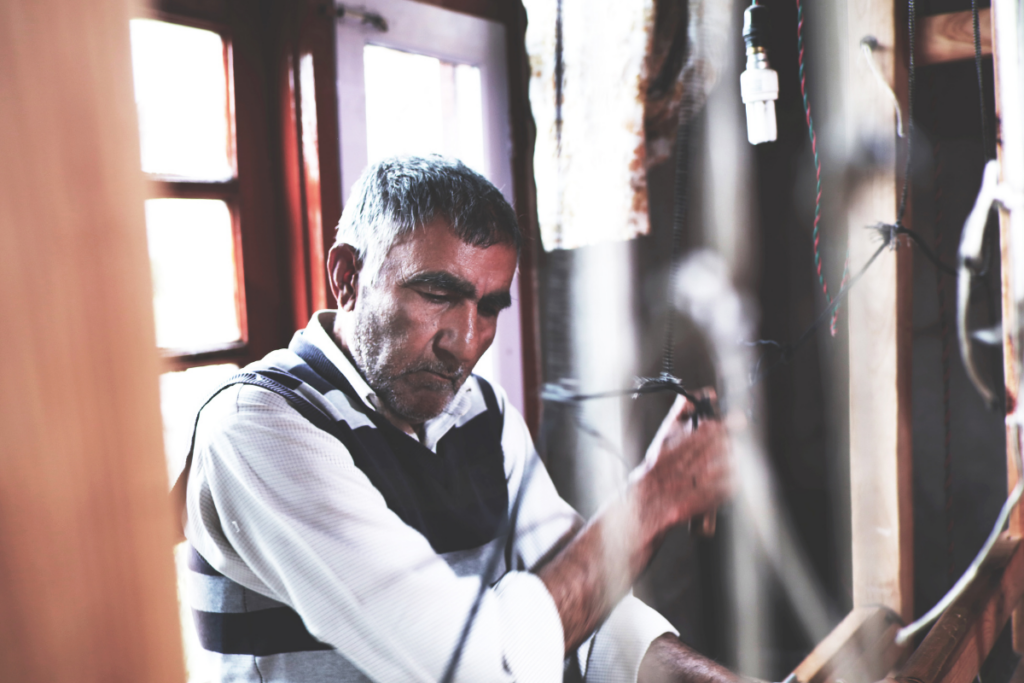
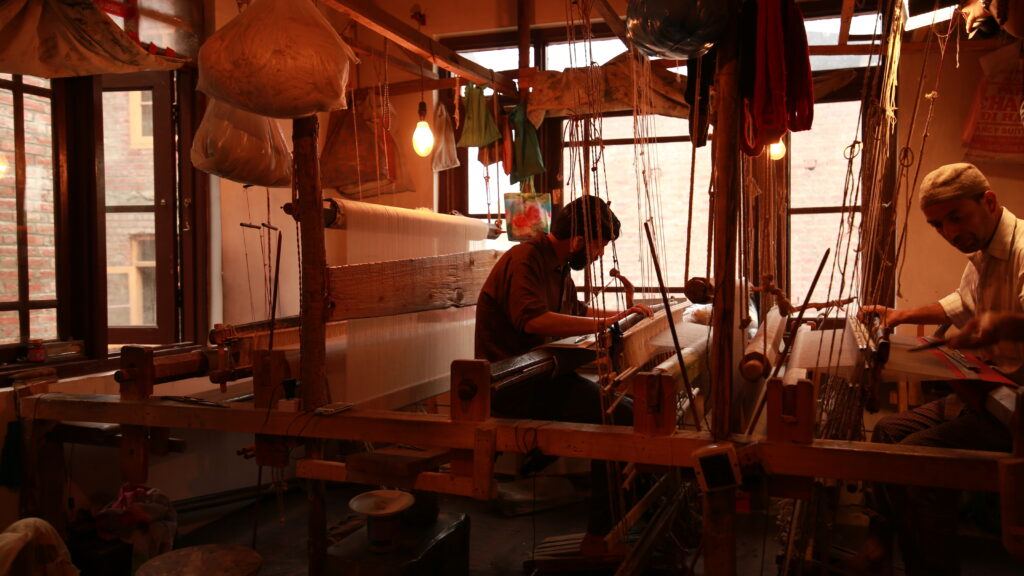
The raw wool is spun on a wooden charkha or spinning wheel, which converts wool to long yarns. These yarns are then handwoven to the fabric. Hence, every procedure which the raw fibre goes through is carried out by hand. There is no intervention of machines, and the entire process is manual.
As many as a hundred families are associated with just one Pashmina scarf. Starting from the acquisition of raw Cashmere, to spinning, weaving, embroidery, ironing, packaging, every single practice is done by labour, from a different family.
Cashmere yarn is extremely fine
The diameter of a Cashmere yarn is 12-16 microns only. That is around one-fourth of a human hair. Please note that human hair is 50 microns. Such finesse in the yarn is unmatched, and that too when it is manually done. Sometimes the yarn is not visible to the naked eye. It is just the masterly skilled and decades of experience of the womenfolk of Kashmir, which help them spin such yarn with ease and perfection.
Pashmina is a family affair
As many as 50 families and a few hundred individuals are associated with just one Pashmina scarf, which makes it more valued. Pashmina weaving and spinning is not a job for people here in Kashmir. It is an act of worship, which these people do to save the art from extinction. It is pure reverence and emotions attached to the art of Pashmina, which makes people want to be associated with it.
In the past, when the Kashmiri economy went too low, and people began to suffer, it was this art of Pashmina which survived them. Thousands of families and individuals took Pashmina making as a job and earned well when it began to be exported to Europe. Hence the makers are still attached to the art, as they remember the times when Pashmina was the only source to keep their family affairs going.
Embroidery takes years and years
If a Pashmina scarf is embroidered at all, then it might take a few years to complete one piece. It again depends on the embroidery pattern. If the shawl has to be fully embroidered, then it might take three years. But if patterns are lighter, then a year or two are enough. The embroidery is again done by hand with the finest threads and needles. Artisans have pockmarks all over their hands, as they have been doing it for decades together.
Kani weave is a weaving pattern in Pashmina, and Kani shawls are well known all over the world. Kani shawls look embroidered, but it is the colourful weaving patterns that make them look so. The meticulousness of a Kani shawl is such that a Kani jamawar shawl takes five years to be completed.
Cashmere from a few goats makes just one scarf
Cashmere, handwoven with an unmatched fashion
It takes the fibre from 2 goats to complete one Pashmina scarf. And since the goat is difficult to find and is extremely rare, the value of a scarf might seem exorbitant. But when one looks at the labour that goes into making the scarf, the value seems perfect.
As much as the size of a Pashmina increase, it takes more wool to complete. Large Pashmina shawls from women need wool from three goats. Larger shawls from men or apparel made in Cashmere would need wool from five to six goats to complete
One Artisan for One Scarf
If an artisan, working on a full embroidery shawl passes away, it either takes a lot of time for other artisans to understand the same. Or the shawl remains incomplete forever. There have been a large number of instances when incomplete shawls have been found in some artisans’ places, and when asked about the same, they narrate the ordeal of their father or grandfather passing away in the middle of the work. Hence one Pashmina scarf can be considered as an exclusive product of imagination, that only belongs to one individual, in this case, its embroidery artisan.
Price of a Pashmina scarf
Is not just more or less embroidery or motifs that decide the price of a Pashmina scarf. The price of a Pashmina scarf depends upon a number of factors that usually sellers, as well as buyers, ignore, and later wonder why the scarf is expensive. Some of the factors which decide the price of a Pashmina scarf are:
Ply
Ply indicates the density of fibre used. A single-ply Pashmina scarf would mean that basic thread is used in its single form. Double-ply or two-ply would indicate that fibre is double twisted. Two-ply is more pricey, as it gives more strength to the scarf made. A single-ply scarf would be more delicate.
Count
Yarn count is a number indicating the meters of yarn that can be spun per gram. The more yarn count the thinner, the smoother and more precious is the scarf. Hence 100 count Pashmina scarf would mean that one gram of the shawl 100 meters of the yarn, and hence the fibre would be more delicate. This type of Pashmina would be more expensive, as the finer the fibre is, the more painstakingly it is made.
The thickness of the fibre
How thick the fibre also determines the price of Pashmina scarves. The finer the fibre used, the more pricey the scarf becomes. Also, surprisingly, it is said that the finer the fibre, the warmer the shawl is.
Weaving Patterns
Weave patterns also determine the price of Pashmina scarves. The diamond weave is the most expensive type of scarves in Pashmina. These are followed by twill weave and basket weave. Jacquard weave is also one major type that is usually worn to weddings or special occasions. Again a tighter weave will be more pricey than a loose one
Fake Pashmina Scarves
As soon as Pashmina got immense fame and recognition all over the world, a few deceitful traders started to produce fake scarves or crafted Pashmina over machines. In both cases, the originality is lost. If Pashmina is mixed with a nylon or silk thread, it loses purity as well as worth. The same is the case when processed over powerlooms. Power looms may be a lot more efficient and faster than handlooms, but handwoven Cashmere is what the art of Pashmina is all about.
A pure Pashmina scarf, on average, will be worth US$120 - 300 (dimension is 200 cm x 35cm). It also depends on purity. This was the price of a 100% pure scarf and not an amalgam of silk or nylon. Unfortunately, many deceptive sellers have hiked prices but sell fake scarves. It is important to ask the seller for a certificate of authenticity. If he is not able to produce one, then he might be a fraud. Nevertheless, plain scarves will range from $120 to $150. If the scarf is patterned, printed, or laced, it will rise in price. Embroidered scarves might even be priced at $300.
It is crucial to check the purity of a Pashmina scarf while buying it. Only pure Pashmina scarves deserve expensive tags because it is them which have been handcrafted laboriously by proficient artisans who work for years together to craft every exclusive piece. Buying a Pashmina is an investment, and should not be wasted to purchase a fake scarf
You might ask a person why choose a traditional Kashmiri shawl over a modish wrap accessory. But you might not be aware of the fact that traditional apparel has its own grace. Let's hear from our fashion experts why they suggest Pashmina, and how ethical fashion is the new way to style.
Almost all of us have purchased a new accessory, which even before we return home, earns our dislike. We might like it for a season or two. But then it just lies there in the darkest corners of our room, never to see the sunlight again. This is a problem with fashion fads. They might blend with your personality or look completely strange. Baggy pants, colorful jeans, feathered hats, and patterned boots might seem chic in a store. But as soon you reach home, all this suddenly turns crazy and attention-seeking. Unfortunately, there are seasons when one has only invested in trendy outfits, and of a sudden, a formal event appears. That's when a sustainable outfit will help.
There are many good reasons to incorporate sustainable goods in our formal and festive wardrobes; if not in our daily wear. If we are careful enough with them, these pieces have the power to make us the best version of ourselves. Apart from holding on to our culture, there are many more reasons to choose sustainable apparel.
Reasons to go for sustainable apparel
Comfort
Pashmina is made out of natural fibre of Changthangi goat
It was long before the industrial revolution and the machine age when synthetic fibres took over, that cultural outfits existed. Pashminas were always made of natural fibre and were hence sustainable. This property makes them comfortable, easy to wear, environment friendly and so comfortable. Synthetic fibres try to reincarnate sustainable natural ones. But always fail to copy the exact sophisticated looks that a traditional outfit would exude.
Timeless
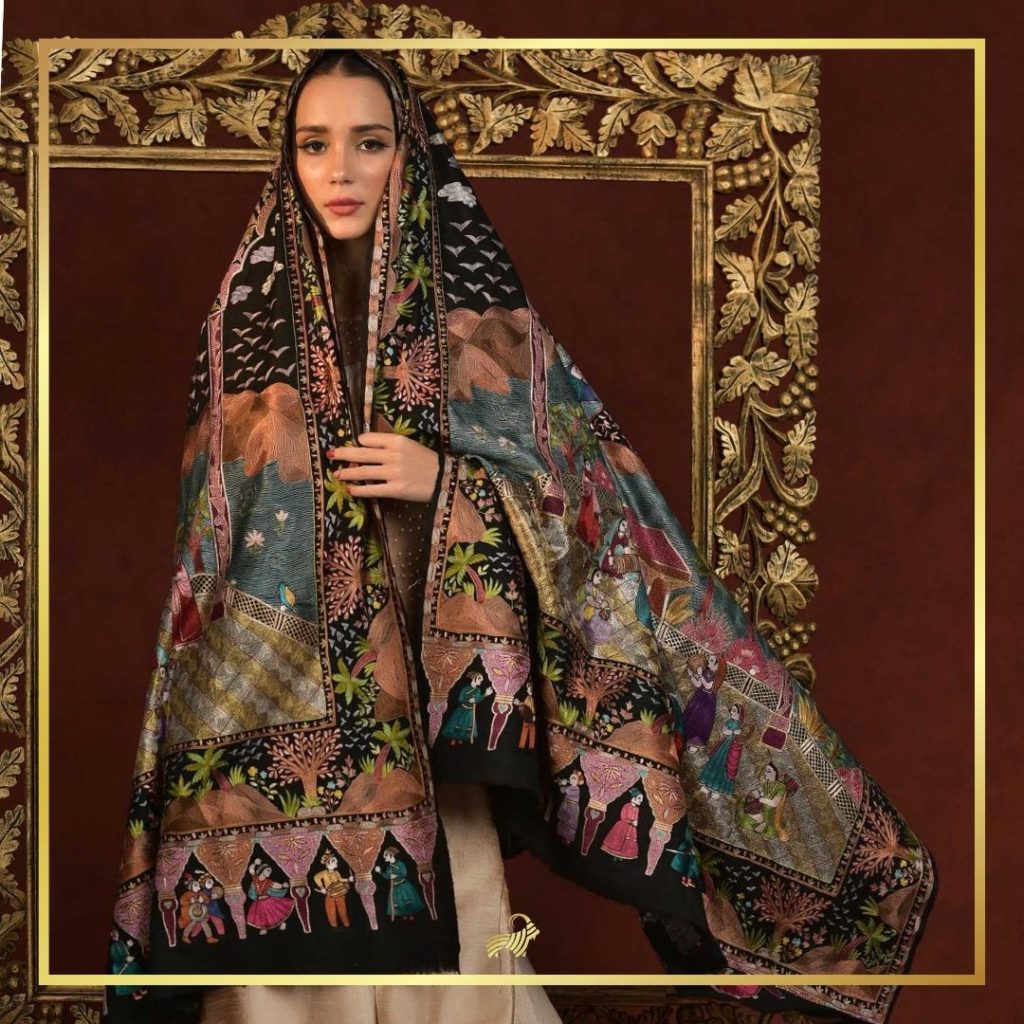
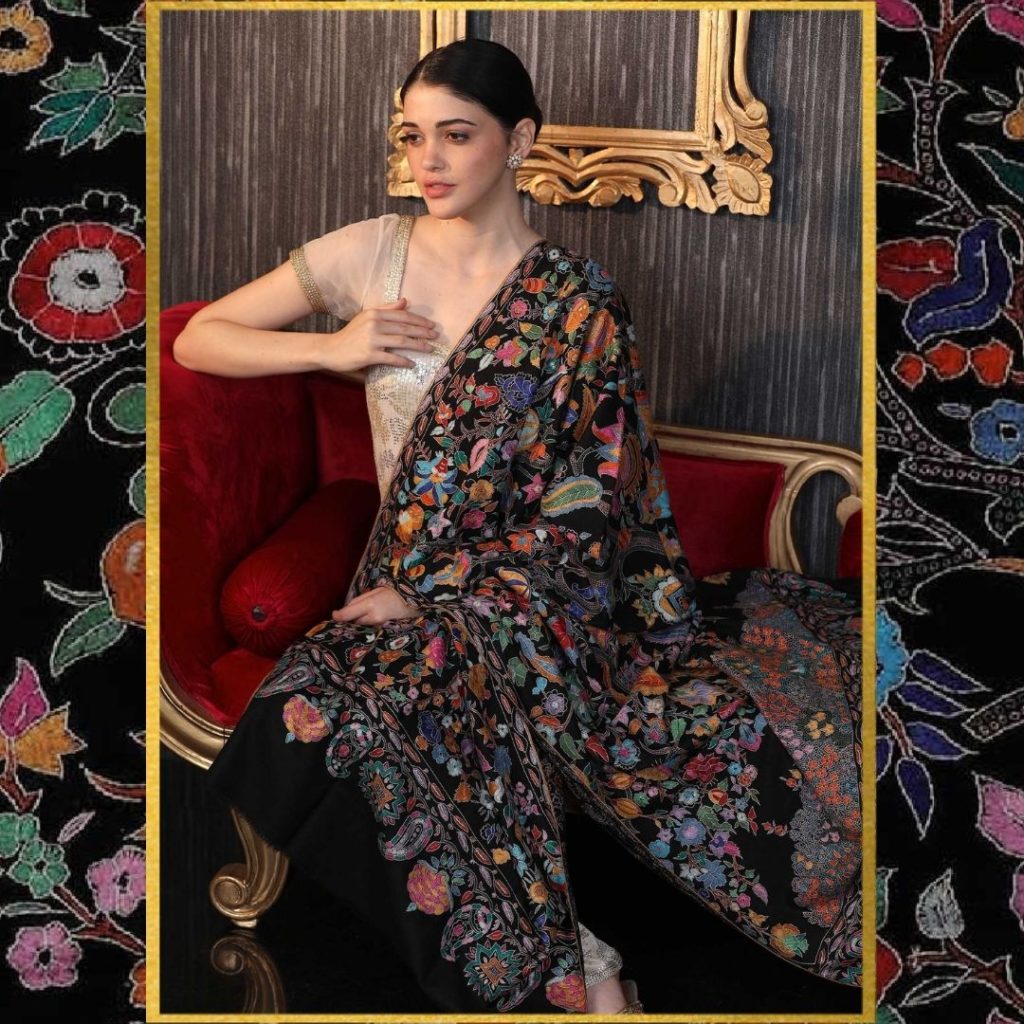
In the timeless black, a Pashmina shawl has been hand embroidered in Tilla Dozi, where fine, intricate threads aggrandize a plain soft base
Sustainability is never out of style. Traditional outfits, which existed before machines took over, are still wearable and carry an innate grace within themselves. Slow fashion, ethical practices, and the use of hazard-free techniques were the key to making traditional outfits. This kept these outfits alive for longer. Even if sustainable fashion is a bit on the high side of the price scale, but its timelessness makes it perfect for every period of time.
Help local artisans and communities
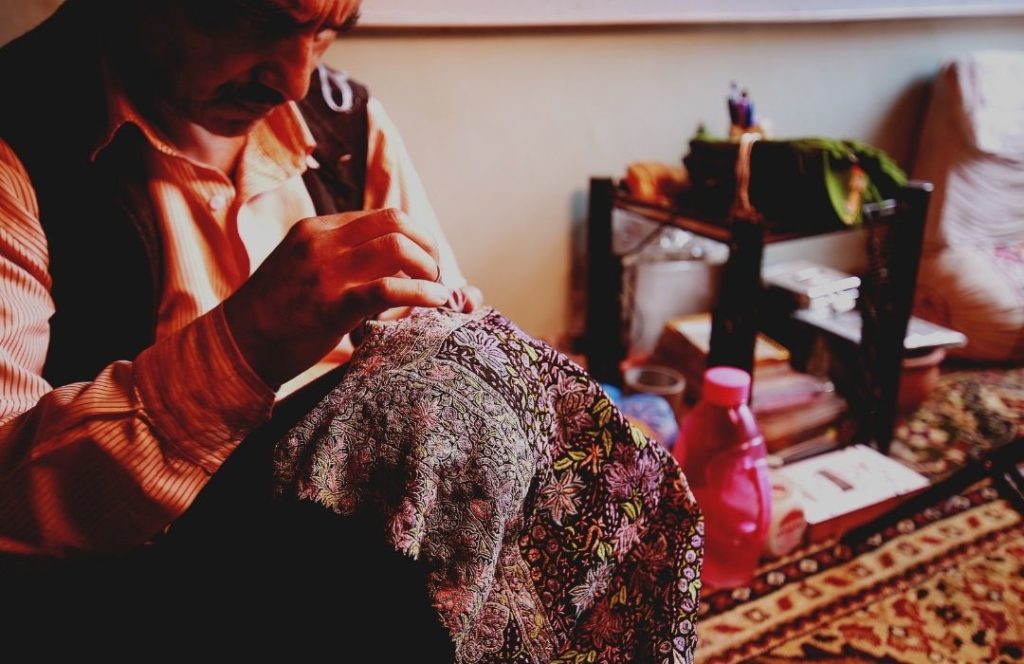
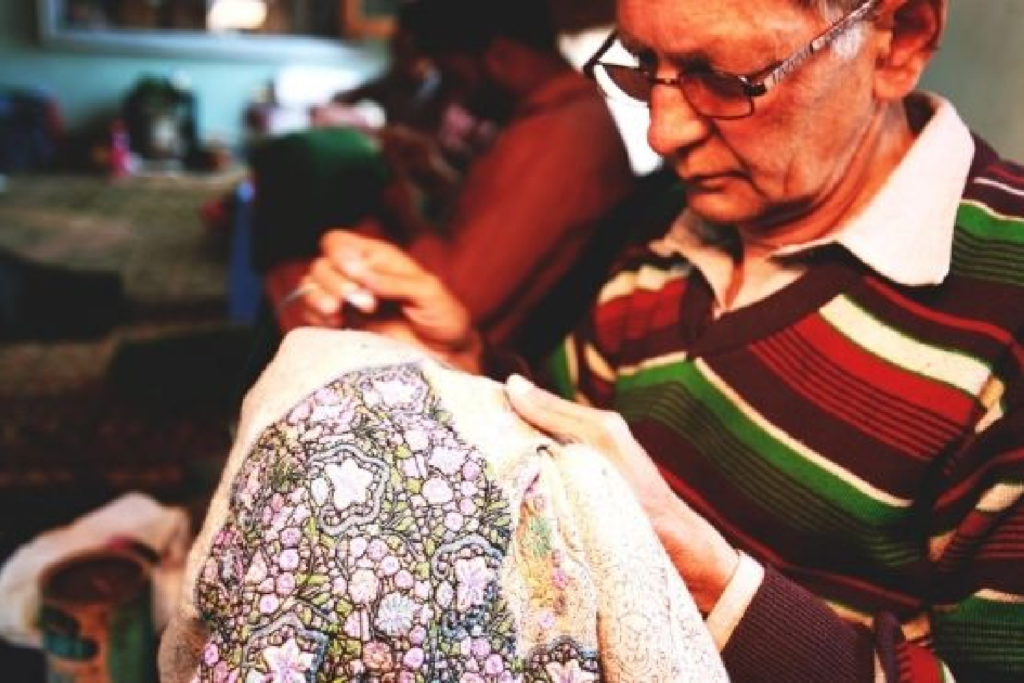
Artisan hand embroidering Pashmina
In the current scenario, sustainability is only prepared by artisans who are in their old age now. The machine age sure took away from them their fame and jobs pushing them into poverty. But it could never snatch from them their adept skill and painstaking efforts that modern apparel never experiences.
Hence, if we invest in more sustainable outfits, be it an accessory made of natural fabric, we are helping the local community survive. We are assisting our brethren to prosper once again.
With regards to traditions and sustainable fashion, Kashmir has its own glorious history to offer, and cultural apparel to swoon over. Not just apparel, Kashmir has a history of rich embroideries, fabrics, accessories, jewelry patterns, and many artistic treasures to flaunt. Yet there is something about Kashmir, that the entire world is swooning over. And it has been so from the time it was first discovered. We are talking about Kashmiri Pashmina Shawls.
What is Pashmina?
Pashmina is the Kashmiri art of handcrafting luxury shawls, wraps, or apparel from the finest Cashmere fibre. It comes from the undercoat of the Capra Hircus goat found in Ladakh. The fibre is natural. Artisans acquire it in a cruelty-free environment. It is then handcrafted by the artisan community without the use of machines and power looms. Hence world-famous Pashmina is a perfect example of sustainable fashion, and that is what we have to offer.
Weaving a Pashmina
The making of Pashmina is complex and meticulous. Every year, the goat sheds its hair naturally, and herders collect it. They then clean and sort, spin and weave it, to come up with a luxurious and warm fabric called Pashmina. From this fabric, Kashmiri shawls, stoles, scarves, wraps, or hijabs are crafted and sold all over the world. The fabric has kept Kashmiri traditions alive for ages now.
History of Pashmina
It was in the 17th century when a traveler passed by a beautiful valley on the silk route. The traveler noticed that local nobles and affluent people wore a type of shawl. The shawl was exceptionally luxurious and graceful. It was given as a gift to kings and queens of other countries as a sign of respect or allegiance. The group of travelers decided to call it Cashmere (from the place of its origin Kashmir). Locally it is known as Pashmina, and it is this luxury craft that has awestruck fashion designers and celebrities alike.
When talking of traditions, the Pashmina shawl is one of the most essential ingredients of a traditional wedding. A mother gifts her daughter a number of Kashmiri shawls as she embarks on a new journey of life. It is considered a lucky charm and blessings from elders which the bride takes along to her new home.
Earlier it was either only brides who wore Kashmiri shawls or affluent women who wrapped themselves in expensive pieces. But since modernization took over, Pashmina was woven into more wearable pieces. Plain shawls, printed stoles, or the ones with less embroidery came into being. This step was welcomed by local artisans who appreciated the incorporation of ancient traditions into the everyday lives of women.
Do Pashmina goats die for Pashmina? Are Pashmina goats killed for Cashmere? Is Pashmina banned? These are some common questions that are continuously asked by customers. These are responsible citizens of the planet and abhor animal cruelty. This section of the society is not necessarily vegans but does not want to be wrapped in something which has been a part of killing or hurting a living thing. But the answer to all these questions is a simple NO. Pashmina is cruelty-free, animals are not killed for Pashmina, and hence, Pashmina is not banned. To know the reason for the ban on this kind of wool, we today dig deep into the making of Pashmina and see for ourselves why Pashmina is cruelty-free and in fact ethical to have.
What is Pashmina?
Pashmina is the art of transforming Cashmere wool into luxury wrap accessories. This raw Cashmere is acquired from Ladakh in a region called Changthang. A peculiar species of the goat is found on the Changthang plateau which has been named the Changthangi goat, or the Changpa goat (its herders are called Changpa), or Pashmina goat. To survive the harsh climate that this region experiences (a temperature of -40 degree Celsius in winters). nature has bestowed the goat with protection. This protection is exceptionally warm wool which grows on the Pashmina goat's body as a down fibre (underbelly, neck, and some sensitive parts of the body). The wool is so warm that the goat roams freely even in the freezing cold.
Pashmina Shawl in a reversible or Do-Rukha pattern
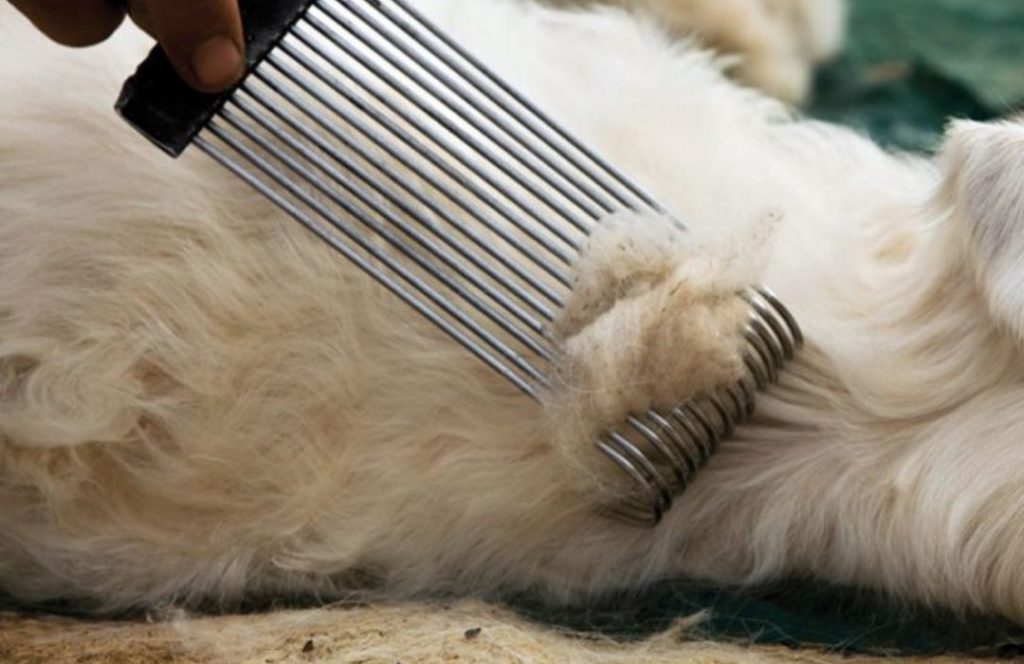
As soon as summer arrives, the goat becomes too uneasy. It hence rubs itself with rough surfaces to get rid of it, which does the job, but not to its satisfaction. Herders, seeing the uneasiness of the goat, immediately call professionals, who come to the goat's rescue. With the use of specialized tools, professionals gently comb off the wool from the goat's body and set it free. This wool is fine Cashmere, and upon processing it is converted to Pashmina shawls, stoles, scarves, and even apparel.
Processing Cashmere from Pashmina goat- Raw Wool
Raw wool is sent to Kashmir, where women take a few parts home and spin it over a wooden spinning wheel called Yinder. This transforms the lump of wool into fine threads of Cashmere, each just 12-16 microns in diameter. These threads are handed over to men weavers, who hand weave the same into shawls, scarves, and stoles. There is minimum wastage, the processes are all manual and the end product lasts for a lifetime.
The process of acquiring wool from Pashmina goats is not cruel, as we can see. So the animals are not killed for Pashmina. Only the wool is separated from its body by gently combing it off. This portion was any way left on the body after the Pashmina goat has tried its best to naturally get rid of it. The hair is not plucked or even sheared. It is softly removed and no pain is inflicted upon the animal. Pashmina is cruelty-free. And so Pashmina is not banned. In fact, it is being sold under the surveillance of the state and central government. Pashmina making is a major source of livelihood for underprivileged families in the Changthang region. And any cruelty towards the Pashmina goat will directly affect the families' livelihood.
However, there is something which is banned. There is a kind of wool that is cruel. There is a kind of wool, which involves killing the animal it is acquired from.
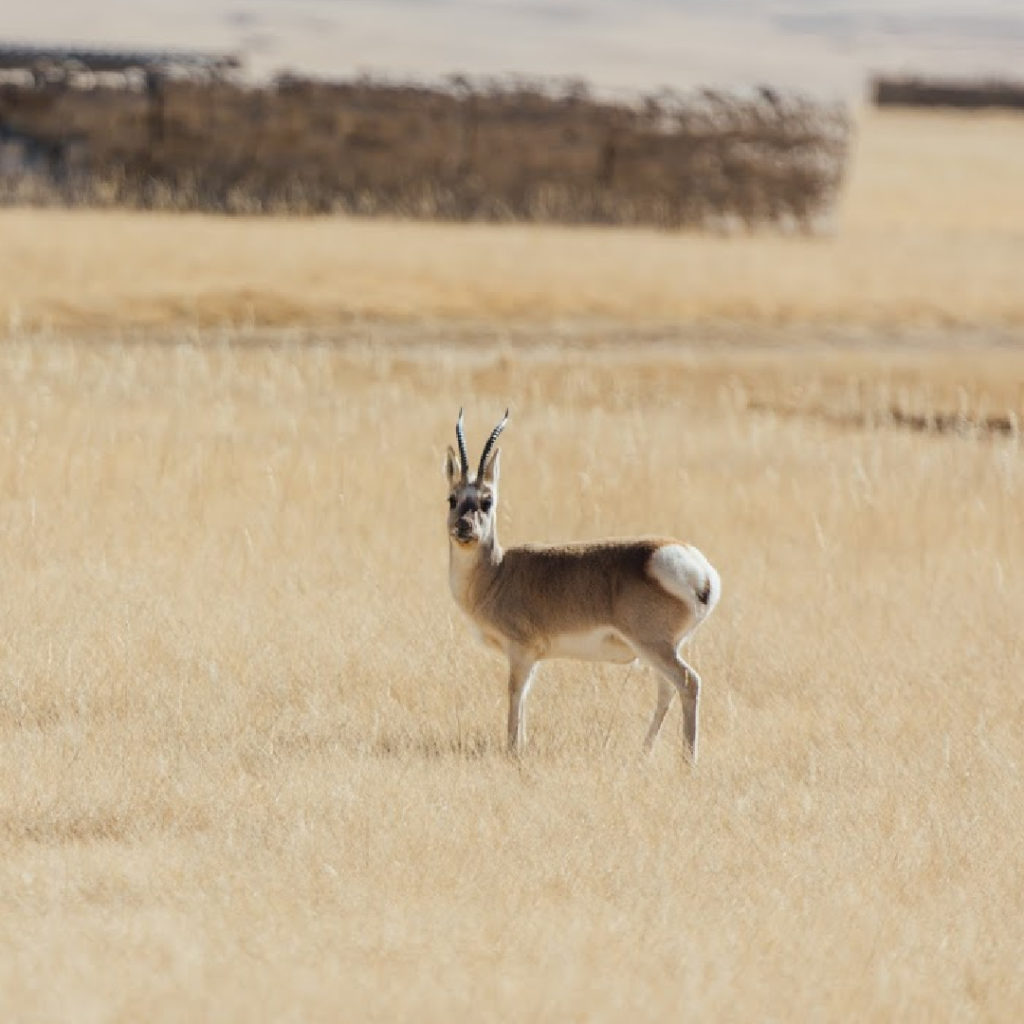
Shahtoosh literally comes from two terms 'shah' meaning 'king' and 'toosh' meaning 'wool'. It actually is the king of all varieties of wool. It comes from the fine hair of the Tibetan Antelope and is the finest and one of the most expensive varieties of wool in the world. But even after being an ideal winter wrap, shahtoosh is banned; its possession and sale are illegal in most countries. The reason behind the ban is the animal it comes from. Chiru is an endangered species under CITES.
Chiru Goats or the Tibetan Antelope
Living in one of the most rigid and severe environments on earth, the Tibetan antelope is found at an altitude of over 5,000 metres. But much like Pashmina, a special type of down fur, being light and excessively warm, allows them to survive in freezing conditions. Chiru goats are migratory animals, and they move from Mongolia to Tibet and gather at the plateau at one point in the year. It is this part of their movement where nomads wait for their appearance, every year. These nomads hunt the antelope for their skin, meat, horns, and mainly the fur - Shahtoosh
Chiru - the Tibetan Antelope
Shahtoosh shawl exists from the time of King Akbar. Under his rule, it was considered the warmest and the most luxurious piece of fabric. It was so soft that it could pass through a finger-ring. earning it the name 'finger shawl'. Shahtoosh would be naturally colored, and people preferred it like that, without the urge to dye it in brighter shades.
Ban on Shahtoosh
Hence, we see that it is Shahtoosh wool which is banned because it leads to animal cruelty. The Tibetan antelope is killed, and the nomads who do so take its horns as trophies for themselves as a mark of pride to have hunted a Chiru. Environmentalists argue that even if it was possible to extract the wool without actually killing the animals, snatching their protective cover amounts to “cruelty", as the cover protects them from biting cold of the Tibetan plateau.
Nevertheless, Shahtoosh trade was banned globally in 1975 under the Convention on International Trade in Endangered Species (CITES), granting the antelope the highest level of protection. Otherwise, three to four chiru goats would be killed to make a shawl, that would be allegedly sold for $1000 to $5000 and sometimes even up to $20,000 in the international market. One adult animal yields about 125-150g of wool. Unfortunately, some traders still carry out the trading of shahtoosh shawls. They manage to sell it secretly to irresponsible customers who ask for the same, just for the sake of showing it off.
Pashmina goat wool is not Banned
For Pashmina the story is different. Firstly, Pashmina goats are domestic and not wild. Hence, herders do not need to kill them, but simply hold them during the hair removal process. Secondly, the hair is removed partially by the goat itself and completely by professionals around the month of April. During this time, the temperature has already gone up, and the goat doesn't need any protection, as winters are over. Pashmina is far from being cruel. These goats are the only source of livelihood for the Changpa nomads. Hence, the goats are not killed for Pashmina.
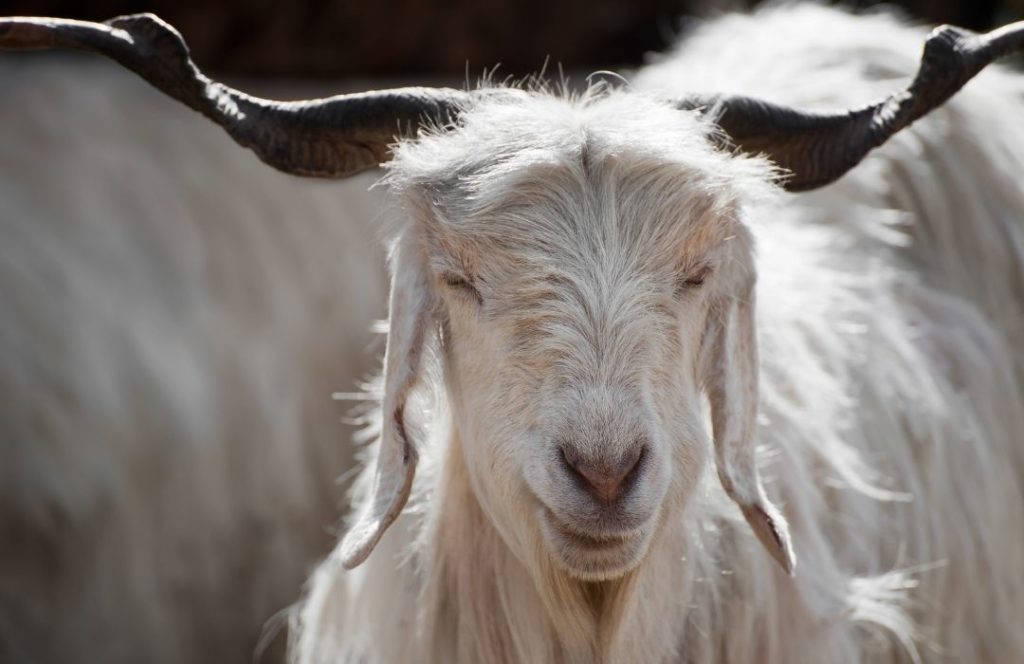
The Changthang goat
Pashmina is not banned and has never been. It is sold all over the world openly. But it has been confused with the Shahtoosh shawls as both are called Kashmiri shawls. But Pashmina is ethical, sustainable, and of course the most beautiful creation of human hands. It just bestows its grace to the wearer, besides covering them in exceptional comfort.
Veganism, or the state of being vegan, is a modern stance against animal oppression and cruelty. People who are vegans do not use any of the products associated with animals. Be it food, clothing, researches, or entertainment, vegans avoid animal exploitation as much as they can.
This means that vegan ideology followers eat plant-based foods and would not prefer animal products like chicken, meat, etc. Similarly, vegans do not wear wool, snake leather, suede, or other materials that come from animals. This would mean that vegans do not wear Pashmina, since it is an animal fiber. Vegans believe that any kind of wool associated with cruelty to animals and hence it is better to avoid it.
Why Veganism?
Veganism is getting more and more popular. That because people have realized it to be better for health, environment, and more ethical. They believe that if they consume eggs and dairy products, they might be promoting the meat industry. That is because once dairy cows and egg-laying hens become too old, they are sold for meat. Yet there are others who avoid these items because of the inhumane conditions which take place during their production.
Many vegans choose this lifestyle in order to promote a more ethical and humane world. They want a world where animals would never be treated as they currently are. This category of individuals believes that it is their responsibility to create an environment where none is treated in a cruel manner.
Veganism and Vegetarians
Vegetarians are the category of individuals who refrain from the consumption of meat, eggs, dairy products, and other animal-derived foods. Vegetarians are also known as dietary vegans, who avoid animal-derived food. The reason is that their production causes suffering to animals in addition to their premature deaths.
Toiletries that Vegans use
Vegans use products that are vegan instead of those which are made from animal remains. An example of vegan toiletry is vegan dental floss which is made from bamboo. Even if products that have animal ingredients are less expensive, vegans pick the expensive ones. They believe that after animals are killed, the remains are put in toiletries, especially the fat.
Vegans and Pets
Some vegans are serious enough to follow veganism in even pet food. If they rescue an animal and pet them for a while, they make sure the pet food is vegan too. However, this practice is widely criticized. This is because dogs and cats are carnivorous, and it might be harmful to their overall health
Vegans and Clothing
As far as clothing is concerned, vegans never use clothing made of silk, wool, fur, leather, snakeskin, or any animal product. As we know, leather is made of animal skin, which can be only acquired by killing or being cruel to the animal, hence being abhorred by vegans. Vegans prefer linen, polyester, rubber, or artificial leather (pleather like mushroom leather)
Is Pashmina vegan?
To understand if Pashmina is vegan or not, let us go deep into the making of Pashmina.
Pashmina is the art of handcrafting luxury wraps, shawls, and scarves. The raw material for Pashmina is fine Cashmere wool which is found in Ladakh. This goat is called the Changthangi goat and is found in Ladakh. It grows Raw Cashmere wool in winter to survive the extreme temperature. (which goes down to -50 degrees), not to forget the Changthang region is located over 40000 feet above sea level. The Cashmere wool protects its body from the freezing temperature until summer.
Acquisition of the wool
Come summer, the same wool makes the goat extremely uncomfortable and it becomes unbearable for the goat to carry it. Herders gauge the discomfort of the goat. With the help of professionals, they comb the wool off the goat's body and make it free to roam again. Some portion of the wool can be found in the surrounding areas which the goat itself leaves by rubbing itself against harsh surfaces. That because it is itself feeling a certain level of discomfort. Hence, on one side we can say that Pashmina is not vegan, because even if it is made in the most ethical fashion, yet comes from an animal. Pashmina is not cruel. No living being is harmed during the entire process of obtaining wool from the Pashmina goat. But it does not support veganism, because veganism doesn't approve of any product acquired from animals, ethically or unethically
Is Pashmina Cruel?
On the other side, as far as the basics of veganism are concerned, vegans disapprove of animal products because those are associated with cruelty to animals. But when we take a look at the making of Pashmina, we see there is no cruelty associated. In addition to this, if at all Pashmina production reduces, it will be detrimental to the animal itself. The only source of income for the herders who rear Pashmina goats in Ladakh, are the goats themselves. They sell raw Cashmere with which they are able to survive themselves, their families, as well as feed these goats.
But if at all Pashmina production decreases, how will the goats and their herders be able to survive. They will have nothing else to depend upon because rearing Pashmina goats is all they know. Hence if you are a vegan, and do not want to wear Pashmina scarves or shawls, take a closer look at the process. If possible visit Ladakh once, and see for yourself the process by which Cashmere reaches you.
Contrarily Pashmina is Sustainable
As opposed to the belief that Pashmina is cruel and shouldn't be used by vegans, Pashmina actually supports the idea of sustainability. To start with, it is acquired ethically, without causing any suffering to goats. Next, it is manually processed by artisans, and no use of machines is involved, thereby contributing nothing to air pollution. In addition to these, Pashmina art empowers underprivileged sections of society by giving them a chance to earn through their handwork. Pashmina is handmade by men and women who belong to a more impoverished section of Kashmiri society, and by investing in Pashmina, one can help support these individuals.
Lastly, Pashmina scarf or shawls stay for a lifetime. If your Pashmina scarf is pure, it will be your company for more than 20-25 years. In Kashmir, mothers used to give their daughters their own Pashmina shawls, which their mothers would have gifted them at their wedding some 20 years back. And the shawls are fresh, intact, and beautiful as ever.
The paradise on Earth, Kashmir, is abundant in natural picturesque scenic beauty spots. Apart from this, it is abundant in the most beautiful handicrafts. The rich and exquisite handicrafts are another feather in the hat when one talks or writes about Kashmir. This is why Kashmir is famous all over the world. And it's not a thing of pride for just Kashmir, but the entire nation (India). This is because handicraft accounts for a significant income of the country. It plays a vital role in improving the economic setup of a nation. Besides, it plays the role of a helping hand for local artisans.
Pashmina and the Artisans:
The art of Pashmina has always been the biggest support and a boost for the livelihood of artisans. This art was introduced by a Persian Saint in the valley. Since then, artisans have been closely associated with the same. The art form earned the artisans their livelihood and improved their lifestyle drastically. Pashmina shawls soon became world famous and so did the artisans. When the shawls were sold at high prices, the artisans got good returns for their work. So much so that this community, which was a few years ago one of the most downtrodden, was suddenly the most famous!
Pashmina artisans received fame as well as strong incomes in just a few years. Hence the maximum population of locals joined the Pashmina team, and started their careers in Pashmina making. Women took up spinning of the Cashmere fibre. This is because it was possible to do the same from the comforts of their home. This made household work as well as earning money easy and simultaneously for them. Some women excelled in hand embroidery as well. Men, on the other hand, took hand weaving and embroidery. Weaving would be done on large handlooms which were to be installed in factories. Large handlooms couldn't be installed at homes, and hence men left their homes for the factories early morning. A few men artisans took up embroidery and excelled in the same, with some flawless pieces to flaunt.
What does Pashmina mean (Pashmina Definition)
Pashmina refers to the art of handcrafting exquisite pieces of wearable apparel or wraps with fine Cashmere. Cashmere is found in Ladakh, India, where the Changthangi goat grows it. The term gained prominence when it was discovered for the first time in the 15th century. Since then, it has been the first priority of the royals, members of the noble courts, the affluent, and some patrons of classic art. Pashmina shawls from Kashmir are well known all over the world. This owes to their finesse, gossamer touch, and exceptional warmth that they lend to their wearer
What does Pashmina mean literally?
The word pashm comes from the Persian language and literally translates to "soft gold". The term comes after the visible smoothness, warmth, softness, and aesthetic attributes related to the final products which are crafted using raw Cashmere. It is coined in Persian as it was Shah I Hamdan, who discovered Pashmina for the first time in Kashmir. Let us go deep into the history of Pashmina, and know everything about what this luxury is.
History of Pashmina
Pashmina has a rich history. The existence of Pashmina has been there since around 2500 BC. At that time, it was only the kings, queens, and other royals and elites who wore Pashmina shawls. Gradually, commoners, who became ardent fans of the art form, started purchasing Pashmina shawls. And even if it meant saving a lifetime of savings, . When it was released by the producers of Pashmina, they started handcrafting Pashmina products at lower prices. These products included small scarves, or shawls which included sheep wool with Pashmina (semi-Pashmina shawls). This way commoners could afford to wear Pashmina.
Not just local Kashmiris, many popular figures all over the world were in love with Kashmiri Pashmina shawls. King Akbar, Jahangir, and Empress Josephine (wife of Napoleon) area few examples. In Europe, Pashmina shawls gained prominence when Empress Josephine set these into a timeless fashion. It was Napoleon who gifted her a Kashmiri Kani Pashmina shawl; it impressed her so much that she ordered a few hundreds of the same. Many centuries later, Princess Dianna was spotted wearing Pashmina scarves. Nowadays Celebrities around the world prefer Pashmina to other categories of wool. This owes to its delicate texture, smooth finish, and exclusive warmth it lends.
The Art and the Artisans
Because Pashmina enjoyed a glorious reputation all over the world, the artisans too benefited from it. This community of exceptionally skilled people got a boost in their personal lives. They also saw an immense growth as far as their earnings were concerned. They were invited by countries all over the world, and requested to train the local artisans in the same. This grew their confidence, and they were empowered in performing much better, even though the tasks were tiring. Hence the rich history of Pashmina can be attributed to the unending efforts that artisans put into it. Additionally, the purity and finesse of Ladakhi Cashmere, plays a huge role.
Pashmina in Kashmir (Pashmina Definition)
It is essential that we know the history of Pashmina in Kashmir. Pashmina definition in Kashmir was the luxury shawls that artisans produced in years. But very few individuals saw the great efforts that were hidden behind the shawls. Pure Cashmere from Ladakh was manually acquired and then processed for months or years together to produce luxury shawls. Note that this technique was indigenous to Kashmir. No nation around the world could process Cashmere like Kashmiri artisans did. It all started when Syed Ali Hamdani arrived.
It was the 15th century when Kashmir's economy was in great trouble. People didn't have jobs to do and earning was much harder than it is today. And then came the day when a Persian Saint by the name of Shah I Hamdan visited the valley. He did this numerous times, and on one tour to Kashmir, he brought with himself 700 skilled craftsmen. These craftsmen were masters of a number of crafts. These included wood carving, silverwork, Papier Mache, Copper work, and many other crafts that Kashmir is well known for today. But one of the crafts gained more attention than the others. That was Pashmina making.
Kani Pashmina - handwoven over traditional handloom, with the intricate and meticulous intervention of Kani bobbins
Pashmina over other art forms
A large number of local craftsmen chose Pashmina. This owes to the way it was acquired, processed, embellished, and later worn. The craftsmen also realised that even a small bit of the fabric fetched a lot. And ever since it has been the backbone of the Kashmiri economy. Those artisans learned, and then their offspring learned the same. That is how Pashmina traveled generations together. Till now, there are artisans, with decades of experience, who are associated with Pashmina making. It is the same art form that Shah I Hamdan trained their ancestors in, five centuries back. Yet the art hasn't lost a tad in its grace, quality, and warmth.
The Coming of a Saint
Syed Ali Hamdani arrived in the valley to teach the locals the religion of Islam. But he brought with himself a group of skilled craftsmen. Along with religious teachings, the craftsmen trained locals in a number of art forms. This included papier mache, carpet making, walnut wood craft, wicker willow craft, and more. But the one that almost all of the locals chose was the art of Pashmina shawl making. The reason for this was the popularity of Pashmina art, and how women as well as men swooned over the final products. The income of Pashmina artisans was handsome. Many were able to tour foreign countries with the help of this art.
Even though the making of Pashmina is a meticulous task, which includes a number of complex processes, artisans never stopped. Since the 15th century, till now, artisans continuously follow every single step in the making of Pashmina shawls. The reason for this is their love for the work. Making Pashmina shawls is a passion for the artisans, and hence it never tires them physically or mentally.
Making of a Pashmina Shawl
Processing Raw cashmere to luxury Pashmina shawls is a wondrous process. It takes days, months, or years together and the efforts of hundreds of craftsmen to craft one Pashmina shawl. Here is a series of the processes that one has to follow to arrive at a beautiful Pashmina shawl.
Step 1: Fibre Harvesting
Raw Cashmere grows on the body of a Cashmere goat which is found in Ladakh. The goat grows it as a defense mechanism against the harsh cold that the region experiences. It is during the spring season when the goat sheds this undercoat. It starts to rub itself against coarse surfaces (stones, bushes, and walls) to get rid of the hair naturally. Some of the hair is lost in the process which is collected later by its herders. The rest of the portion is removed by the process of combing. It is done by professionals who bring along specialized combs and tools and make sure the animals aren't hurt in the entire process. Hence the combing off of the undercoat. of goats is fully ethical.
When the entire hair is gathered, it is then cleaned as it contains impurities like dust, sand, vegetable wastes and other types of contamination that are attached to it. It is then sorted according to certain parameters, the first one is the colour. Cashmere fibre can also be sorted on the basis of fibre length and finesse. Finer, longer and white Cashmere fibre generates more return than rough, short and coloured fibre.
Step 2: Dehairing the Fibre
Pashmina goats produce double fleece. This means the raw wool we get after combing is a mix of fine hair (which is Cashmere) and guard hair. Using special equipment, the two of these are separated from each other. The guard hair should be absolutely absent before processing. If the presence of guard hair is more than 5%, it affects the quality of the final product.
Step 3: Spinning the Fibre
The collected fibre is sent to Kashmir, as Ladakh does not have Pashmina artisans available locally. As soon as it reaches Kashmir, it is spun by hand, which is locally known as Yinder. Before spinning, the fibres are placed in containers filled with rice powder, which adds more strength, shine, and softness to it. Hand spinning is a painstaking and time-consuming process. It requires a lot of skill, patience, and immense dedication to the work.
Step 4: Weaving the spun Yarn
Artisan weaving the Pashmina on a Hand Loom
We all know now how delicate Pashmina yarn is. Hence no machine in the world can process it without damaging it. There might be shawls that have been woven on power looms, but they are a mix of silk and Cashmere, hence impure. Weaving pure 100% Cashmere shawls are done on handlooms. Two people sit across the handloom, and in a few days, a shawl is handwoven completely. Weaving is considered an art in itself, and for centuries, craftsmen have passed on the art to their younger generations.
Step 5: Dyeing and Embroidery
After the fibre is handwoven and it is a complete shawl, scarf, or a luxury wrap, it is to be dyed in desired colors or patterns. People might like their shawls in the natural colors that Cashmere has, and indeed the basic colors are really graceful, but Pashmina is flexible enough to hold any other dye. Pashminas shawls are dyed manually. Most of the time vegetable dyes are used which are azo-free and metal-free, but that is not always the case. chemical dyes are used as well.
A skillful artisan hand embroidering the Pashmina beautifully
After dyeing Pashmina shawls, they are sun-dried and sold in handicrafts markets. Or else they are sent for embroidery
Embroideries on Pashmina Shawls
Pashmina is a delicate fibre, and therefore the embroidery to be done over it must be delicate as well to protect the underlying gentle base. There are specialist artisans who have decades-old experience in the embroideries they are associated with. Usually, three kinds of embroidery patterns are limited for Pashmina. They are as follows:
Sozni Embroidery
Sozni embroidery is preferred the most as it consists of thin needles and fine threads which the embroidery artisan moves in and out the wrap as he embroiders his masterpiece. This kind of embroidery is the lightest and hence can be done all over the shawl without damaging the base.
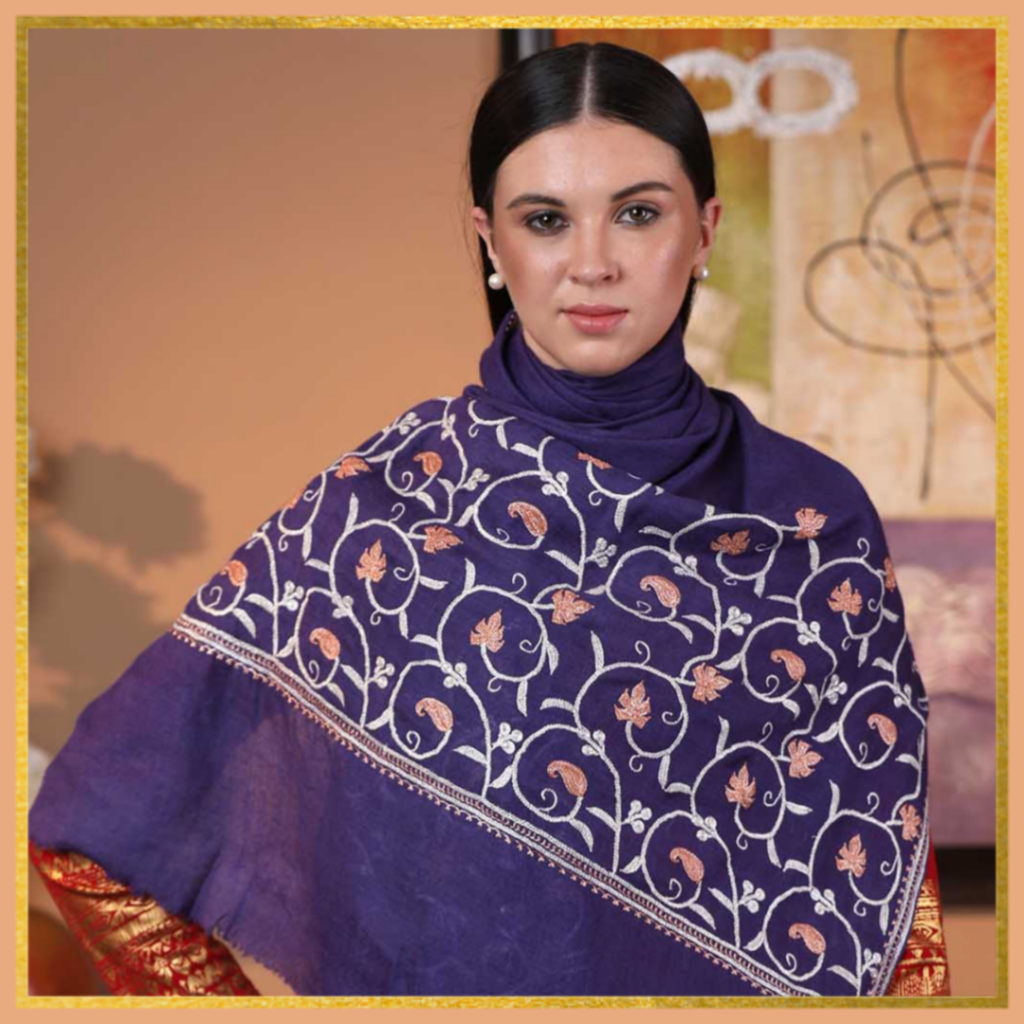
Hand embroidered in the intricacy of Kashmiri Sozni Kari, the shawl hosts a plethora of flowers in a contrasting white
Papier Mache Embroidery
Another type of thread and needle embroidery is the Papier Mache embroidery. It uses thicker threads and protruding motifs to give a deeper, colourful and more artistic effect to the base. These type of shawls are mostly used on special occasions like weddings.
Covered with hues of Kashmiri Papier Mache which transforms the downy base into something extraordinary
Tilla Embroidery
The last type is Tilla Dozi, which is the most elite and royal manifestation of any embroidery indigenous to Kashmir. this embroidery was once reserved for the royals only as it used real gold and silver threads to be passed through Pashmina shawls. However, as time passed, it was made affordable for the general public by using metallic wires coated in gold or silver. Tilla shawls are special and are hence used as gifts for bridal accessories.
Tilla Dozi - the magical art of Zari embroidery casts a magical spell on the Kashmiri Pashmina
This is the end of the journey of a Pashmina. After embroidery, it is passed on to dealers who sell them to the admirers of these classic wrap accessories. People from all over the world have been patrons of this traditional art and have wanted to own at least one piece. Pashmina shawls are considered a social status, as these are heirloom pieces with a huge value.
Popularity of Pashmina Shawls all over the world
Kashmiri Pashmina shawls hold great eminence when it comes to Europe and The United States of America. A number of shawls have been preserved in world-famous museums in these places. Some of them are:
Map Shawl: The exquisite Map Shawl of Srinagar which was handcrafted in the late eighteenth century is considered one of the most amazing pieces of art on fabric to ever exist. This shawl took 30 years in the making. It is presently at the Victoria and Albert Museum in London. This was gifted to them by Mrs. Estelle Fuller in 1970 and the specimen as per the Museum was made in 1870
Another Kashmiri Pashmina Shawl belonging to the 19th century is present at-the-Guimet-Museum-Paris.
A small piece of a Kashmiri Pashmina Shawl from the late 18th century on display at Ashmolean Museum, University of Oxford. the shawl features the ever cherished Buta (paisley) motif.
The Decline of Pashmina
What goes up must come down. When it comes to Pashmina, this expression is absolutely correct. In around the late 1990s, the glory of Pashmina saw a gradual decline, owing to changing preferences, high prices and the usual new styles introduced by locals. Another large decline in the shawl industry was the making of fake shawls. A number of shawl traders started selling pashmina shawls which wouldn't be made from pure Cashmere. They would mix sheep wool, or nylon with Cashmere, yet sell these shawls at the price of Pashmina shawls.
Another large factor for people switching to other shawls was the introduction of machines. The power loom, which was introduced as a competition to traditional handlooms, produced shawls in a few hours, as compared to a few days taken by artisans on a handloom. This would have been a welcome step, hadn't the producers mixed Cashmere with the strengthening fibre to make Cashmere bear the strain of the machine. These shawls, even though produced in less time, were poor quality. A Pashmina shawl lasts for a lifetime, but these shawls couldn't last for 3 or 4 years. This was a blow to local artisans as well as the industry itself. So much so that a time came when already handcrafted products had no buyers.
Soon the world famous Pashmina shawls had almost no buyers, as it lost the reputation of being timeless and having a long life. Women switched to other alternatives like sheep wool shawls, silk shawls, polyester shawls and more. These were much cheaper as well as stylish. This led to a sharp decline in the economic growth of the nation, and Kashmir suffered as a whole. Women were left unemployed, and men were forced to look for other options.
Pashmina - Present Scenario
The present scenario isn't very favourable for the Pashmina industry. A large number of artisans who decided to quit the art form had no successors. Hence a meagre amount of artisans are left, but they are immensely skillful. Realising their skill and unmatched love and reverence for this art form, young individuals re-introduced the art of Pashmina by directly contacting these sellers. Some of them are as old as 80 years, while others, who have learnt from these octogenarians are still in their 40’s. This is the community of artisans left, who are trying to revive the art.
Pashmina.com is one such platform which directly gets in contact with producers of Pashmina shawls, and does not, hence, require the interference of traders, wholesalers or retailers. The best thing about this model is that the returns earned from the shawls go directly in the pockets of these, now underprivileged artisans, who are in desperate need of it. We have managed to sell the shawls at international levels, and hence tried to give the same respect to the artisans
Pashmina and Pashmina.com
A young man in his 30’s noticed the agony of the local Kashmiri artisans and hence decided to give them a helping hand. Varun hails from Delhi, and it was during a religious trip to Kashmir that he realised the art of Pashmina deserves to be revived in the best way. He started Pashmina.com, and sold some luxury pieces online. Soon men and women all over the world followed the same and hence the website as well the industry got a new boost. It has been just 5 years into the business, Pashmina.com has managed to help more than 100 artisans which includes taking care of their families as well.
Varun supports the education of the artisans’ children, as well as employs their wives, who help with spinning or embroidery of shawls, scarves and wraps. The organisation is a proud assembly of artisans, weavers, embroidery artisans, spinners and labourers. All of these members are respected members of the organisation and together make the art of Pashmina better each day. As such, products that the organisation sells are always hand woven and hand embroidered. The designs are modern as well as conventional. The best part of the products is their quality, and the certificate of authenticity attached to each batch of products that come from Kashmir after a stringent quality check at the Craft Development Institute (CDI), Srinagar.
A decade back in time, Pashmina shawls were only seen through a traditional eye. Shawls were considered as heirlooms that were perfect to be worn only on momentous social occasions. In Kashmir itself, which is the hub of Pashmina making, Pashmina shawls were worn by the affluent on special weddings, or formal events, given to daughters in their trousseau, or gifted to a VIP. It was a time when Pashmina wasn't very accessible to everyone and people could painstakingly buy one or two pieces in their lifetime. There was nothing like Pashmina styling because one was a challenge itself. These pieces were then passed on to generations together because Pashmina wasn't a day-to-day wrap accessory. Such shawls were truly heritage pieces because some of them used to be over 30 years old.
Pashmina was never overrated as some modernists would say. It was indeed the cream of the crop. With its smooth touch, delicate feel, cozy warmth, and exquisitely graceful look, Pashmina has been regal since its inception. It is history itself that stands testimony to the fact that no other shawl could ever eclipse the material and the methods used by the highly skilled craftsmen from Kashmir to make a Pashmina. Kashmiri Pashmina shawls have long transcended any other of its imitations or equivalents but surpassed everything and ruled supreme.
Modern Design in Pashmina
Just some years back, the traditional Pashmina shawl got a modern makeover. Now, Pashmina wasn't the same heirloom wrap that had to wait for an occasion to come out of large iron chests where they were kept, but had become a modern day-to-day accessory. Now Pashmina shawls are more than a protective layer in winter. One more reason why Pashmina got modernized was its availability. Pashmina is available in the entire world now (if not in its purest forms). Online shopping websites have large catalogues which list every single type of Pashmina made in Kashmir and make Pashmina styling one of their concerns
Pashmina has been a part of many designers' works now. Designers work over it and try to declare it a luxurious lightweight accessory that is worn in late fall, winter, and early spring. Designers are excited to prove to the world that Kashmiri Pashmina is a versatile accessory that has hundreds of techniques to make, wear, or pattern. In addition to this, the way pastel colours and subtle shades are taking over the fashion world, a pastel-dyed solid Pashmina would never be an occasion favourite. It would naturally fit into a casual wardrobe.
Styling of Modern Pashmina
The more Pashmina got modernized, the more style came into being. Now a Pashmina wasn't only draped across the shoulders but was easily twisted and turned into a neck scarf. It could be worn as a sarong, as a shrug, as a handbag accessory, and whatnot. Gone were the days when Pashmina shawls would hold a somewhat secretive place in a house. Now, these chic accessories are in every casual wardrobe and even worn as daily office wrap. Styling a Pashmina is considered a hot topic with designers giving style tips on how to wear Pashmina, every other day
The question remains, has Pashmina lost its glory. Has it devalued from a timeless heritage piece to just an everyday wrap? The answer is NO! To give it a modern touch was just to prove how timeless and ageless Pashmina is. The heritage pieces which were cherished by Empresses and kings of Europe and India are still there, just that the occasions when you wear them are more special and extravagant.
Now since we have so many varieties in Pashmina, why wear it in just two or three ways. We let loose the fashion diva inside you, to come up with more modern as well as traditional styles to wear a Pashmina shawl or stole. But first, let's check on a few factors that need to be considered when choosing Pashmina
Choosing the Right Pashmina
When it comes to choosing the right Pashmina, several factors can help ensure you select a piece that complements your style and meets your needs. From the quality of the material to the color and design, here are some essential aspects to consider:
Material Quality
The quality of the Pashmina material is paramount. Authentic Pashminas are made from the fine undercoat of the Changthangi goats found in the high altitudes of the Himalayas. This cashmere wool is renowned for its softness, warmth, and lightweight nature. When shopping, look for labels that certify the authenticity of the Pashmina, ensuring it's 100% pure cashmere. Beware of blends or imitations that may compromise on these superior qualities.
Weave and Craftsmanship
Pashminas come in various weaves and levels of craftsmanship. Hand-woven Pashminas tend to be more delicate and intricate, showcasing the skill and tradition of the artisans. Machine-made versions, while often more affordable, may lack the unique texture and subtle imperfections that give hand-woven Pashminas their charm. Examine the weave closely – a tight, even weave indicates machine-made, whereas an irregular weave indicates handmade.
Colour and Pattern
Choosing the right colour and pattern can make your Pashmina a versatile addition to your wardrobe. Neutral colours like beige, grey, and black are timeless and can be paired with almost any outfit. For a pop of colour, consider shades that complement your skin tone and existing wardrobe. Patterns, ranging from classic paisleys to modern geometric designs, can add a touch of personality and style. Think about the occasions you’ll wear it for and select a design that suits your lifestyle.
Size and Weight
Pashminas come in various sizes, from narrow scarves to wide shawls. The size you choose should depend on how you plan to wear it. Larger shawls are versatile, allowing for different draping styles, while smaller scarves are perfect for a subtle touch of elegance. The weight of the Pashmina is also important – lightweight options are ideal for year-round wear, while heavier versions provide extra warmth during colder months.
Care and Maintenance
Consider the care instructions for your Pashmina. High-quality Pashminas require gentle handling, such as hand washing or dry cleaning. If you prefer low-maintenance accessories, ensure you are prepared to invest the necessary time and effort to keep your Pashmina in pristine condition.
Price and Value
Lastly, the price of a Pashmina can vary significantly based on the factors mentioned above. Authentic, high-quality Pashminas are an investment, reflecting the craftsmanship and materials used. While it may be tempting to opt for cheaper alternatives, investing in a genuine Pashmina ensures you receive a luxurious, durable, and stylish piece that will stand the test of time.
Choosing the right Pashmina involves balancing quality, style, and practicality. By considering these factors, you can find a Pashmina that not only enhances your wardrobe but also offers comfort and elegance for any occasion.
How to wear a Pashmina - Pashmina Styling in Solids, Ombre, Patterns, and Prints
If your Pashmina falls under one of the above categories, then know that you have a hundred options of modern Pashmina styling. Also, you already know how to wear a Pashmina in solid, ombre or prints, as these aren't heavy but easy to carry. A solid wrap would mean a plain Pashmina without any embellishments. An ombre Pashmina is dyed in bright shades in an ombre pattern, a patterned Pashmina is designed in modern checks, stripes, or abstract art patterns, and a printed Pashmina features modern prints or monogrammed designs. If you own one of these, here is how you can style them.
How to wear a Pashmina like a scarf
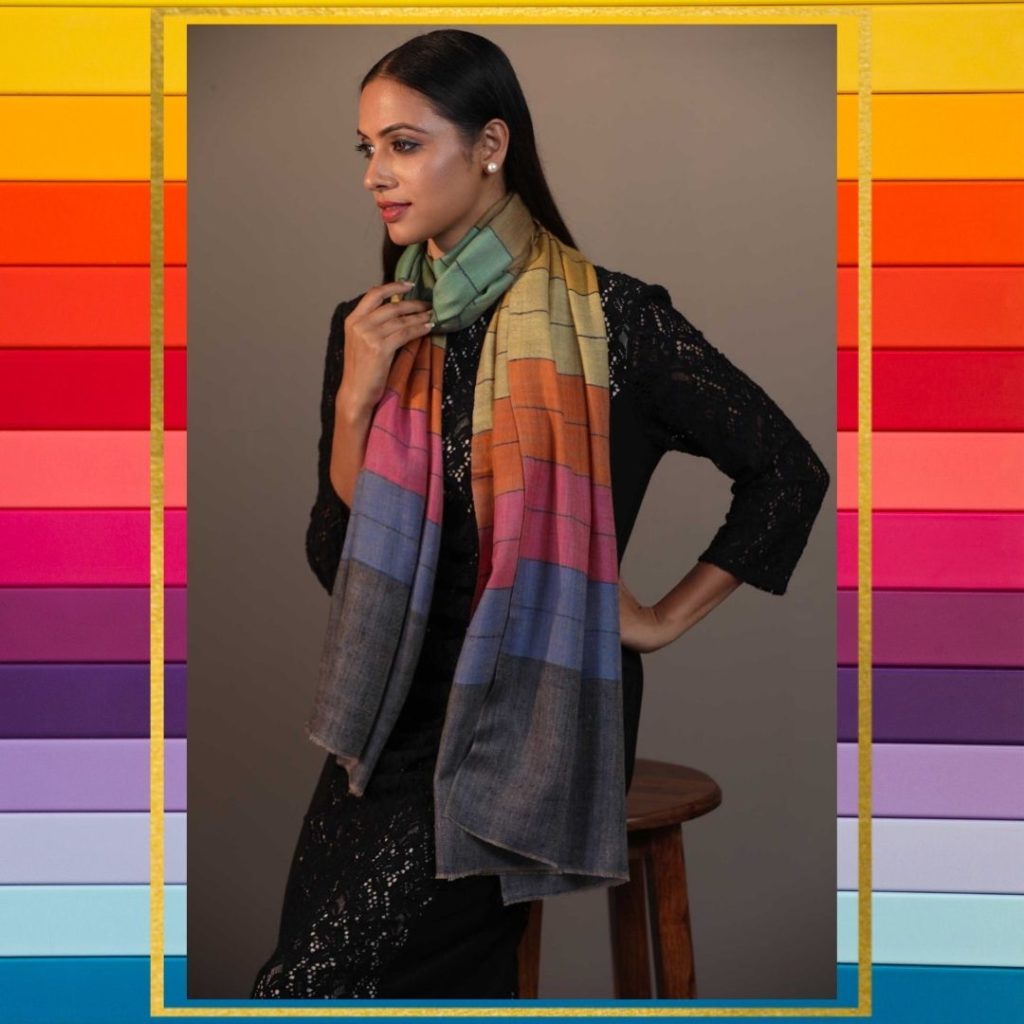
Handwoven with utmost rescission, the wrap hosts motley stripes of rainbow shades, all standing in a perfect order
Since your modern design Pashmina features a beautiful colour, it's time to pair it up with a pastel-shaded outfit or vice versa. The first style would be to throw the shawl over your collar with one end longer than the other and bring it back from the other side. Adjust the ends so as to make them equal length. Now your shawl looks more like a scarf and you are well protected from the chilly winds outside. This works well with short length shawls or wraps.
How to wear a Pashmina at the waist
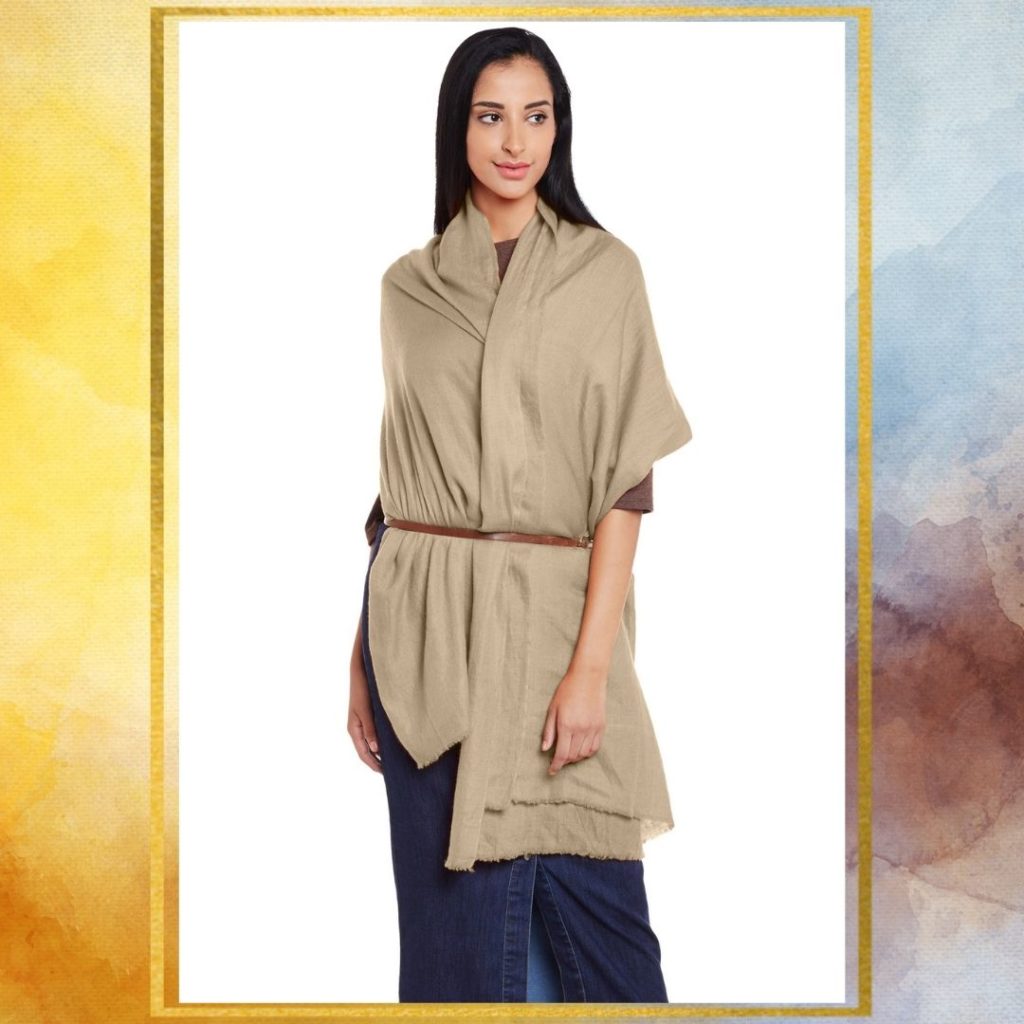
A Kashmiri Pashmina shawl, handwoven in a solid pattern, is ready to make your winter days more fun and stylish
This method of wearing a shawl works best when your outfit is of a complementary colour. Drape this luxury shawl over your shoulders and secure it at the waist with a trendy slim belt. You can add more layers of a long coat or sweater and you are done for a contemporary day.
How to wear a Pashmina in a knot over the back
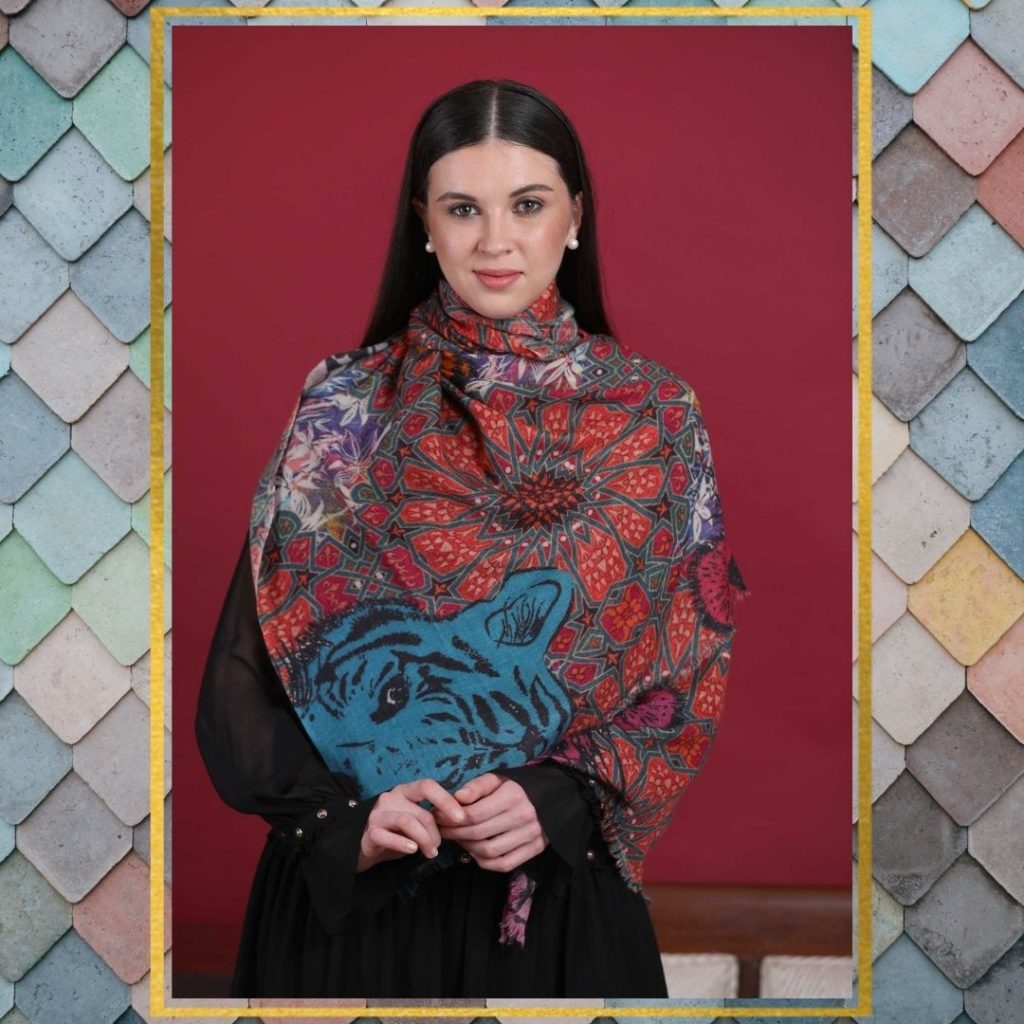
The Cashmere wrap accentuates multicoloured patterns of Indian flora and fauna amongst a warm hued base
The style of knotting a Pashmina at the back works well when your shawl is full with prints or patterns so that you can show those off easily. Also, wearing a shawl in this way would cover your top front fully to make it the first thing your friends will notice. Wear your pashmina like a dupatta and tie a knot at the back. Perfect to wear with your skirts with not so boost worthy tops
How to wear a Pashmina as a shawl
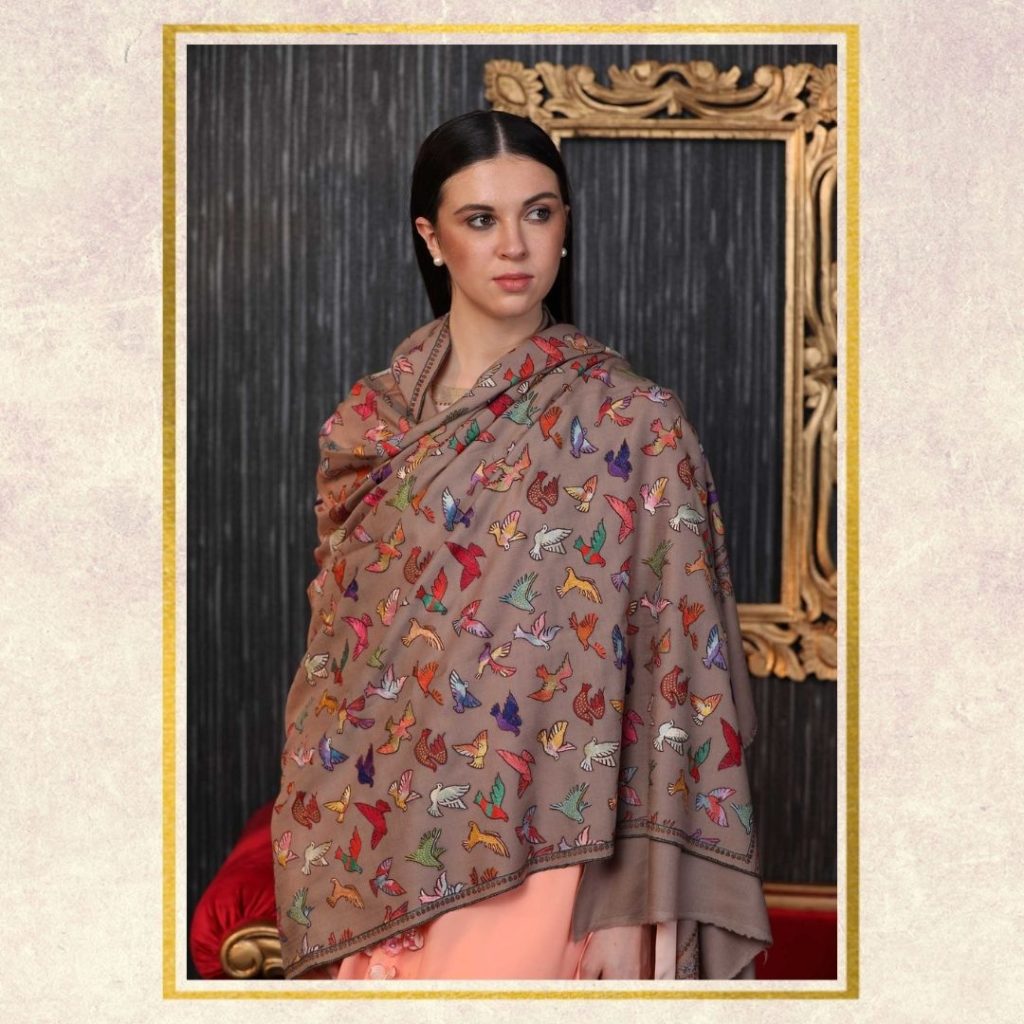
Kashmiri Pashmina has from times immemorial been considered an epitome of class
For those who wear Pashmina just because it is made from Pashm threads which are warm enough to keep frosty winters at bay, this style might be the perfect one. Drape the luxury shawl around your shoulders and throw one end over the opposite shoulder to keep it intact.
Wear your luxury shawl in a casual way
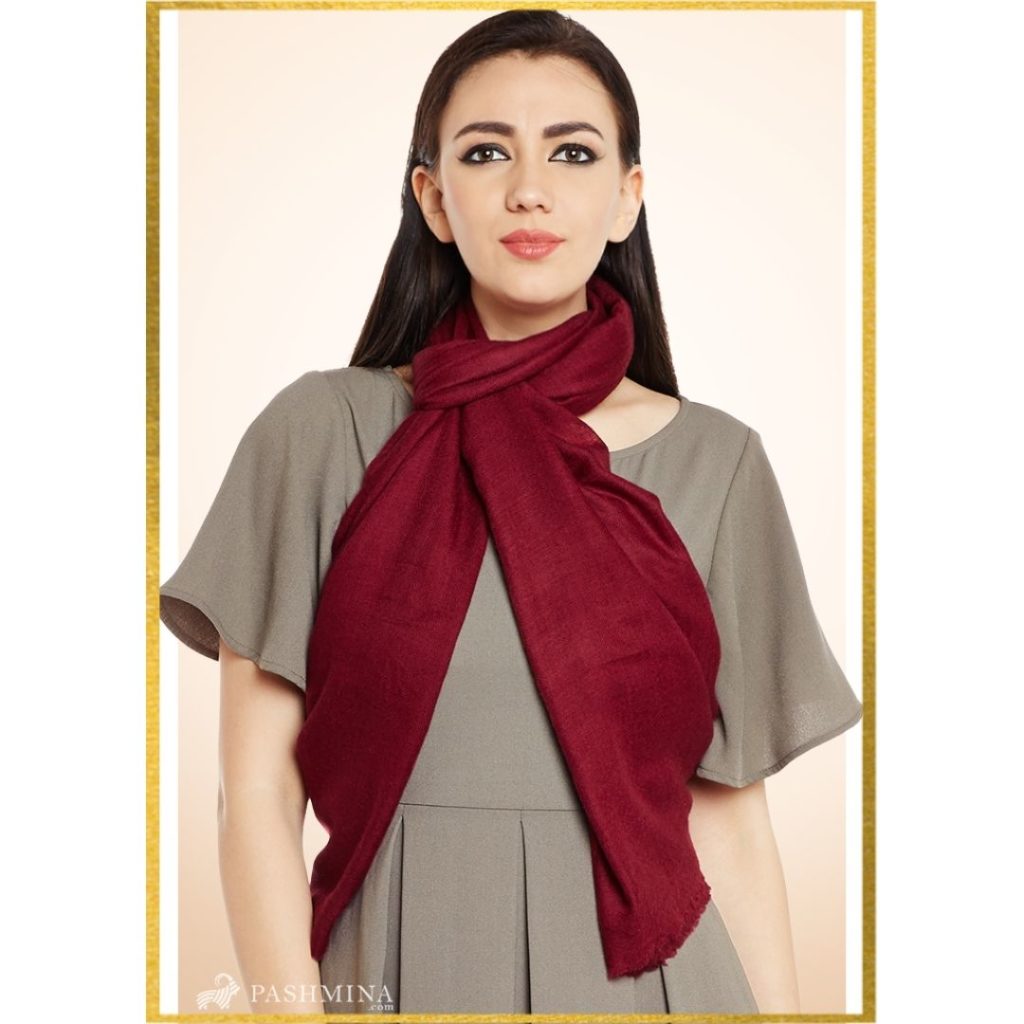
Handmade Burgundy Pashmina Scarf
Fold the Pashmina in half and tie it around your neck. Bring the loose ends together through the loop at the other end and pull them tighter for a perfect fit. This style works best when you are wearing a western outfit. You can let the ends hang over the front or tuck them inside a sweater or coat.
Tie like a Tie
Slide the wrap around your neck and hold both ends together at equal lengths. Tie a knot over one side and pass the left side through it. Tighten the knot or a snug fit. You are perfectly dressed for the office, casual days, or a lazy winter weekend day out.
How to wear a Pashmina like a headscarf
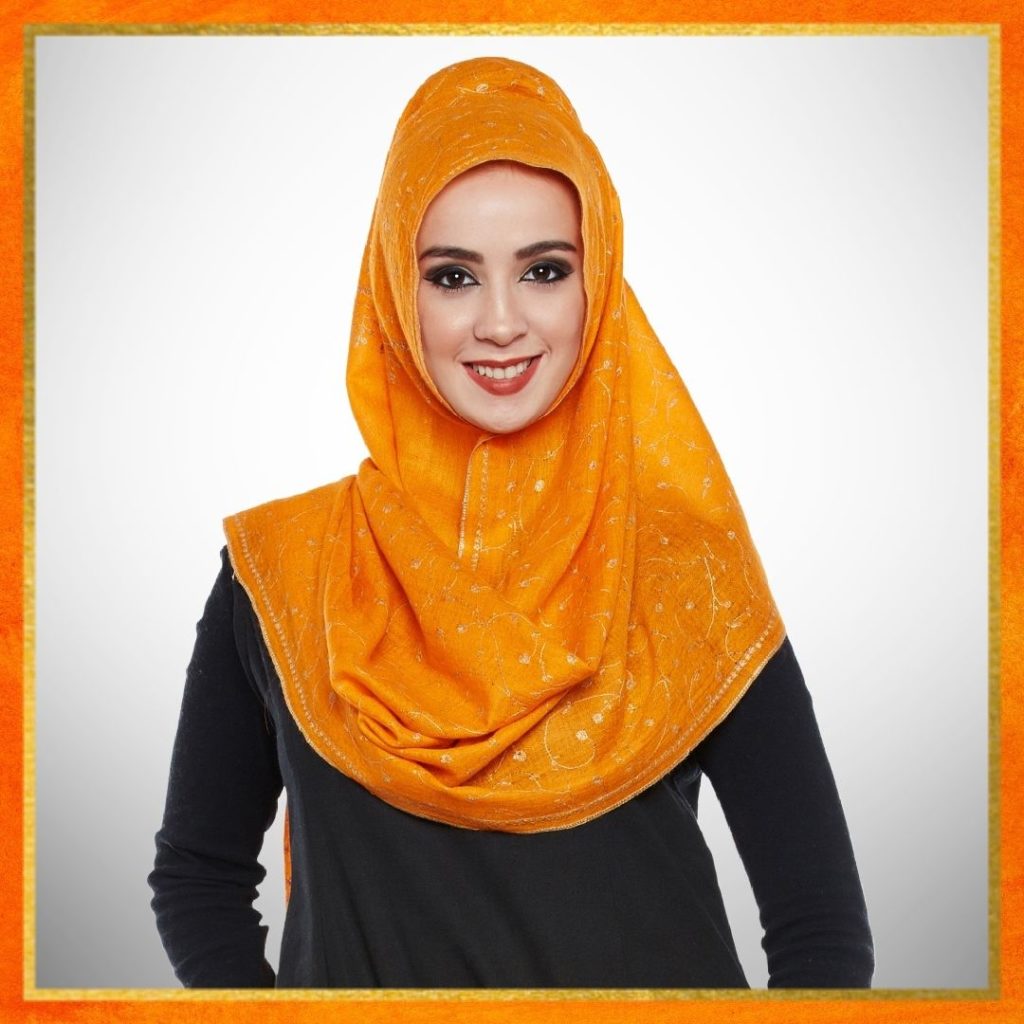
The enthralling golden filigree motifs adorning the radiant orange pashmina base
Place one side of the shawl over your head and throw the other side over your shoulder. You can also cover your head with the middle portion of the Pashmina shawl and tie and knot by the other two ends near your nape. If you do not prefer to cover your hair, you can fold the shawl in half so that the hair still shows.
Wearing with collar layers
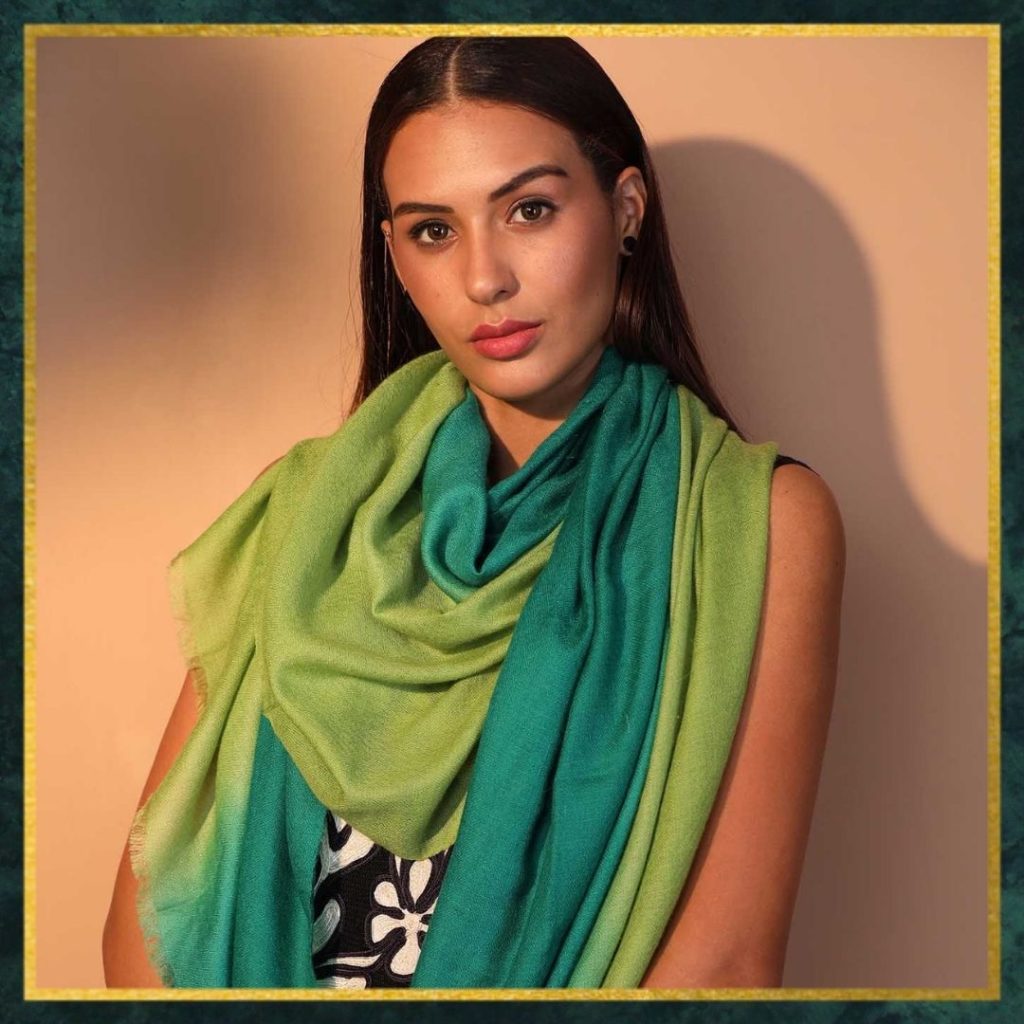
The Cashmere wrap features colours merging into each other in an ombre design to fill your winter days with charm and comfort
If you are wearing the Pashmina with a collared sweater or coat, you can fold it twice lengthwise, drape it under the collars over your shoulders and let the ends loose over the coat.
Just for the shoulders
The pristine White Mountains, slowly turning a bright red as the sun sets among them
Throw the wrap around your shoulders with both ends at equal length on your front. Place the corners of both ends over the opposite so that your top is visible and the shoulders are mostly covered. This style works with plain dresses and bright shaded Pashminas.
Brooched Pashmina Styling
Bring a touch of vibrance and colour to your winter wardrobe with a handpicked Pashmina shawl
Turn up the shawl in half around the right side of your body and pin the two parts with a brooch over the left shoulder to prevent it from falling off. Do not tie it too tight or you won't be able to move your arms freely. This pattern is again perfect for the wraps which are filled with prints or patterns.
Tie in a diagonal
You can tie your luxury shawl across your body and bring both ends over the opposite hip to pin them there with a beautiful brooch.
Roll around your neck
This sophisticated style of wearing a Pashmina is ideal when you do not have enough time to dress up and you are in a hurry. Just take one end of the shawl and roll it around your neck till you reach the other end. Tuck the other end under the already-formed layers and you are good to go.
These aren't the only styles in which you can drape a modern Pashmina. You can always be your own personal fashion designer and invent more patterns to wear this accessory.
Traditional shawls with heavy embroidery patterns however are heavy to be tied into knots and brooched. The artistic embroidery patterns that expertly skilled craftsmen have done need to be flaunted as much as possible. Their styling is totally different from modern ones. Let's take a look at some of them
For Embroidered, Kani weave, KalamKari or Embroidered Reversible shawls
Since you have invested a lot in buying this category of shawls, why not to drape it in a way that shows all of it.
How to wear a Pashmina - Pashmina Styling of Traditional Shawls
The traditional Pashmina gets a surprise modish twist when it gets handwoven in the Do Rukha or reversible pattern
The most common way is to style Pashmina across your shoulders and let the loose ends hang at the front. This way the rich pattern of the shawl will be fully visible from the front and back and you will look the epitome of graceful styling.
Another method is the one-shoulder drape. Just look for the lengthwise middle of the Pashmina shawl over its border. Place this portion of the Pashmina shawl on either of your shoulders and let the rest of the shawl loose over the front and back
One more fashion in which a heavy shawl is worn is to drape the shawl around your shoulders and throw one end over the opposite shoulder to keep it intact.
You can also try styling the Pashmina exactly like a dupatta with all the base showing over the front and the ends resting over the shoulders. This way the entire adornment of the shawl is the first thing people notice in your winter looks.
How versatile is this one piece of wrap accessory? It can take the shape of a shawl, wrap, scarf, or hijab, and not lose a bit of its exquisite elegance.
As mentioned earlier, Kashmiri Pashminas were only worn on very special occasions or major events. But since it has adapted to our everyday fashion needs, let's take a look at how Pashmina serves us at almost all times.
Pashmina Styling - Wedding looks
Nothing can beat the graceful demeanour of a traditional handmade Pashmina shawl when you have to attend a wedding ceremony. The best ethnic choices at weddings will definitely be a Kani Pashmina shawl, a Tilla embroidered shawl, a Kalamkari shawl, or a full work (Jamawar) Papier Mache embroidery shawl. When such heritage pieces are paired with your carefully shopped ethnic ensembles, you will for sure be the star of the night.
The intricate and meticulous intervention of Kani bobbins, which fill the base with a shower of colourful blossoms
If however, you aren't wearing ethnic apparel, a Laced Pashmina will definitely do justice to your western outfit.
Pashmina Styling for Casual Looks
Some decades back, no one would believe that we are wearing Pashmina to a casual get-together or a casual day out with friends. But from the day Pashmina got acquainted impeccably with chic prints and modish patterns, they became an almost inseparable part of an everyday winter getup. Give your casual outfits a luxury finishing touch of a printed or patterned Pashmina shawl and watch your friends delightfully surprised.
Styling Pashmina for Office looks
For those who want to carry a formal look, yet display a nonpareil sense of styling, solid and ombre Pashminas have got your back. A basic and neutral shaded Pashmina wrap can easily be paired with well-cut pantsuits. Or else an Ombre Pashmina can blend seamlessly with those Collared button-up shirts which are subtle in colour. Pair these colour-filled Pashminas with your formal attire and stay warm and classy.
Bridal Looks Pashmina Style
Over the resplendence of Kashmiri Pashmina, the afterglow of the summer sun in the form of Zari embroidery creates a magical aura
At least in Kashmir Valley, a bride's getup is considered incomplete if it is not given the finishing touches of a luxury shawl. The Pashmina shawls chosen for this blissful purpose are either a Kani shawl or a Sozni embroidered shawl. It is often chosen in a subtle colour (mostly white) to perfectly compliment the warm-hued bridal ensemble.
Pashmina as a gift
It has been a culture in Kashmir for a mother to gift her bride-to-be daughter a Pashmina shawl as a treasure token from her heritage collection. A Pashmina from a mother to her daughter would symbolize affection and everlasting love. In fact, a bridal trousseau was considered incomplete without the inclusion of a few Pashmina shawls.
The Perfect Gift for your loved ones
For a bride, embroidered and Kani shawls are considered the best options. Alternatively, a bride might choose a few more types that go with her bridal dresses.
Caring for your Pashmina
Now we know that one Pashmina can bestow us so many looks - modern and traditional - and we are more and more in love with this exquisite piece of ‘soft gold’. And since we want it to be a part of our lives for years and years, its ultimate care becomes quintessential. Hence it's not just styling a Pashmina, but caring for it is a major concern
Pashmina is a delicate and soft fabric and so beautiful and warm that we will definitely want to preserve it and pass it on to generations. But since the fabric is exceptionally fragile and sensitive, it is to be properly handled and cared for, because if done so, a Pashmina will last for ages and in fact age gracefully without losing a bit of its regal demeanour.
So the question remains, how to care for a fabric that is so gentle and delicate. Here is a list of tips from the experts and makers themselves, which when stringently followed ensures your Pashmina remains intact for a lifetime.
Washing
Fortunately, natural fibres do not need too much washing, unlike their synthetic counterparts. Hence it becomes easier to take care of your Pashmina since you do not have to do this much often.
Never wash your Pashmina in a washing machine. Make sure you hand wash your shawl or wrap in cold water and a mild detergent or baby shampoo. Do not bleach Pashmina products as they can cause damage.
Never wring or twisting your Pashmina to remove excess water. This can alter the shape or cause a deformity in the weave. Let the water pass naturally and gently.
Drying
Do not hand your Pashmina for drying. This can alter its shape. Lay it flat on a cloth dryer or a dry towel.
Never expose your Pashmina to direct sunlight. Allow it to air dry. Do not place Pashmina in a cloth dryer.
Ironing
Do not iron your Pashmina directly. Place your shawl in between two towels to smoothen the wrinkles away.
Iron your Pashmina on medium heat.
Storing
Always fold your Pashmina neatly and wrap it in a non-archival tissue paper or muslin cloth.
Store in a dust-free, well-aired place. Make sure the place is free of moisture and heat. Direct sunlight and a damp environment can be harsh to your precious piece.
Make sure the string space has no place for moths to enter or grow. To prevent moths, use aromatic cedar chips or naphthalene balls.
Everyday care for Pashmina
Avoid wearing the same shawl every day. Let your precious accessory rest for 2-3 days before you wear it again
Avoid wearing a Pashmina with rough outfits and metal jewelry as it can cause pilling. Pills are the tiny balls that start to accumulate on your shawl especially in the areas where there is friction. If at all pilling appears, use a cashmere comb to remove them gently.
Let your Pashmina breathe occasionally. Hand it out in a shaded spot to get some fresh air. Let the exquisite fibres freshen up, shed the folds and creases, and recapture their pristine weave.
Over an altitude of 15000 feet above sea level, in the rough mountainous terrains of Ladakh, the Changpa goats are found. Evident and unmistakable they are. Fresh as if just born, white, like the snow-covered mountains surrounding them, and soft as velvet and silk, in fact, even more, the Changpa goats have long adapted to the rough terrain and the beautifully cruel and rough landscapes do not affect their splendor a tad. Their unmatched beauty is a hint enough for the visitors to understand where a Pashmina shawl comes from.
Breeds of Pashmina Goats:
Its not just the Changthangi goat of Ladakh that produces Cashmere wool. Cashmere goat has more breeds which belong to other areas in the Himalayas. These goats too produce Cashmere, just not of the superior quality like Ladakhi goat does.
Malra goat: Malra goats are found in the Kargil area of Ladakh.
Chegu goat: Chegu goat is found in Himachal Pradesh - North India
Chyangra goat: The Nepalese Pashmina goat Chyangra too produces Cashmere wool.
The Nomadic Tribe of Changpa
The high living species of goats belong to a Buddhist Nomad tribe of Ladakh, the Changpa tribe. Their main occupation remains to rear a small herd of the purebred Capra-Hircus/Changthangi/Changpa goats for 500 years. The Changpa tribe cares for their goats in the best way possible. And it's not for their meat or milk primarily, but the “soft gold” that they grow naturally over their underbelly. The Pashm - whose softness and preciousness even left the 16th century Mughals royals smitten.
The Changpa goats and the people who invest their lives in them, both live on this relatively disconnected paradise, over the top of the hills. This lifestyle of theirs remains relatively unchanged for over 400 years now. Even if traditions and fashions have drastically changed in the lower part of the world, the Changpa tribe remains clung to their own lifestyle, religion, and beliefs.
The plateau, which carries the nomads, their goats, and the birthplace of Pashmina isn't quite luxurious as one may imagine. It stretches across 1600 kilometers from the west to the east, and just one-third of it lies in India. There are days when the area freezes at -40 degrees. It leaves the area cut off from the entire world for even 9 months at times. Even after such difficulties and hardships, the Changpa tribe masters the art of surviving with their pedigreed goats.
Changpa and Pashmina
Pashmina, or what they call it in the west - Cashmere - was introduced to the world in 1664. It was when Francois Bernier visited Kashmir and discovered the beauty of Cashmere. He somehow managed to get a Pashmina shawl which inspired awe in the Europeans, especially the affluent ones. They were fascinated by the fact that this shawl had been woven out of Pashm. And by the looks of Pashm, it seemed impossible to collect, clean, weave, and embroider.
What actually happens over an altitude of more than 14000 feet, is so divine. The Changpa goat grows a unique and extremely soft inner coat called “Pashm”. Pashm literally translates to soft gold. It grows over the underbelly of the goat to protect it from harsh cold and freezing temperatures. As soon as summer arrives, the Changpa goat rubs itself against rocks or some shrubs. Hence it leaves behind the ever cherished fleece - the Pashm. This fleece called ‘Asli Tus’. It is collected manually and sold to the patrons who are well aware of its value and exquisiteness.
This raw Pashm is 6 times finer than a human hair. Its average fibre length is 40 mm, average fibre diameter being just 14 microns. Even then, Pashm is considered the warmest natural fiber. Hence used to make the coziest Pashmina shawls, stoles, wraps, or sweaters.
Even with such a growing demand, especially for the Pashmina shawl, the people of Changpa have never compromised on quality. The fibre, therefore, obtained from this tribe is the purest. It is also superior to the one obtained from the same breed of goats from other parts of the world like China, Nepal, Tibet, etc.
Where is Pashmina Shawl made? | Pashmina and Kashmir
The story of Pashmina and Kashmir begins as soon as raw Pashm reaches the valley. The weaving of raw Pashm starts here, in this picturesque valley nestled in the grand Himalayas. It is said that this tradition of Pashm weaving was started by Sultan Zain ul Abideen, with the help of a Turkish weaver Naghz Geg. Geg who was famous for his skill and expertise in the same, Kashmiri locals were trained.
After the Pashm yarn is woven over handlooms, the downy shawls so obtained are washed over the Jhelum river. It is for this exquisiteness and regality, Pashmina shawls became famous in 18th century Britain. It is believed that the shawls were exported from Kashmir through the East India Company at outrageously high prices.
From Birth to Maturity: Lifecycle of a Pashmina Shawl
From its birth when it is just raw Pashm threads to an opulent and colourful shawl, Pashmina treads a complicated journey of 4 processes:
Pre Spinning processes
Spinning
Weaving
Embroidery and Finishing
Pre Spinning Processes
These processes start when the Changpa goat naturally sheds the Pashm. It is later dehaired manually to free the useful material from the guard hair. The fibre is combed to separate impurities from it which includes dust or some vegetable matter. Later pounded rice is glued to the fibre to make it a bit strong and soft. This raw fibre concoction is to be combed again after two or three days.
Spinning of Pashmina
Spinning is the process when the cleaned Pashm is converted into the required yarn count. It's the yarn that is further processed over looms. Spinning is usually done over a wooden Charkha locally known as Yinder. It is women from remote areas who are mostly associated with it.
Weaving a Pashmina Shawl
Mounting the material over large wooden stands, making the warps manually, fixing the warps over a wooden handloom and a few more steps in this process lead to the woven material, which still is not complete
Finishing a Pashmina Shawl
This step consists of clipping extra hairs, washing, dyeing, ironing and embroidering the Pashmina shawl (which has its own set of processes). This marks the end of the process, and a beautifully designed Pashmina shawl, now complete, ruffles in sheer grace and grandeur.
Let us discuss the processes in detail
Pre Spinning
The first process in Pashmina making involves pre-spinning processes which include activities responsible for converting raw Pashm into one which is easier and less complicated to manage further. Let's study the processes in detail:
It is believed that in the making of Pashmina shawl, sometimes as many as 200 men are employed. And why not so. The number of processes and the masterly skill it needs to be completed wouldn't require any less. The pre-spinning process starts with the initial harvesting of the Pashm.
Harvesting
The very first phase in Pashmina making is harvesting. Changpa goats usually shed or molt the fleece (which it no longer needs as the winter season has gone) in the spring season - from mid-March to May - and hence the Pashm fleece is collected during the same period. It is calculated that each Changpa goat produces 80 to 450 grams of Pashmina per year. And hence, for one Pashmina shawl, it would take the fleece of three goats. The male goat (buck) sheds more fleece than the female one (doe).
Before combing the goat to acquire Pashm, the experts note if the goats are combing their own selves naturally. Sometimes the goats run around in the bushes and shrubs, sometimes they rub themselves against rocks and rough fences, thereby leaving the soft Pashm over these natural surfaces. But since this natural process does not clear the goats of all the burden they have been carrying for months, the experts switch to professional tools like combs and brushes to acquire the fleece. Natural Shedding is not enough for the making of Pashmina
Combing off the dust and debris over the fleece, the Combing experts use a combination of a pin brush, a slicker brush, and a natural bristle brush to comb the backbone, across the ribs to the belly of the animal which loosens the Pashm fibre and it naturally separates from the goat’s body. The expert works in this way, all over the goat's body, one side at a time and it takes not less than 30 minutes for the most skilled person to complete combing one goat.
The Pashmina fibre so acquired is full of impurities like dust, vegetable remains, sand particles, and much more which needs to be separated from the fibre in the next processes to come.
Dusting and Combing
Before sorting the fibre according to the quality, the raw Pashm goes through dusting. Dusting is a process that makes sure that sand and dust separate from the actual material. It is believed that sometimes there is a loss of 20% of Pashm in this process. That is because, with the impurities, fine particles of Pashm also tend to be lost. And since their size is nanoscopic, they never come back. Hence a loss is tolerated in the making of Pashmina, but impurities are not
If the impurities are too many, then a metal comb upright over a wooden stand is used. Over it, Pashm fibre is continuously impaled three to four times until the tuft seems cleaner. The process is also known as carding - as the fibres get separated and straightened. Nowadays carding is done through machines and wooden combs are the least used.
Sorting and Dehairing
Sorting and dehairing is a manual process in the making of Pashmina. It includes sorting the fleece according to the quality and length of the Pashm fiber and then separating the guard hair from the useful one. Raw Pashm consists of 50-60% guard hair. And since the guard is much rough and coarse, it needs to be carefully eliminated from the actual Pashm fleece. This is either done manually by the womenfolk or with the help of specialized machines which consume less time for the dehairing process to complete. It is said that this rough guard is also stored by the tribes for personal use.
Glueing
This is a crucial step in Pashmina making where the fibre is mixed with natural glue to lend more strength to the fibres. Usually pounded rice mixed with water is added to the fibre tufts and kept stable for 2-3 days. This gives it strength, moisture and extra softness (rice water is used because it is water-soluble and can be easily washed away later. This Pashm is then cleaned again to get rid of the rice particles in it. The resulting clean and strong Pashm is given a round or square shape known as Thumb.
This Thumb is the part of the Pashm which is taken to handspun over Yinder - the classic charkha. This is the next step to the completion of the ever loved and ever cherished Kashmiri Pashmina shawl. The spinning of the Yarn is the most meticulous and sensitive activity to do. But since Kashmiris have mastered this art from times immemorial now, it seems effortless and easy for the womenfolk. Note that it is the womenfolk, who come from the remotest areas of the Kashmir valley to collect the thumb from the sellers. And spinning this thumb into fine yarn becomes an everyday activity for them.
Spinning fibres of a Pashmina shawl
The process of spinning Pashmina starts with the Thumb, which is the end result of pre-spinning activities. This thumb is handed over to women, who convert these downy puffs of Raw fibre into required yarn count over a traditional wooden charkha locally known as Yinder, to make it suitable for further use.
In the hand spinning method, a small portion from the tuft of fibre is held between two fingers and thumb. The spinner turns the charkha wheel with her right hand, raising and lowering the left hand which carries the fibre, in perfect sequence and rhythm. This part of spinning is the most crucial because if the spinning of charkha is not in line with the movement of the hand, the fibre will break. Next, the resulting yarn is spun over a light holder called Phumblet or a grass straw. The spun yarn is transferred from two of these light holders to a wooden reeler and hence the thread is doubled. At last, this doubled yarn is transformed into hanks, over a wooden reeler locally known as Yarandol and sent to the next batch of craftsmen who weave it into a shawl over looms.
Machine Spinning
In modern times, Pashmina's making has gone through some changes. Spinning the Raw Pashm in a machine is the modern alternative to hand spinning over Yinder. To enhance the production and lessen manual errors in spinning, Pashm is sometimes spun over a semi-automated spinning machine. The spinners add a component fibre (usually nylon) with the Pashm so that it can bear the harshness of the machine. Later, when a shawl is complete, the processors remove the added component fibres by treating it with commercial grade hydrochloric acid, and the resulting shawl is just pure.
Hand vs Machine
It is Hand spinning that is preferred over machine spinning when it comes to the making of Pashmina. Hand spinning makes the Pashmina shawl softer, more lustrous, and carries the tag of being handmade, which in itself is a luxury. Also, when the machine-spun shawl is treated with acid, it weakens the fibre and the overall process becomes less cost-efficient. Hand spinning, on the other hand, is quite a painstaking task that ensures no additions. It requires immense endurance, perfect know-how, and focus to deal with threads that are 14 times thinner than a human hair. However, for the onlookers, this process is an absolute delight to watch.
The Journey of Handmade Pashmina shawl
While the world glorifies the end product, we went in-depth into each step of the journey. It starts from the underbelly of a Changtangi goat and ends being the crown of a woman’s wardrobe. Starting from the acquisition of the Pashm, and then spinning, the next path that the fibre has to pass through is its weaving. While women are associated with the spinning part of it, it is the men of the family who undertake the weaving part. And hence all members of a family here in Kashmir get involved in the making of a Pashmina.
Why does weaving of Pashmina shawl take so long?
Weaving the fine Cashmere to produce Pashmina shawls is not an easy task. It is a labor-intensive process that takes 5-7 days to complete. Artisans sit for 8-10 hours manually weaving the delicate yarn together to form luxury wraps. Weaving is not just one activity. It consists of a number of steps, the end result of which are opulent Pashmina shawls. Following are the steps of weaving a shawl, which showcase the meticulous efforts and skill of artisans. These steps answer the question "Why weaving Pashmina takes so long"!
Weaving Pashmina
Pre Loom Stage
We all know that weaving starts over a loom and that's where the fibres of Pashm finally become a shawl. But before getting to the loom, the fibre, which is right now in the shape of hanks after getting spun over yinder, goes through a number of pre loom activities thereby associating more labour and more hard work with itself. Here is a detailed description of what happens to the fibre, before it reaches the loom, in the making of a handwoven Pashmina
Opening the hanks is the first and foremost activity which is done after the spinners of Pashm handover the Pashmina yarn to weavers. The thread is stretched over thanjoor, large wooden stands comprising of two straight wooden rods and a base. When the yarn gets perfectly stretched as if required, it is next passed on to a prech, which again is a wooden structure around which the yarn is spun. If the yarn needs to be dyed, it is dyed at this stage and is hence is sent to a dyer (rangrez) who uses natural dyes for it. After dying, the Pashmina yarn is again wound on the prech and this process is locally known as Tulun. So now what we have are a number of prech over which the Pashmina yarn is wound.
Yarun: Stretching the Pashmina Yarn
A few of these prech are next, taken outside of the room where four to six rods are driven into the ground in a straight line, at regular intervals. Two men work together by moving back and forth to wind the yarn from the prech around these iron rods by using thin sticks called yarun wej. This process is known as yarun. In this process, the crossing of yarn at each turn is crucial as it can easily get tangled if not properly turned. Over a thousand threads are in this way wrapped around these rods to form warp (locally called yaen) which is considered enough for 4-6 handwoven Pashmina shawls.
Over the Loom: Birth of a Handwoven Pashmina shawl
It's time for Pashmina yarn to meet the loom now. From the iron rods, the yarn is again collected and handed over to the wrap dresser locally known as Bharangorr, who starts fixing it onto the heddles of the Pashmina handloom. Even this process is so complex that it takes more than 5 days for each thread in the saaz (heddles) of the handloom.
The handloom is made of wood, with a bench on which two people (one who passes threads from behind and the other who pulls it through the loop) can comfortably sit. The threads have to follow a specific order according to the weave(diamond, herringbone, or twill). And thus the weaving of Pashmina threads into a shawl starts with the clanking of the handloom. It so happens sometimes that the delicate threads of Pashmina break during the process of weaving. But that is not a problem since the weaver has a veil of threads hung in front of him. He quickly picks another longer thread and uses it instead. During the weaving process, a 10% wastage is completely acceptable.
In the making of handwoven Pashmina, a shawl has been woven but still incomplete. It is known as thaan. Owing to the sumptuousness and gossamer texture of the thaan, it is washed in cold water and a herbal soap or reetha is used.
Finishing of the thaan
The thaan we get after weaving of the threads over the loom is still not complete. Some superfluous flaws, attached threads, or other imperfections need to be corrected before the shawl is sent for embroidery. Hence, it is sent to a purzgar, who clips, tweezes, and brushes off any waste material attached to it. He does this with the help of a wooden frame which consists of two rollers above and below. The shawl is tightly attached over the rollers so that the base is clearly and closely visible. This makes its finishing easy and flawless. This handmade shawl can be finalized by following the below steps
Use of Kasher over the smooth base
Rubbing the thaan with the rough core of gourd, bitter gourd, or a maize cob known as Kasher, makes the surface smoother. It also frees the fabric from surplus threads.
Washing the Handmade Pashmina
The thaan is sent for washing to an expert Pashmina washer. He washes the thaan in running spring water by continuously striking it with a hard surface. Cemented structures or simply stones can be used
Drying the luxurious fabric
The fabric is either wrung in a hand-operated spinner or simply spread left stretched for days together in the sun.
The shawl is finally sent for calendaring. Here it is stretched, ironed, and packed into plastic packets ready to meet its seller.
Dyeing and Embroidering Handwoven Pashmina
Depending on the color of the hair of the Pashmina goat, Pashmina is naturally ash Grey, White, Black or muddy and cream colors. But these can be dyed in any colour or shade, as per the requirement
If the shawl needs further processing like dyeing or being embroidered, then it is again sent to dhobis. They use less harmful natural dyes for a safe and beautiful final piece. Embroiderers embroider the shawl with hands because the base is delicate and cannot bear the stress caused by machine embroidery.
Pashmina is timeless. Its finesse and rarity makes it one of the most unique treasures in the world. Pashmina shawls are expensive, but as we apprehend the processes which lead to its completion, we know it is a must buy and worth our attention, reverence and admiration.
Pashmina refers to the exquisite art of handcrafting warm luxury wraps and apparel from Cashmere wool. The word Pashmina originates from 'Pashm' which translates to soft gold. Cashmere wool is processed in a series of steps, and each of them is painstaking and meticulous enough to make Pashmina scarves expensive. But those who back traditional art and heritage craft do not concern themselves with the prices but focus attention on the processing part of it. For those who don't know much about the processing, here is a detailed beginner's guide to Pashmina scarves.
Origin of Pashmina scarves
Pashmina comes from processing Cashmere. Cashmere comes from a goat which is found in the high mountain ranges of Ladakh. It is a place called Changthang which lies over 14000 feet above sea level and houses this rare goat, reared by herders. It is this goat whose wool has been long utilized to craft luxury shawls, scarves, and other accessories. The goat grows Cashmere as an undercoat over its underbelly, throat, and more sensitive areas. It is this wool that is painstakingly combed off gently by professionals and herders together. The process is completely ethical and no animal is hurt during the entire process. This hair is sent all the way to Kashmir, as Ladakhis do not have the expertise to process raw wool.
Changthangi goats in Ladakh
In Changthang, the temperature goes down to -40 degrees C. To survive such a bitter temperature condition, the goats naturally grow Cashmere which is so warm that they freely roam around. It grows as a down coat in the Winter season and sheds naturally in Spring.
Pashmina scarves: In Kashmir
As soon as raw wool arrives in Kashmir, it is handed over to experienced women who begin with cleaning the raw hair. Pure Cashmere is separated from dirt, vegetable remains guard hair or any other foreign material attached to it. The wool consists of impurities because goats roam all over the Changthang region. This includes places like hilly mountains, rough dusty roads, in addition to their own food materials getting attached to them at times. Cleaning the wool gives us pure threads of Cashmere which are soaked in rice water for three days to lend them extra strength and make them smoother than before.
Spinning of Raw Wool
To start with, Cashmere threads are removed from the rice powder mixture and cleaned again to get rid of the same. Raw Cashmere is in lumps and needs to be processed to refine it. This is done over a wooden Spinning wheel known as "yinder" locally. Lumps of wool are transformed into the yarn over this spinning wheel. Note that the yarn so produced is delicate, fine, and extremely soft. The diameter of this yarn is just 12-16 microns and sometimes barely visible.
It is the decades of experience and an extraordinary skill that makes these women the only ones to spin such fine yarn. Kashmiri women, who belong to the underprivileged sections of the society have been associated with spinning yarn for centuries. In fact, this has been the case ever since Pashmina was discovered. Since then it remains a bequeathed profession, and women consider art as a form of worship.
Weaving the Yarn
Weaving of Pashmina
The yarn produced after spinning is mounted onto a handloom. This process has to be taken exceptional care of, as the raw material is the finest threads of Cashmere. If proper care of Cashmere yarn is not taken, it might break or tear, jeopardizing the quality. Handlooms are native to Kashmir. A traditional handloom is made of wood and the maximum amount of work is done manually. Cashmere yarn is processed for 3-4 days over this handloom and that is how the fabric is produced.
Two men sit on the opposite sides of this handloom. They then work according to a series of steps, which is crucial to the weaving of the fabric. This fabric is later transformed into Pashmina shawls, stoles, scarves, apparel, accessories, and more. Like spinning, weaving is also a centuries-old tradition. While the womenfolk from a family would be associated with spinning, it would always be the men who would choose weaving Cashmere.
Embroidering Pashmina scarves
Embellishing a plain Pashmina started at the time of Mughal rule. There are motifs, designs, and patterns that have been named after Mughal rulers, and inspired by their architecture. Embroidery remains the first embellishment which rules the world of Pashmina shawls.
If embroidery is required to be done over a Pashmina, it takes more artisans, more time, and more meticulous efforts. A fully embroidered Pashmina (known as a Jamawar shawl) takes 4-5 years to complete. Needles are thin, threads are exceptionally delicate and intricate, and the area to be embroidered is large. There are artisans who have weakened their eyesight in the process of embroidering. Others have backaches, neck pains, and more health issues. This is especially common in embroidery and spinning. Nevertheless, embroidery done on Pashmina scarves is also an age-old tradition and has been fascinating ever since.
Washing, Drying, Ironing
Pashmina scarves can't be washed in washing machines or by hand. These are sent for washing to an expert Pashmina washer. He washes the scarves in running spring water by continuously striking them with a hard surface. Cemented structures or simply large stones, which are nearby available can be used
For drying, the scarves are either wrung in a hand-operated spinner or simply spread and left stretched for days together in the sun.
The shawl is finally sent for calendaring. Here it is stretched, ironed, and packed into plastic packets. Later, it is sent to the final retailers who sell the shawls to the final customer
Are Pashmina scarves expensive?
While patrons never look at price tags, there are still buyers who believe that Pashmina scarves are expensive, and moreover, they shouldn't be so. But as we go through this article, or for that matter any write up on Pashmina scarves, and their making, we believe they are not overpriced at all. In fact, the way Pashmina scarves are crafted, they deserve every bit of it. Let us summarize a few points which prove the unparalleled techniques and ways that Pashmina scarves are made, because of which they seem overpriced or expensive.
Rare Cashmere goats
The Raw material for Pashmina scarves comes from the special breed of goats, which are indigenous to the high altitudes of the Himalayas - North India. These goats are not found anywhere else in the world, and as such their fibre is the softest, warm and smooth as compared to its counterparts. This is the reason that Kashmiri Pashmina scarves are better than every other Cashmere scarf in the world.
Manual Efforts of Workers
The time, energy, and labour it takes to process raw Cashmere are noteworthy. From collecting the raw material to the completion of a solid scarf, the process may even stretch to a year. And if the scarf is to be embroidered in jamawar pattern, or a Kani weave, then 3-4 years are spent on one piece
Meticulous efforts, Hardwork
Yarn is hand-spun on a wooden wheel called Yinder. The process is painstaking and thorough, and it takes a lot of time and serious effort to spin a raw yarn. Had it not been a regular practice of local womenfolk, no one would dare to spin Cashmere on the wooden spinning wheel, especially in the times when machines are available for doing it.
Weaving Cashmere on Handloom
The same goes for weaving Cashmere. Cashmere is handwoven on traditional wooden looms. It is a process that requires patience and hard work besides taking a very long time to get completed
Hand Embroidery
Based on the design and intricacy, the embroidery of a Pashmina scarf might take a few years to complete. Some shawls take 5 years, while others may never finish if the main artisan passes away or becomes unable to work in any way
Feathery Light and Warm
Pashmina scarves are airy light, yet they produce such an exceptional amount of heat that no other wrap can beat. A large women's Pashmina scarf weighs around just 300 grams, yet keeps one such warm that you might not even need a sweater in fall and spring.
Sustainable Fashion
Sustainability has recently gained more weight when it comes to modern times. It is crucial in today's world, when fast fashion is on a ramp, that we shop responsibly and invest in ethically produced goods. Pashmina scarves are one of them. Raw wool which is a natural fibre, is acquired ethically; it is combed off the body of the goat by professionals, and not plucked or sheared. Then it is handmade all through the making, without the use of machines and minimum waste generated. Pashmina scarf making employs underprivileged artisans, hence helping small businesses grow.
Conclusion
Pashmina scarves support slow fashion, in the way that they last for over 20 years as opposed to fast fashion, where apparel may last for just one season or 2 years at the most. Pashmina scarf makers care about the environment and the future of the planet. And hence pricing is no hurdle for the real admirers of these artfully handmade pieces.
Cashmere is a natural fibre made from the downy undercoat of a Kashmiri goat which is found in the Ladakh region. Cashmere is often used for any type of soft wool, but real and authentic Cashmere comes from Ladakh only. When this exceptionally soft and warm wool is handwoven by the most skilled artisans of Kashmir, the outcome is an extraordinary Cashmere scarf, which has had ancient royalty swooned.
Which animal grows Cashmere?
Over 14000 feet above sea level in Ladakh, the Changthang region is home to an exotic and rare kind of goats. These are named after the place and are called Changthangi goats. It is these goats that grow a soft fleece as down fibre to survive the harsh temperature of -40 degrees. The fleece is exceptionally warm and is able to protect the goat and keep it alive in winters.
Changthangi goat
As soon as it is summer, the goat loses this hair naturally, and the rest of the wool is collected by herders. This fine wool is called Pashm. The word Pashm comes from the Persian language and means 'soft gold'. However, in the early 19th century, Cashmere wraps reached their zenith and Europeans discovered it too. It is them who named it Cashmere. Locally it was called Pashm
Features of Cashmere wool
Cashmere is the undercoat of the Ladakhi goat and its diameter is as small as just 12-16 microns. One goat yields just 150 grams of Cashmere. Hence it takes the wool of 3-4 goats to prepare one Cashmere wrap of length 200 cm and breadth 100 cm. For a smaller length scarf, the wool from two adult goats is required.
Cashmere wool is so gauzy and gossamer that sometimes it isn't even visible to the naked eye. It is more than 50 years of experience of its weavers which makes them the perfect community to deal with such delicate threads, without breaking or deteriorating the quality.
Processing of Cashmere Scarf
When Cashmere is combed off the body of Ladakhi goat, it is processed in Kashmir. That is because even though Ladakh is blessed with the existence of Cashmere goats, but the locals do not have the know-how to process the same. This is done in Kashmir.
Raw cashmere fibre
Firstly, Cashmere is cleaned and sorted by women who make sure there are no foreign materials attached to the wool. After cleaning, a lump of pure Cashmere wool is left. This is handed over to spinners. Womenfolk of Kashmir are masters when it comes to spinning. The lump of wool is converted into the fine yarn over a wooden spinning wheel called 'Yinder'. The yarn is now ready for weaving. A traditional wooden handloom is where the yarn gets woven into luxury wraps and scarves.
Cashmere scarves are expensive. Plain wraps are less expensive than embroidered shawls or the ones with Kani weave where more manual labour is involved. Nowadays Cashmere has been blended into every contemporary pattern and design following the adoration of the young generation. Cashmere can be ombre dyed, printed, patterned, laced, studded, and woven into reversible patterns
Kashmiri Cashmere is better in quality than its counterparts which come from Mongolia, China, Iran. It is finer, warmer, and far better in quality than the other types.
Is Cashmere Vegan?
Veganism is a modern term that refers to the practice of staying away from the use of animal products. This includes consuming their meat, or wool. Such Cashmere is not Vegan, as it comes from a goat.
However, the acquisition of Cashmere does not constitute any animal cruelty and no living being is harmed in the process. Cashmere goats are domestic and do not need to be hunted or killed. And the wool is not shared off their body, it is gently combed off. Also, the wool is combed off in summers, when the wool itself makes the goat uncomfortable.
Hence if you wear Cashmere, you can still be vegan, since the goat is not harmed and grows the fleece naturally next winter
What is a Pure Cashmere Scarf?
When you want to invest in a Cashmere scarf, be sure you are picking a pure Cashmere. This is because if your Cashmere is not pure, it is not worth buying. Either invest in pure Cashmere or nothing at all. Here are some reasons why Cashmere should always be bought pure.
Exceptional warmth
If your Cashmere scarf is pure, rest assured that you are going to get the most pleasant warmth that you would ever have experienced. Now you can get rid of those oversized jackets and fluffy warmers, and just put on a fine Cashmere scarf, enjoying the same warmth, plus the unmatched grace that it bestows over you.
Friend of a lifetime
Pure Cashmere stays for a lifetime. If your Cashmere scarf is pure, it will stay with you for a minimum of 20 years. It is said that the ancient Kashmir, a bride's mother would gift her own Cashmere shawl to her newlywed daughter, and it would look as fresh as new
High-End softness
Skin is one of the most sensitive parts of our body. If a wrap is rough, your skin attests it in a minute. But if you are wearing a pure Cashmere scarf, your skin will enjoy it to the fullest.
Ages with Grace
If taken proper care of, a Cashmere scarf will age in the most graceful fashion. It is believed that after every wash, Cashmere takes a more and more antique look and looks like a lost treasure even after 25 years of proper use.
Cashmere wool, simply known as Cashmere, is a fine wool that is obtained from Cashmere goat/Pashmina goat. It has long been used to prepare luxury apparel, wraps, accessories, and upholstery. The word Cashmere was used for the first time by Europeans in the 19th century, when they visited Kashmir, and pronounced the place "Cashmere" instead. It was the 19th century, and the Europeans had visited the valley in search of the world's finest fibre, which happened to be Cashmere. It is this fiber that is used to make Pashmina shawls - the shawls which were owned by royals and the affluent noblemen in ancient times.
Source of Real Cashmere shawl
As warm as Cashmere is, makes it's apparent to one that its making is painstaking and labour intensive. after all luxury has never been easy. Ladakh region, North India, is the place where the Changthang area is home to exotic Pashmina goats. The goats, in order to survive a temperature of -40 degrees naturally grow a down fibre starting winters. It is this downfibre that helps them survive the harsh winter and keeps them warm and comfortable till the start of summers.
Onset of Summer
As soon as summer arrives, the goats appear more uneasy to the herders, as they keep rubbing their bodies with surrounding areas. A portion of their body wool is found around near shrubs, rocks, and bushes, where they have rubbed themselves to get rid of the fibre over their bodies. When their uneasiness becomes unbearable, herders call professionals, who comb off the rest of the hair from their bodies, making them relaxed. It is this fine, smooth, warm fibre that is called Cashmere. It is still in its raw form and needs processing. Processing helps make it cleaner, and ready to be woven.
Collecting of wool
Cashmere is collected in the spring season when the goats naturally shed it. It can be as early as March and as late as May. The hair is removed not by shearing, but by gentle combing of the hair from the goat's body.
Combing the wool off the Changthangi goat's body
Professionals visit Ladakh and use specialized tools for combing the wool off the goat's body. This hair grows back at the onset of winter. No animal is harmed in the entire process.
Is Cashmere expensive?
Cashmere is expensive as it is rare. It is grown by the Changthangi goat just once a year and has to be processed once a year as well. Also, during the processing, a lot of fibre is lost, reducing the fibre to almost half, and making it even more precious and exceptional.
For this reason, a number of traders and manufacturers prepared fake Cashmere, by either mixing nylon and silk with pure fibre, or softening sheep wool and falsely claiming it to be pure. But since we do not want the patrons of pure Cashmere to be cheated upon, we created a list of several tests that can be conducted on an already purchased piece to check its purity, or kept in mind while buying a new piece.
Real Cashmere will have a number of qualities. Here are some tests to check the purity of a Cashmere wrap or scarf:
Tests to check if Cashmere is real
Cashmere is soft
And this is the most basic property that this luxury fabric has. Cashmere will never be irritating to the skin. It is hypoallergenic and feels heavenly on the most sensitive skin even.
The GI Tag or Certificate
Cashmere will either consist of a GI tag, or its seller will have given you a purity certificate. If both of these haven't taken place during the purchase, then there are chances that your wrap is not pure.
Cashmere will not be too transparent
It might be able to transfer some portion of light due to loosely woven, but if the wrap or scarf is too transparent, chances of it being fake are more.
Uneven Weaving
A genuine Cashmere wrap or scarf will have an uneven weave. This is because it being handmade. If the weave is too regular and straight, it might be made by a machine. Machine-woven wraps are a mix of pure threads as well as a strengthening fibre, as pure fibre cannot bear the strain of machines. Hence handwoven pieces are unevenly made, which adds even more to the antique-looking texture.
Pilling is Natural
Cashmere will pill. And it is a surprise to many. Original Cashmere is a natural fibre. Hence pilling is a natural process if the wrap is real. If however, no pilling happens ever, chances are that this wrap is silk.
Burnt Smell of Hair
Cashmere gives a natural hair-burnt smell if it is burnt. To test this, you can pick a fringe from the wrap and burn it. If it gives a smell like burnt hair smell, then it might be a real Cashmere.
Too much Shine
Cashmere will not be too shiny. Because natural fibre will never give out the artificial shine. If your wrap is too shimmery, there might be silk fibre mixed with it.
If you going to purchase a new wrap or scarf, here are some things you need to look into.
Buying a New Piece?
Check GI tag
To preserve the art of handcrafting pure Cashmere, the Government of India (Under WTO) has established a quality check for authentic Cashmere that will identify products made from the pure fibre of Changthangi goat. A geographical Indication (GI) Label on Cashmere is a US patent stamp on the original fabric. If you are buying a scarf and it contains the GI stamp, it is 100% pure and real.
Certificate of Authenticity
If your seller is able to produce a certificate of authenticity with the scarf that you're buying, the wrap is pure.
Who is the Seller?
Is the seller well-known?
Does he have a large number of long-term customers?
Does he have a positive word of mouth amongst customers?
If all these are positive, the chances of him being an authentic dealer are higher.
Whether you already own a scarf or you are planning to purchase a new one, be careful about who are you buying from. You are buying a valuable treasure. Never compromise on the quality. It is an investment of a lifetime. Pure Cashmere will last for more than 25 years. And you wouldn't like carrying something fake for such a long time, would you?