Across the world of aesthetic nature, there lives a place, going nowhere and everywhere. The pathways to the place, blessed with the shrouds of creation are explicit. It is the Pashmina. The way it enhances its presence on the paths of luxurious fashion grooms the pathways to creativity. Being one of the prestigious Craft in the Art and Craft World, exquisitely created, designed and marketed with Sustainability to nature and creation.
Pashmina is not a particular brand. It is the premium crafting of the finest Cashmere. The explicit crafting takes its flight in the high altitudes of Ladakh and lands in the Valley of Kashmir. Therefore, Pashmina is the crafting. The luxury in each masterpiece of Pashmina profuse a brand of fashion far beyond the luxury. Beyond simply being a craft, pashmina represents ageless elegance and workmanship that is enduring. Originating in the far reaches of the Himalayas, Pashmina represents the tranquil beauty of its birthplace of mountains. The fine yarns are taken from the undercoat of the rare Pashmina goat and are carefully gathered by hand so that every thread has the mountain's soul in it.
The meticulous gathering method demonstrates the great regard for heritage and environment that characterizes Pashmina workmanship. The fibers are harvested and then given a sophisticated makeover by hand-spinning and weaving methods that bring out their natural warmth and softness. Each Pashmina piece narrates a tale of the natural environment and the artists' talent that brings it to life.
Legacy of Pashmina
The rich cultural legacy of Pashmina adds to its attractiveness in addition to its physical attributes. Once the preserve of aristocratic families and royal palaces, Pashmina weaving has long been a revered craft in Kashmir. With motifs drawn from Persian art, mythology, and the natural world, Pashmina shawls' elaborate patterns and designs frequently showcase the region's rich artistic and spiritual influences. Each shawl is transformed into a work of exquisite craftsmanship with the hand-embroidered designs, which range from delicate floral arrangements to intricate paisleys. Pashmina is a sought-after heirloom that is valued by people who love both beauty and tradition because to this fusion of artistry and tradition.
Pashmina has blended in with modern fashion in the modern day, creating a seamless transition between innovation and tradition. Pashmina's opulent texture and adaptability have been welcomed by designers worldwide, who use it to create elegant clothing and accessories that enhance any look. Pashmina never ceases to enchant with its ability to blend elegance and utility, whether it is worn as a throw, a scarf, or a shawl. The fabric's versatility guarantees its relevance in today's fashion scene, and its classic appeal guarantees that it will always be regarded as a treasured representation of ageless beauty and taste.
Centuries of tradition, skill, and cultural significance have been woven into the complex tapestry that is Pashmina's legacy. Originating in the Himalayan highlands, Pashmina has long been prized for its unmatched warmth, softness, and grace. Royalty and aristocrats throughout Asia and beyond have treasured this exquisite cloth as a status and refinement emblem. In Kashmir, where craftspeople have honed their craft for generations, the painstaking process of gathering, spinning, and weaving pashmina is a deeply ingrained custom. Pashmina's everlasting appeal stems from the way it combines natural beauty with the best of artisanal craftsmanship, making every piece a tribute to fine craftsmanship and classic design.
Origin of the craft of Pashmina
The origin of the finest Cashmere dates back to the 13th century. A sage from the Middle East, Mir Syed Ali Shah Hamdani started his journey with 700 craftsmen towards Kashmir. On his journey to Kashmir, he encountered the rare goats of Ladakh. Enthralled by the fine wool on their bodies. He combed some out of them and made socks. The fine socks were warm and Pure. He gifted them to the ruler of Kashmir, Zain-ul-Abideen. In addition, he suggested making a local industry to curate the fine wool. His 700 craftsmen taught the people of Kashmir several skills. The skills proved to be the main requisite for curating the finest Cashmere. Thus, the art of Pashmina came into existence. The high skill prevails in the valley till now. Thus, incorporated into the heritage of Kashmir Valley.
The remarkable properties of Pashmina wool were recognized by the Mughal monarchs, who were greatly influenced by Persian art and culture, and they endeavored to incorporate it into their royal dress. The weaving and embroidery skills were adopted and improved upon over time by the native Kashmiri artists, who turned the trade into a unique and highly valued art form. The rich cultural legacy of the area as well as the scenic beauty of their surroundings were mirrored in the elaborate patterns and designs created by these craftspeople.
As the technique developed, it won praise from all throughout the world and came to represent beauty and luxury. Kashmiri artists are carrying on the heritage of Pashmina weaving by preserving old techniques and modifying them to suit modern demands. This persistent legacy demonstrates the extensive cultural contacts that have shaped Pashmina art over centuries, as well as the extraordinary talent of the weavers.
The uniqueness of procuring Cashmere
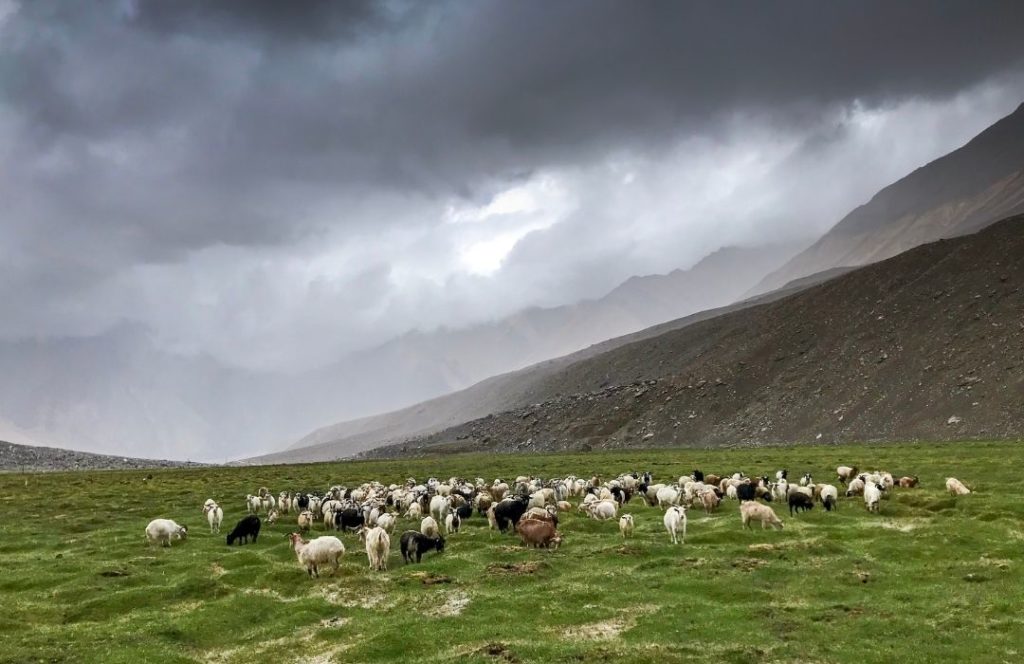
The Changhthanghi plateau extends into the region of Ladakh. It is a high-altitude region in Ladakh. The herders around the Ladakhi Changhthanghi are of the Changpa tribe. The tribe herds the rarest breed of Goats called Changra.
The severe yet breathtakingly beautiful Ladakh scenery is reflected in fine Ladakhi cashmere, which is frequently praised as one of the most opulent textiles in the world. This magnificent cashmere is known for its unmatched softness, warmth, and lightness. It is derived from the delicate undercoat of the Ladakhi goat. The goats in the Ladakh region must grow a thick, silky underlayer due to the severe, freezing temperature; this layer is carefully gathered by hand during the spring moulting season. This fine cashmere is woven into exquisite, light-weight garments that are the epitome of luxury and coziness. It is a combination of the artisan's ability and the resilience of nature.
It is known that at high altitudes, the temperature lowers to the minimum. The winters are the harshest in this region of Changhthanghi. Therefore, the Changra Goats naturally cover their bodies with thick wool to combat the harsh winters. All along the winters, the thick wool reserves the heat beneath their bodies giving them the warmth of nature. On the seasonal climate change, the goats naturally shed off the wool with the help of coarse rocks and trees. To overcome the heat of summers, they eventually shed off the thick wool mostly from their bellies, neck region, and behind the ears. In addition, the herders also comb out the wool manually. The soft wool is Cashmere wool.
Spinning and Weaving in Kashmir
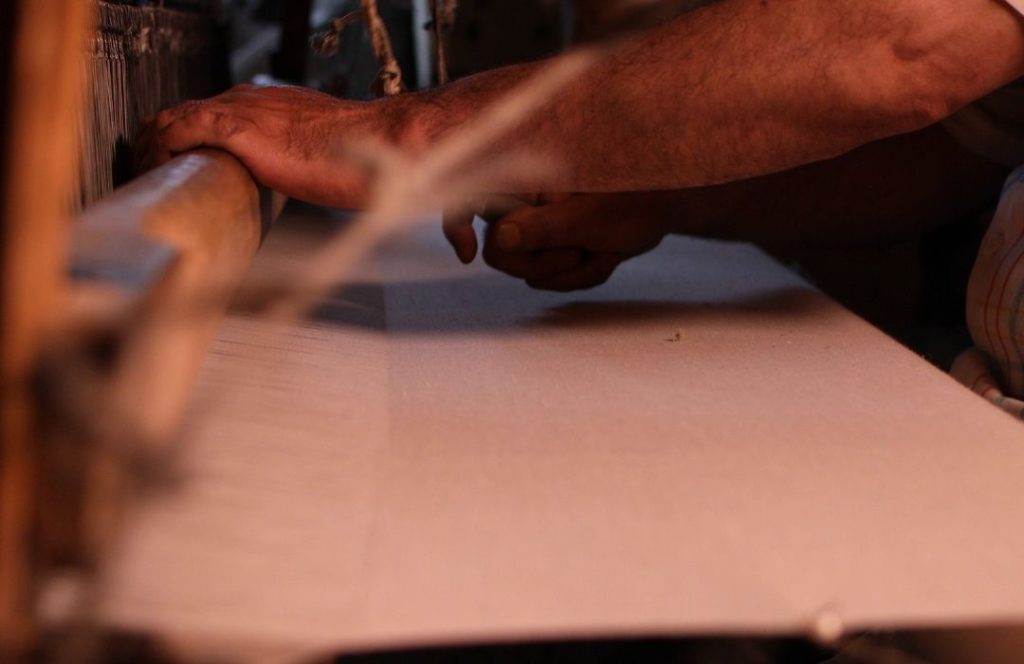
After combing out the Cashmere wool, it is cleaned from the excess dust and filled into the packets to transfer to the valley of Kashmir. The Cashmere wool is sorted and undergoes several procedures in the valley itself. The cleaning, drying, and soaking make the Cashmere wool vividly clean. Afterwards, the Cashmere wool, translated to the finest fibres by the process of spinning. The yarn of fineness is transferred to the handlooms in the valley to weave the yarn into several styles of accessories.
Spinning and weaving are more than just crafts in the enchanted region of Kashmir; they are poetic representations of cultural legacy and artistic proficiency. The procedure starts with the delicate task of spinning wool from the Pashmina goat, which is an elusive animal that roams the frozen heights of the Himalayas. A centuries-old, meditative, rhythmic spinning process turns each strand of this remarkable wool into a beautiful yarn. In order to preserve the yarn's inherent softness and warmth, the wool is painstakingly hand-spun on traditional charkhas (spinning wheels) by expert artisans using a delicate touch.
In Kashmir, the real magic is found in the skill of weaving. Using traditional looms that have frequently been passed down through generations of craftspeople, the spun yarn is then woven into incredibly beautiful fabrics. These looms, dubbed "kani" looms, are wonders of engineering and craftsmanship that enable weavers to produce intricate patterns and designs that are a reflection of Kashmir's rich cultural tapestry. The weavers use techniques that combine traditional themes with modern aesthetics to carefully make each piece. The end product is a fabric that is both visually arresting and delightful to the touch, with each weave expressing a tale of talent and legacy. The completed textiles, whether they are sumptuous shawls or exquisite clothing, capture the classic elegance of Kashmiri workmanship, honoring the confluence of custom.
Thus, the whole process of spinning and weaving the finest Cashmere is called the Art of Pashmina. Moving along the art of Pashmina, several other processes like dyeing, printing, interweaving, and embroidering the Cashmere cater to the exclusive collection of Cashmere. Therefore, the art of Pashmina cherishes every inch of the finest Cashmere to bring luxury to the world.
The Dyeing and Designing
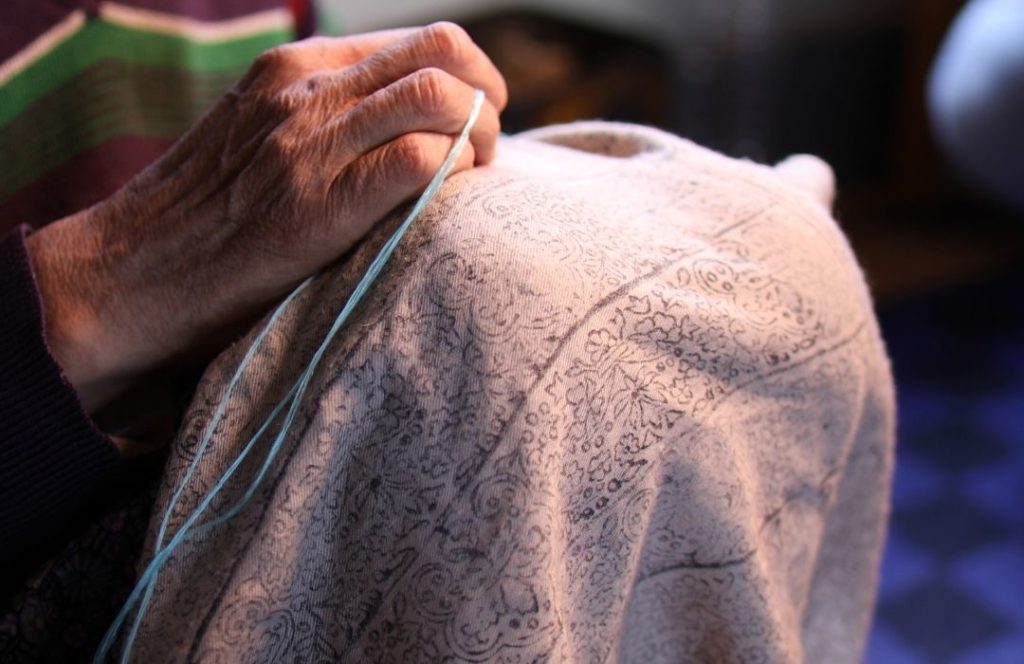
The chroming of the outcome of the weaving is thereupon done manually based on the design prescribed. To define its beauty with edges of colours of various pigments, Cashmere is dyed. The design of the Pashmina propagates choosing the process of colouring. There are some specific steps like; tracing of the requisite design and rubbing of colour powder. In addition, the tracing can be replaced by the hand-block print process where a wooden block, already carved along with designs and motifs according to the fashion and tradition side by side. Therefore, the print, scribed on the shawl with a skilled hand and colour medium is explicit.
When raw threads are dyed and designed in Pashmina, they become stunning wearable artwork, showcasing the full craftsmanship of this opulent fabric. Since Pashmina wool is recognized for its extraordinary warmth and tenderness, the coloring process starts with the natural fiber. For durable and vivid colors, artisans choose their dyes carefully, frequently employing age-old techniques. Rich, subtle hues are added to the cloth, enhancing its natural beauty, by using natural dyes that are made from minerals, plant extracts, and roots. A deep, glossy color that holds true over time is guaranteed in the finished product since each batch of dye is painstakingly manufactured and tested to attain the ideal hue.
The Cashmere wool is ready for the designing stage once it has been dyed, when it is transformed from plain yarn to a gorgeously patterned cloth. Embroidery and hand weaving are two of the complex methods used at this stage. Using age-old techniques, talented artisans painstakingly create traditional Kashmiri designs including paisleys, flowers, and geometric patterns. Each thread is expertly intertwined to form intricate and visually attractive patterns during the weaving process, which is a monument to the region's artistry. Furthermore, intricate embroidery work frequently covers the completed pieces, giving layers of texture and pattern. Expert dyeing and elegant design come together to create Pashmina clothing that is not only opulent but also rich in cultural importance and creative expression, capturing the classic beauty of this
There are different journeys to the faith of Cashmere. Therefore, all the journeys are exquisitely memorable and meticulous.
The Hand Embroidery of Pashmina
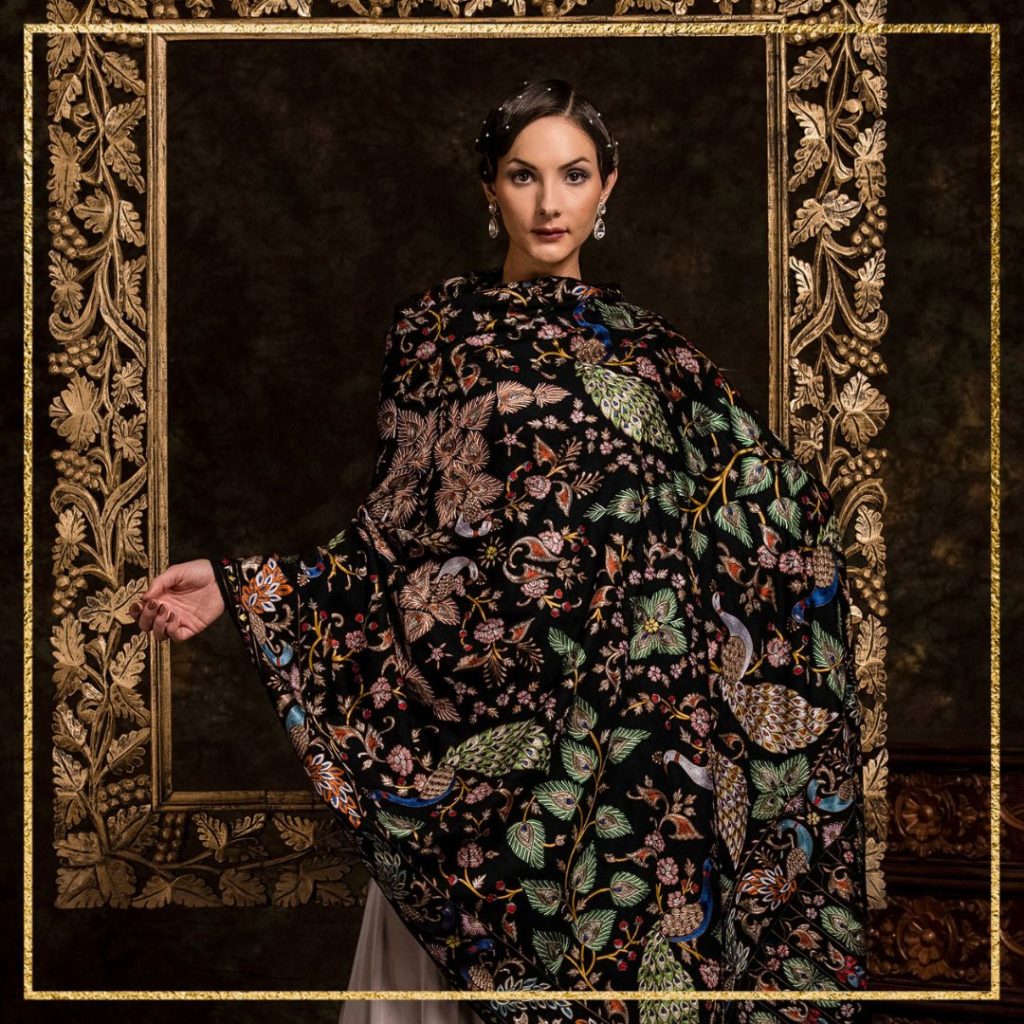
The exquisite art form of hand stitching on Cashmere takes the opulent fabric to new levels of beauty and intricate design. This beautiful method entails expert needle workers painstakingly adding elaborate embroidery that reflects a rich cultural legacy to Pashmina shawls and clothing. Traditionally, the embroidery designs, which include themes like blossoming flowers, flowing vines, and intricate paisleys, are inspired by the scenic beauty of Kashmir. These designs skillfully combine historical and regional aesthetics, drawing inspiration from Mughal and Persian artwork. The dyed Pashmina is thereby passed on into the hands of artisans who with skilled hands perform magical performances on its surface. There is the use of needles, colourful threads, and the patience of years to perform the artistic creation.
Moreover, various forms of hand embroidery are done over the Pashmina shawls. An acquaintance of Pashmina with many styles of embroideries described them as a source of enlightenment for the Pashmina Shawl. Embroideries like; Sozni, Aari, Paper Mache, Tilla Dozi, and Aksi. Moreover, It has also taken several other patterns in its ways of creation like Scarves, Wraps, and Shawls.
The persistence of hand embroidery in Pashmina is evidence of the skill of Kashmiri weavers and their capacity to fuse custom with individuality. A basic article of clothing is elevated to a sumptuous declaration of cultural richness and refinement with each embroidered Pashmina shawl, which narrates a tale of artistry, patience, and talent. Through painstaking craftsmanship, Pashmina is preserved as more than just a fabric—rather, it is treasured as a symbol of grace and history.
Sozni
The Kashmir region is known for its exquisite and painstaking craftsmanship, and this delicate stitching style is called sozni hand embroidery. Usually used on Pashmina shawls and other opulent textiles, this embroidery method entails using a thin needle and thread to create intricate patterns and designs on fabric. Because of the precision needed in this art form, the title "Sozni" is derived from the Persian word "soz," which means "needle." Skillfully employing a range of techniques, such as satin and chain stitches, Sozni embroidery artisans create elaborate designs like paisleys, vines, and floral patterns. Each piece is a unique and magnificent creation due to the sophisticated and detailed Sozni embroidery that enhances the feel and visual attractiveness of the fabric.
Since Sozni needlework has been a part of Kashmiri culture for millennia, its artistic roots are profound. The skill and meticulousness of the process are what make it so unique; artists can take weeks or even months to finish a single piece. Because every stitch is placed with such care, the finished design is both exquisite and long-lasting. The patterns frequently combine conventional themes with avant-garde designs, taking cues from Persian art and nature. As a result, ordinary clothing is transformed into opulent, classic pieces of art with exquisitely embroidered fabric that displays the artist's talent and invention.
Aari
Hand embroidered aari, a traditional art from Kashmir in India, is well-known for its detailed and textured motifs. In order to create intricate, complex patterns on fabric, this embroidery method uses a specialized tool called a "aari," which is a hooked needle. With the help of the aari needle, craftspeople can create intricate and textured designs by working with a range of stitches, such as chain and knot stitches. Usually, the elaborate designs of the needlework elevate the texture and visual attractiveness of the cloth, particularly on high-end crafts like pashmina.
The utilization of a hooked needle to produce raised, textured designs is what gives Aari needlework its distinctive three-dimensional feel. This method frequently produces paisleys, flower patterns, and other classic motifs influenced by Persian art and the natural world. Every Aari needlework item is a work of art, demonstrating the artist's care and expertise as they painstakingly apply each thread to produce the intended effect. The end product is a gorgeously embellished fabric that fuses elegance with handcrafted skill, elevating Aari embroidery to the status of a treasured component of fine textiles and a widely recognized aspect of the area's cultural legacy.
Tilla Dozi
The height of Kashmiri textile artistry is embodied in the beautiful embroidery known as Tilla Dozi. This excellent technique creates rich patterns and designs that are both sumptuous and ageless through painstaking embroidery using gold or silver thread. Tilla Dozi, which means "gold embroidery" in Persian, derives from the employment of metallic threads that give the fabric a deep, glittering appearance. Fine textiles, like Pashmina shawls, are painstakingly stitched with these threads by artisans to create exquisite patterns, which frequently feature geometric, paisley, and floral motifs. Metallic threads are used to give the cloth a sense of grandeur and sophistication, in addition to improving its aesthetic appeal.
Tilla Dozi needlework is made by hand, and it takes a great deal of talent and accuracy to create. To guarantee that the silver threads are put securely and uniformly, each pattern is meticulously planned and carried out by artists using age-old methods. Because of its ability to catch light and shimmer with elegance, this fabric is much sought after for formal attire and special occasions. Tilla Dozi needlework celebrates the artistry and elegance of traditional fabrics while serving as a monument to Kashmir's rich cultural legacy and the timeless craftsmanship that has been handed down through the years.
The Luxurious Weave of Kani
The Kani Shawls, are crafted in the region of Kanihama in the Ganderbal district of the Kashmir Valley. Moreover, the shawls have been in the valley since the artistic era of Mughal Rule.
The finest of the wool brought to the handloom is magnificient. The manual weaving of the Kani shawl commenced quite different from the interweaving of a normal Pashmina Shawl. Moreover, the hair, hand-sorted and selected to preserve its quality and exquisitely.
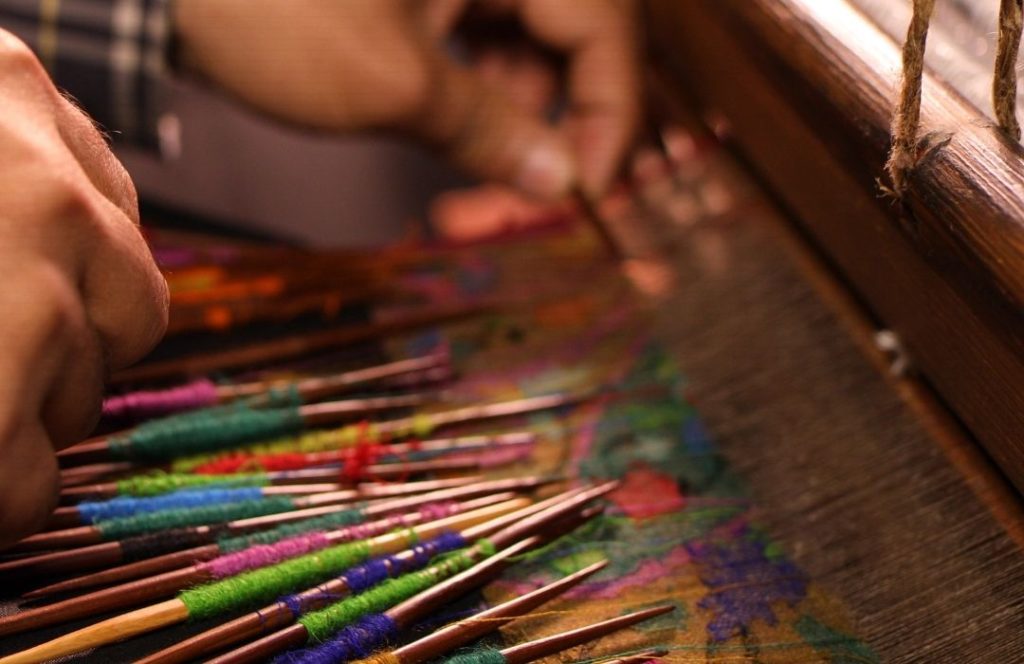
The weaving of the Kani Shawl is very extensive and delicate at the same time. The weavers have the desire and skill to sustain their survival and create a fashion craving Kani Shawl. Henceforth, the weaving, preceded by the Kanis, wooden sticks of hand size made of forest wood known to as “poss tul”. Thus, the Kanis have a colourful thread around to present their wefts in an already warped Shawl.
The premium type of pashmina known as "Kani Pashmina" is distinguished by its fine workmanship and elaborate pattern. In Kashmir, a particular kind of loom known as a "Kani" is essential to producing these opulent fabrics. Famous for its ornate patterns, Kani Pashmina shawls frequently have geometric patterns, paisleys, and exquisite floral themes. Using the Kani loom, these motifs are painstakingly woven into the cloth to produce incredibly colorful and complex patterns with a finely textured finish.
The weaving begins by galloping the colourful threads around the Kanis. The artisans skilfully do the work with the hands of the heavens. Also, a particular number of Kanis was used for the weaving of one Kani shawl. Around 70 to 100 Kanis are used up for the design of a Kani shawl.
The Ombre style
The amalgamation of various shades of colour procured on the Pashmina shawl itself with the skilled hand of Rangur, the dyer. Moreover, Ombre Pashmina not only produced by the variation of colours but also by the amalgamation of different colours in a distinct pattern.
The ombre look in pashmina puts a modern spin on this age-old fabric, giving its traditional elegance a dynamic, contemporary edge. Ombre, a French word for "shade" or "gradient," is a coloring method in which colors are blended smoothly from one hue to another to produce a gradient effect. This look in Pashmina is accomplished by a methodical and creative dying process in which several tones are progressively blended to create a visually arresting color shift.
Craftspeople first prepare the cloth with a base color to achieve an ombre look, and then they apply dyes in a gradient, making sure that the colors blend seamlessly. This method can produce dramatic shifts between clashing hues or delicate transitions between tints that are similar to one another. The end product is a sumptuous shawl or dress with a sophisticated yet flowing color scheme that uplifts the classic allure of pashmina. Fashion-forward people who value both tradition and innovation in their wardrobe are drawn to the ombre style because it not only makes the cloth more visually appealing but also provides a multitude of styling alternatives.
The Embellished Craft of Pashmina
Here comes two of the glared and elegant journeys of its artwork; The Laced Pashmina and the Swarovski Crystals Pashmina. In the craft of Laced Pashmina, the french Chantilly lace incorporated in the handcrafted Pashmina Shawls makes the onlooker awestruck by the intricate designed beauty.
Moreover, the handcrafted Pashmina shawls with embellished precious Swarovski crystals take the credit for authenticity and elegance. In addition, the elegance, and radiance near the creation of these Pashmina Shawls, are extraordinarily cherished all over the world of Art.
The Simple yet Elegant paths of Pashmina
The two elegant designs over the journey of Pashmina; Patterned Pashminas and the Reversible pattern Pashmina. These two different yet magnificent artworks over the hand-crafted Pashmina lets you drool over their presence.
Moreover, relishing various simple and elegant patterns over the Pashmina shawl by weaving various designs in the form of warps and wefts. Patterned Pashmina proves to be useful as well as luxuriously fashionable on any offering or occasion.
Moreover, woven with two different colours of threads on the handloom, the style of the reversible Pashmina Shawl is thus explicitly distinguished from any of the luxuries. The Reversible Pashmina Shawls pertain to the world of luxury as well as utility in terms of occasions and casual life.
Pashmina is the Craft not a brand
Although pashmina is commonly misunderstood as a brand, it is actually a traditional craft with a long history. Pashmina is the name given to the fine, soft wool that is taken from the undercoat of the Pashmina goat, and it comes from the high-altitude parts of the Himalayas, especially Kashmir. The word "Pashmina" itself comes from the Persian word "pashm," which means wool; it's not a brand name; rather, it represents the place of origin of the cloth. Over generations, trained artisans have refined the painstaking process of harvesting, spinning, and weaving to create the exquisite craft of pashmina. This procedure guarantees that the finished item will be an opulent, priceless textile that is well-known for its warmth and tenderness.
The workmanship and cultural legacy surrounding pashmina are what truly define the material. Hand-spinning the fine strands and weaving them into complex patterns, a labor-intensive artistic process used in the creation of Pashmina fabrics. The customs of the Kashmir region, where the methods and abilities have been handed down over the years, strongly ingrained with this workmanship. Whether it is a scarf, shawl, or garment, every Pashmina work embodies the rich cultural history. Also, an artisanal expertise of the area shows the commitment and craftsmanship of its creator.
Even if pashmina has become more popular and significant in the world market in the modern day. It is still important to acknowledge it as a traditional craft rather than just a brand. Pashmina's worth is found in the centuries-old methods and cultural customs. Seeing pashmina as a craft emphasizes how important it is to maintain these age-old techniques. And value the creativity that goes into each item rather than judging it only based on its commercial value.
Also read: ALONG THE PATH OF GRACEFUL PASHMINA
A Stop for the Flourishing of Luxury
Pashmina.com is the source for authentic and genuine Pashmina Shawls, Cashmere Scarves, and Cashmere Wraps. Here at the stop of Pashmina.com, we let the luxury take a flight to your closet to fill it with colours of fashion. Also, the Varieties and the standard quality of Pashmina deliver a look at the onlooker to mesmerize the soul from within.
Also read: WHERE CAN I BUY PASHMINA SHAWLS ONLINE?