In addition to captivating its magnificent scenery, Kashmir, sometimes known as "Paradise on Earth," possesses a rich cultural legacy profoundly ingrained in its customary crafts. One of these crafts that stands out as a representation of luxury, tradition, and moral workmanship is the fine art of making pashmina. The underside of the Capra hircus goat yields high-quality wool known as pashmina or cashmere. The Himalayan region is home to it natively. We explore Kashmir's Pashmina industry's ethical concerns. Studying the customs and the craftspeople that create this intricate work. Environmental and artistic preservation were the goals of the sustainable methods. The traditional Pashmina Craft becomes a symbol of the region's culture, fusing unmatched workmanship with its scenic surroundings.
The world-famous Kashmiri Pashmina, which reflects the artisanal skill passed down through centuries, is a symbol of luxury. The soft underbelly fibers of Capra hircus goats, transformed into elegant shawls and scarves by expert hands against the breathtaking backdrop of snow-capped mountains and calm lakes. The captivating fusion of age-old weaving methods, vivid hues from natural dyes, and the commitment of Kashmiri craftspeople yields Pashmina items that are not only elegant and warm, but also capture the essence and history of the Kashmir Valley, making them a treasured cultural object appreciated across the globe.
Origin of Pashmina Craft
It all started when a Persian saint was travelling across the globe. Mir Syed Ali Hamdani was a sage from the Middle East. The footprints of a saint Mir Syed Ali Hamdani from the Middle East came to Kashmir with 700 craftsmen to adorn the beauty of the valley and to spread the holy message. He rested his feet in the region of Changhthanghi Ladakh. Thus, the saint landed its appearance in the Changhthangi Mountain in Ladakh. While perceiving nature, he locked his eyes on the Goat of marvellous wool. Awestruck with the softness and fineness of the wool, he made socks out of it and gifted them to the Sultan Zain-ul-Abideen of Kashmir Valley. Perceiving the beauty of Cashmere wool, suggested making an industry that cultivates the Pashmina in desirable styles. Even the name Pashmina, derived from the Persian word, pashm, meaning "the soft gold" is exquisite in being.
In the thirteenth century, Pashmina rose to an unparalleled status, drawing the interest of nobles and kings from all over the world. Royalty, emperors, and wealthy patrons prized Pashmina textiles for their lavishness and exquisite workmanship, especially in the Kashmir Valley. The delicate shawls became cherished treasures, representing both luxury and sophistication made from the opulent underbelly fibers of Capra hircus goats, native to the Himalayan region. These beautiful Pashmina decorations, worn by royalty in Central Asia and the Middle East, such as emperors and sultans, who valued the delicate texture as well as the artistic skill displayed in the elaborate designs. Consequently, the 13th century was a golden age for Pashmina, since it crossed local boundaries to become the heritage itself.
Procuring the finest Cashmere
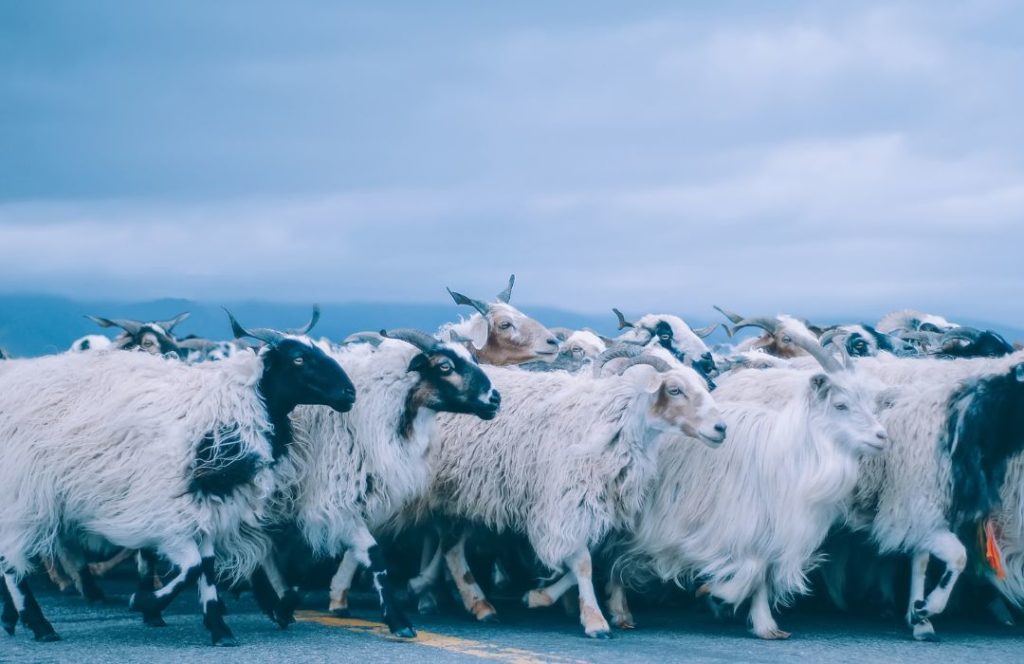
The journey begins at the top of Changhthanghi mountain. A unique kind of goat known as the Changra Goat resides there. The medium-sized Changra goats have two twisted horns. primarily herded by the Changpa tribe. In the winter, the temperature in the Changthangi region drops to minus forty. As a result, the Changra goats grow a thick wool undercoat covering their body. therefore shielding themselves from the severe weather. The wool is supple and thick. We refer to it as cashmere wool. Of all the cashmere wool produced, Ladakh produces the best quality. Goat breeds that yield cashmere wool are numerous. However, the Ladakhi Cashmere wool is the best of all.
Crafting of Pashmina in Kashmir
The adept craftspeople known as "Karigars" are the backbone of Kashmiri Pashmina artistry. These artisans carry on a centuries-old custom by learning the trade of Pashmina weaving from previous generations. The craft of making pashmina is labour-intensive and requires time, accuracy, and deep comprehension of the delicate threads. When the goats moult in the spring, the finest and softest fibers are obtained, therefore the trip starts with the goats being carefully combed. The wool, gathered and then carefully cleaned by craftspeople who take great care to separate the valuable underside fibers from the rough outer hairs.
Pashmina's spinning is an amazing demonstration of hand-eye coordination. Using a spinning wheel locally referred to as a "yinder," Karigars expertly spin the fine fibers into yarn. This age-old technique not only improves the wool's quality but also gives the finished product a unique look. When the yarn is prepared, it goes through a laborious dyeing process in which skilled weavers employ natural pigments to produce an array of vivid hues. In addition to giving each piece a touch of art, the hand-dying method uses no hazardous chemicals and is in line with sustainable and ethical standards.
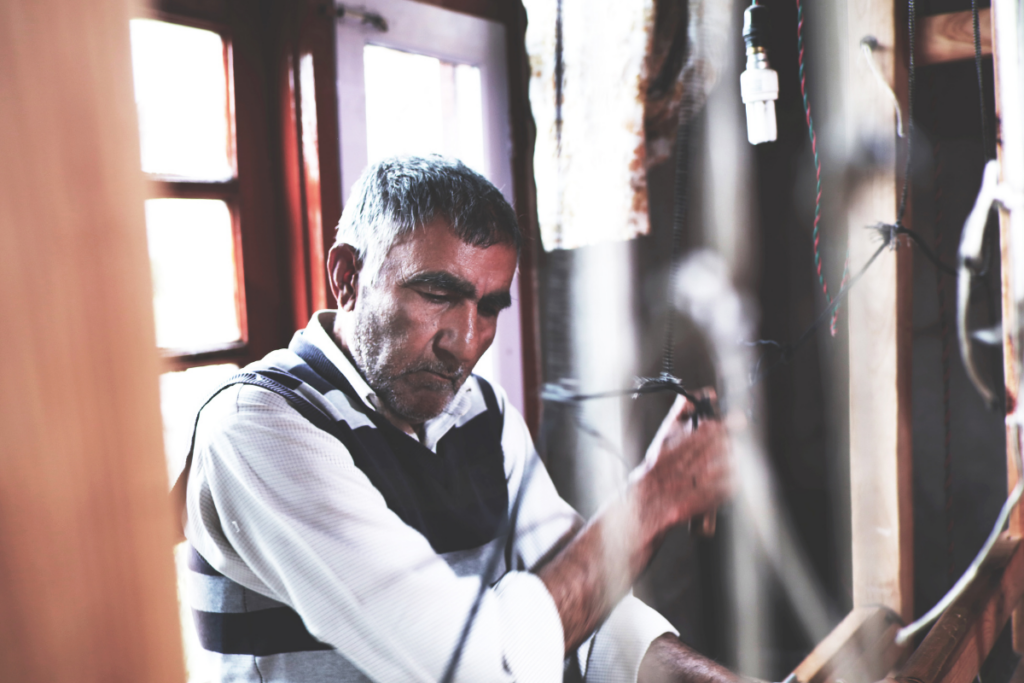
Throughout the weaving process, the loom serves as the artisan's creative canvas. Handwoven with care, pashmina shawls, scarves, and wraps each have a distinct hint of the craftsman's skill. The elaborate designs and vivid motifs of the traditional Jamawar and Kani weaving techniques highlight the artisan's expertise in Pashmina handicraft. The Pashmina history of Kashmir, defined by the continuity of skill and tradition that these techniques have created, passed down through the centuries.
Ethical and Sustainable Craft of Pashmina
The worldwide fashion business has placed an increasing emphasis on sustainability in recent times, and the Pashmina sector in Kashmir is no different. Beyond maintaining ancient methods, ethical creation also involves treating craftspeople fairly and with consideration for the environment.
The procurement of raw materials is a key component of sustainability in the production of pashmina. The welfare of the goats is the top priority for ethical Pashmina makers, who make sure they receive humane treatment and aren't subjected to cruel procedures like dehorning. By using sustainable grazing management techniques, the Himalayan region's delicate ecosystem thus protected from desertification and land degradation.
Furthermore, environmentally friendly techniques have been used in the dyeing process. As an alternative to chemical dyes, some craftspeople use plant-based dyes made from materials like madder root, indigo, or walnut shells. These colours have less of an adverse effect on the environment. This change not only complies with moral requirements but also results in Pashmina products that have a distinct character and highlight the beauty of organic colours.
Empowering Artisans
Fairtrade policies that put the welfare of the craftspeople first are another aspect of ethical crafting in the pashmina sector. To guarantee that artisans and women efficiently paid fairly for the complex labour they perform, numerous cooperatives and organizations are in operation. These projects provide the craftsmen with economic empowerment through transparent supply chains, enabling them to provide for their families and communities.
Some groups even go so far as to offer the artisan communities access to healthcare and education resources. The benefits of the Pashmina business extend beyond the production of exquisite clothing, as this all-encompassing approach to fair trade promotes the general growth and welfare of the artisans and their families.
Because the Pashmina craft in Kashmir combines talent, tradition, and economic advancement, it is a potent tool for empowering craftsmen. Craftspeople, known as "Karigars," are essential to the elaborate process of turning premium Pashmina wool into beautiful clothing. Centuries-old weaving traditions, painstakingly preserved by their hands, resulting in items that are not only the pinnacle of luxury but also a reflection of the local cultural history. Fairtrade methods used in the ethical manufacture of pashmina, guarantee craftsmen a fairly compensation for their skill. Beyond financial concerns, empowerment includes efforts in community development, healthcare, and education. The Pashmina craft serves as a catalyst for positive change in addition to preserving a rich cultural history by fostering and promoting the abilities of these artisans.
Rich Culture of Kashmir
In Kashmir, ethically crafted with consideration for fair trade, sustainability, and cultural preservation. Kashmir's history and identity are profoundly ingrained in pashmina weaving, which showcases the skill and artistry of the area. Artists and producers help to preserve this rich cultural legacy by upholding ethical standards. Younger generations, guaranteed to inherit the skills and knowledge necessary for Pashmina handicraft through rigorous training and apprenticeship programs. The craft maintained by this generational transmission of abilities is profound. It also permits it to develop, adding modern components while adhering to its historical foundations.
In areas such as Kashmir, the production of Pashmina is a potent stimulant for the resuscitation and conservation of traditional cultural assets. With its centuries-old customs firmly ingrained in the community spirit, pashmina serves as a live example of the region's diverse cultural heritage. Time-tested methods and motifs with echoes of previous generations are used in the painstaking process of weaving pashmina. Craftspeople dedicate their lives to their work. Not only do they make beautiful wearable art, but they also revitalize cultural stories. Every thread of pashmina becomes a medium for the weaving of legends, symbolism, and customs. It preserves and revitalizes the community's intangible legacy. The craft becomes a dynamic link bridging the present and the past.
Pashmina Craft facing modern problems
Even though ethical Pashmina weaving has advanced, there are still difficulties facing the sector. The abundance of fake Pashmina items on the market, which frequently pass for genuine handcrafted items, is a serious problem. This diminishes the worth of authentic Pashmina artistry in addition to undermining the efforts of real artisans.
Organizations and governmental agencies are developing certification and labelling systems. Thus, to identify genuine Pashmina goods in an effort to address this issue. By doing this, consumers are empowered to make knowledgeable decisions, promoting moral producers and maintaining the integrity of the industry. Pashmina's wealth is the epitome of elegance. The only website offering premium pashminas with GI (Geographic Identification) validation from the Ministry of Textiles is Pashmina.com. This guarantees the superior qualities of hand-spun and hand-woven materials. Different processes are used to verify each Pashmina's quality. The Pashmina In the lab designated for testing Pashminas, crafted accessories are put to the test. They verify that the Pashmina is hand-spun and hand-woven in Kashmir through inspection. Additionally, they examine the Pashmina to produce the GI authenticity certificate.
The weather is another issue, as it has an immediate impact on the supply and quality of Pashmina wool. Also, resilient grazing management and environmental conservation initiatives are examples of sustainable practices. Thus, becoming more and more important to lessen the effects of climate change on Pashmina production.
Rich Collection of Pashmina
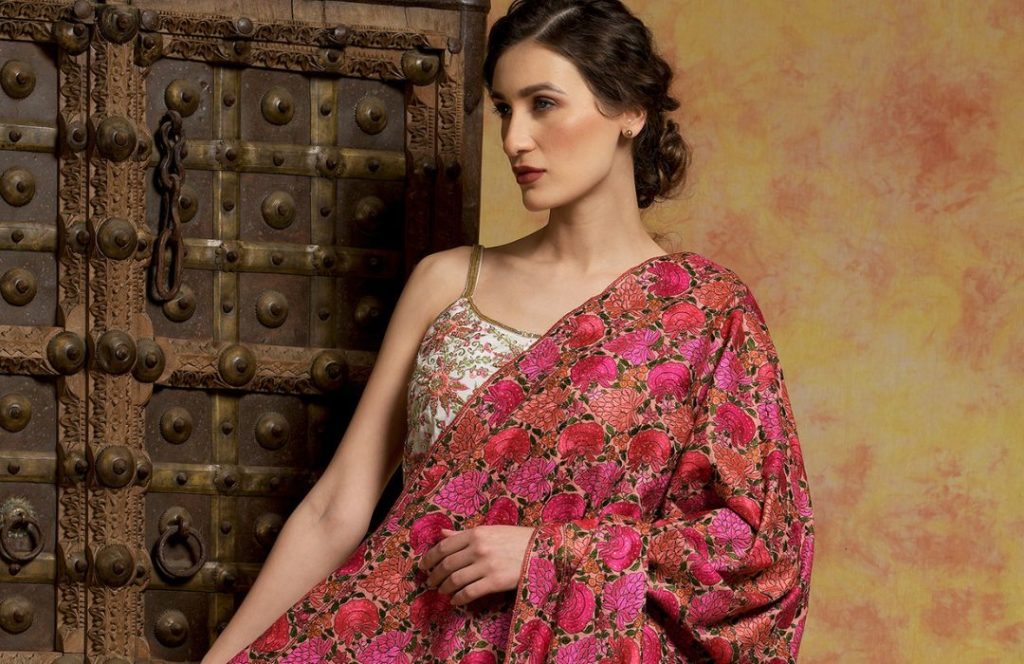
Tradition, sustainability, and social responsibility harmoniously blended in Kashmir's ethical Pashmina creation. Each work is given life by the expert hands and hereditary wisdom of the craftspeople. Thus, resulting in the creation of artwork and clothing that capture the spirit of a rich cultural past. as customers grow increasingly aware of the ethical and environmental effects of the decisions they make. Thus, Kashmir's pashmina sector is a shining example of ethical craftsmanship.
through upholding customs, adopting eco-friendly methods, and giving the artisans more authority. The Himalayas' sensitive ecosystem is protected by the ethical making of Pashmina. However, moreover adds to the socioeconomic advancement of the area. We value a Pashmina shawl's warmth and attractiveness. Let's recognize and assist the hands as well. Therefore, carefully incorporate heritage, sustainability, and culture into each and every work of art.
Also read: What is so special about Pashmina?