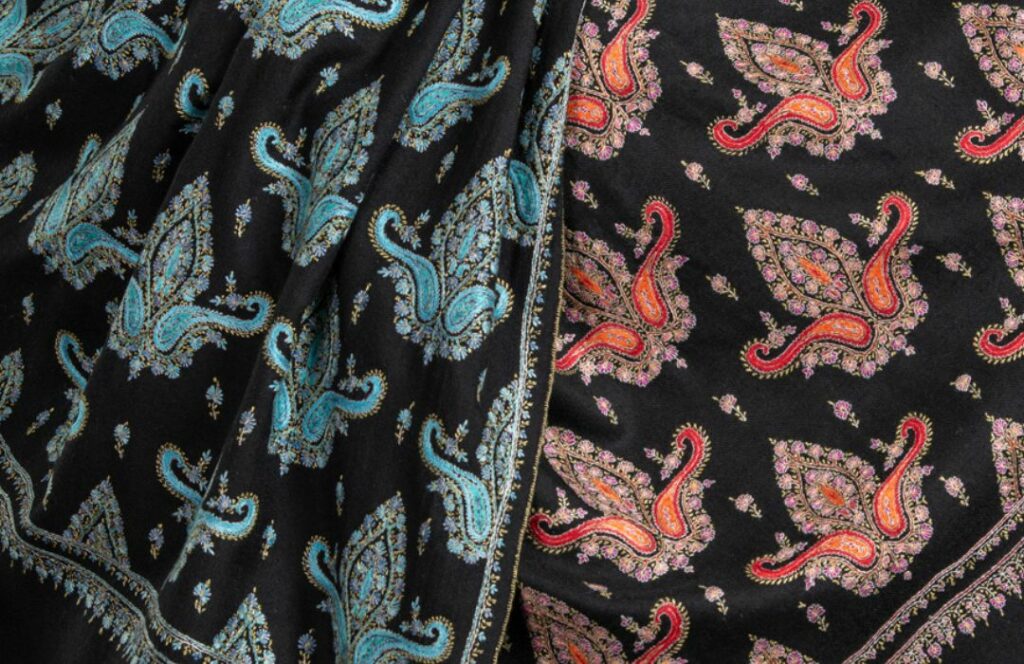
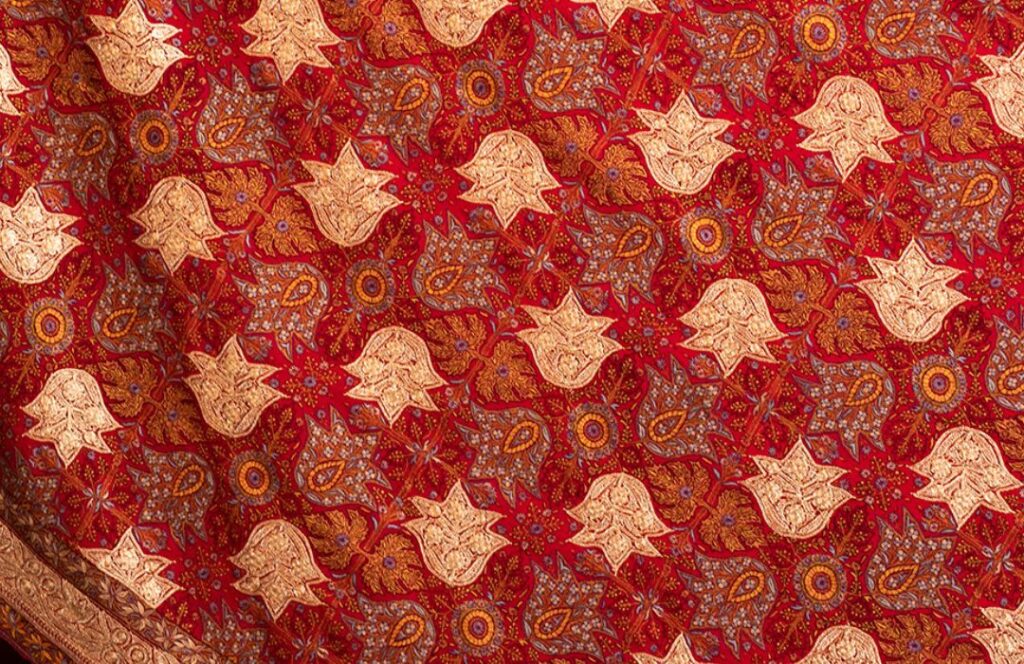
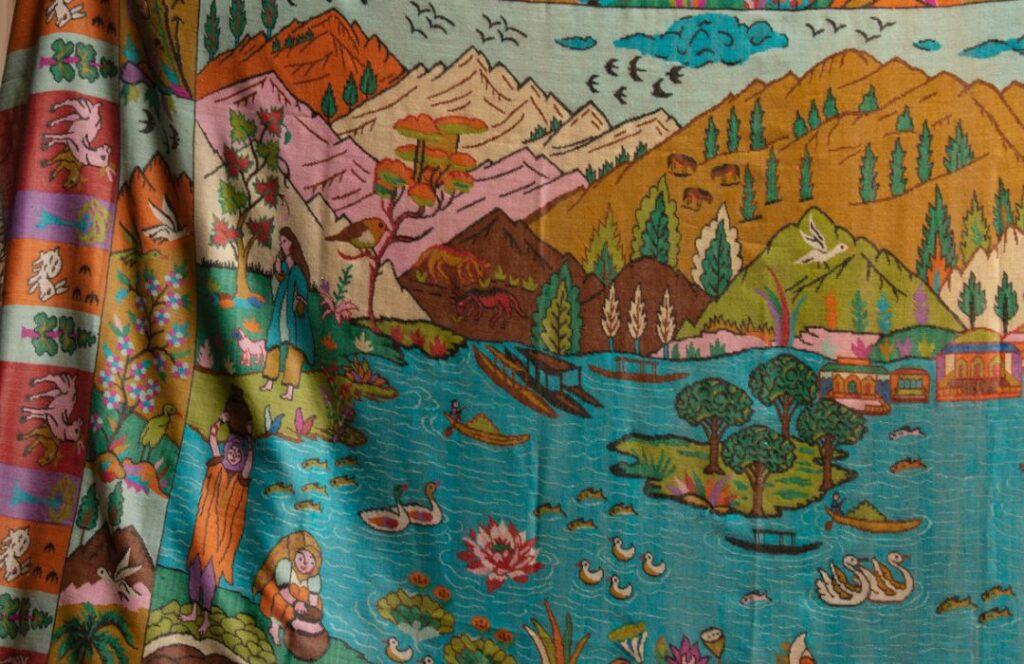
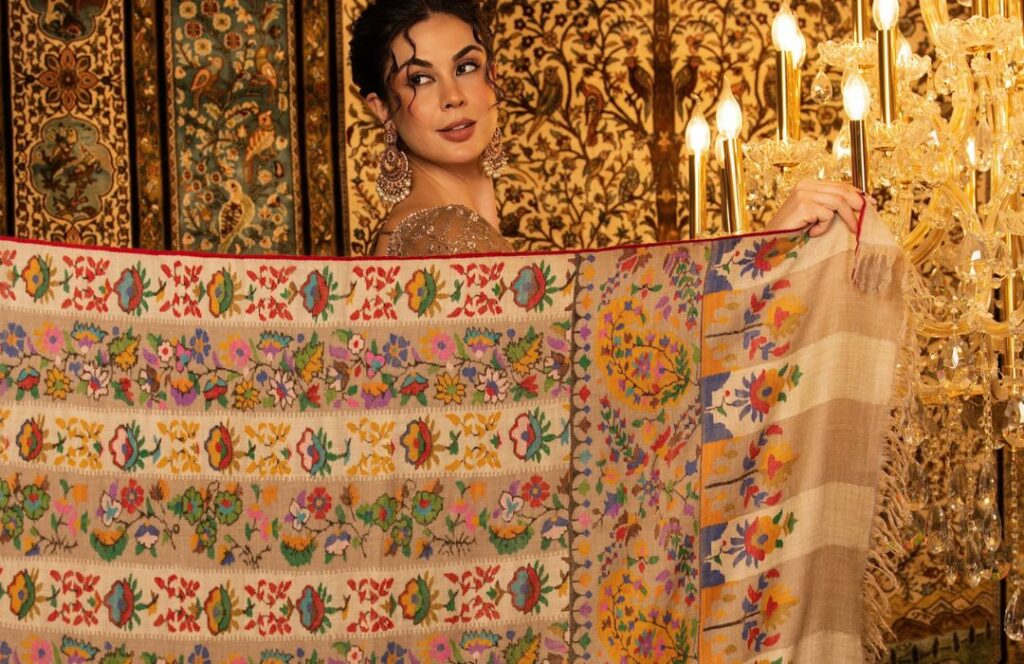
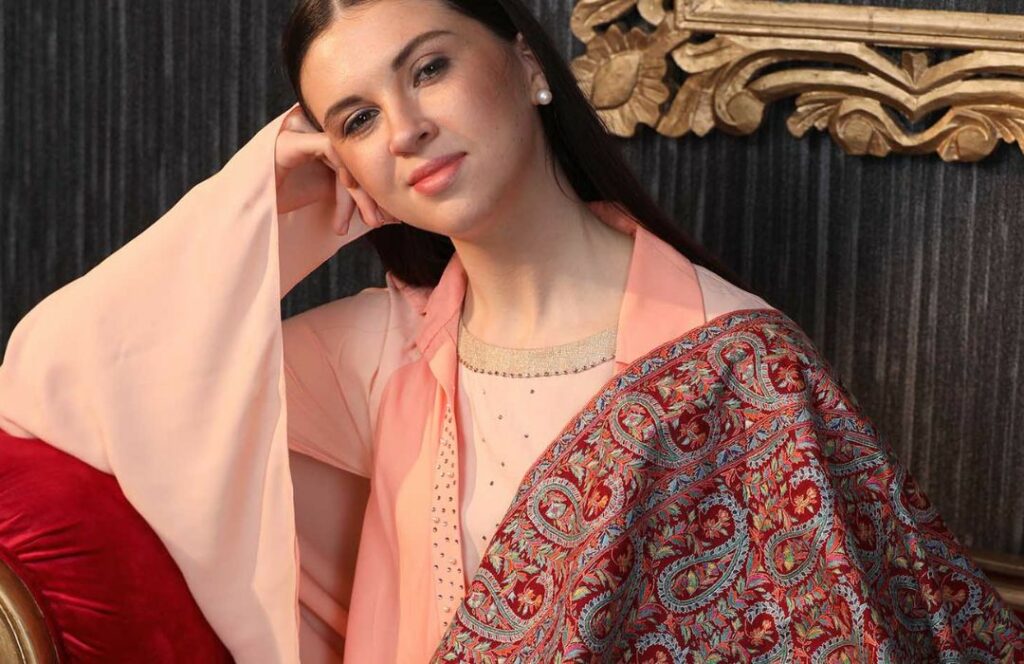
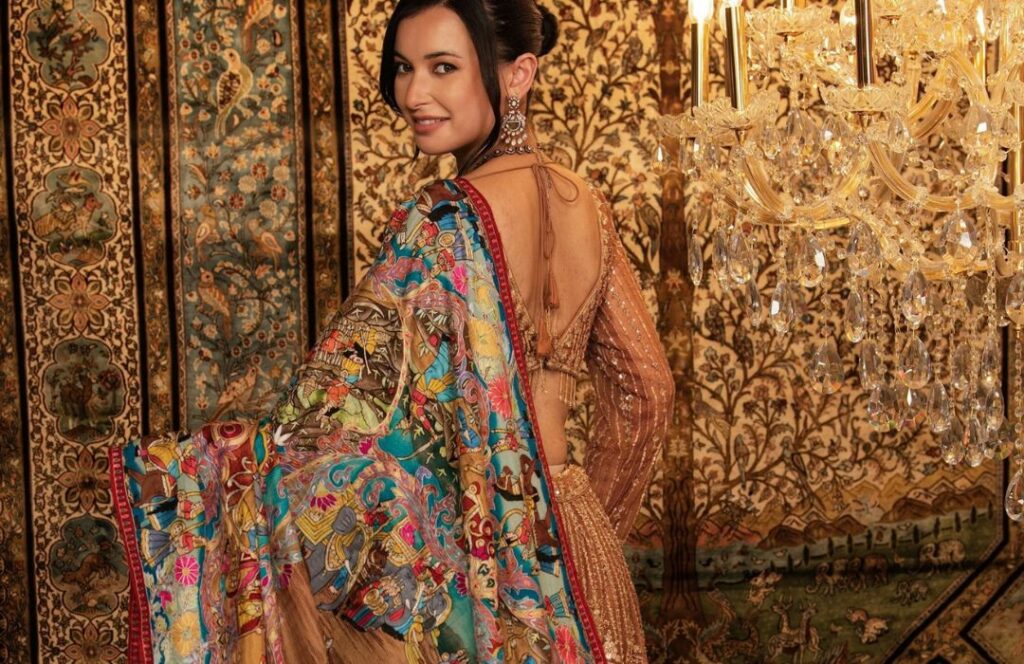
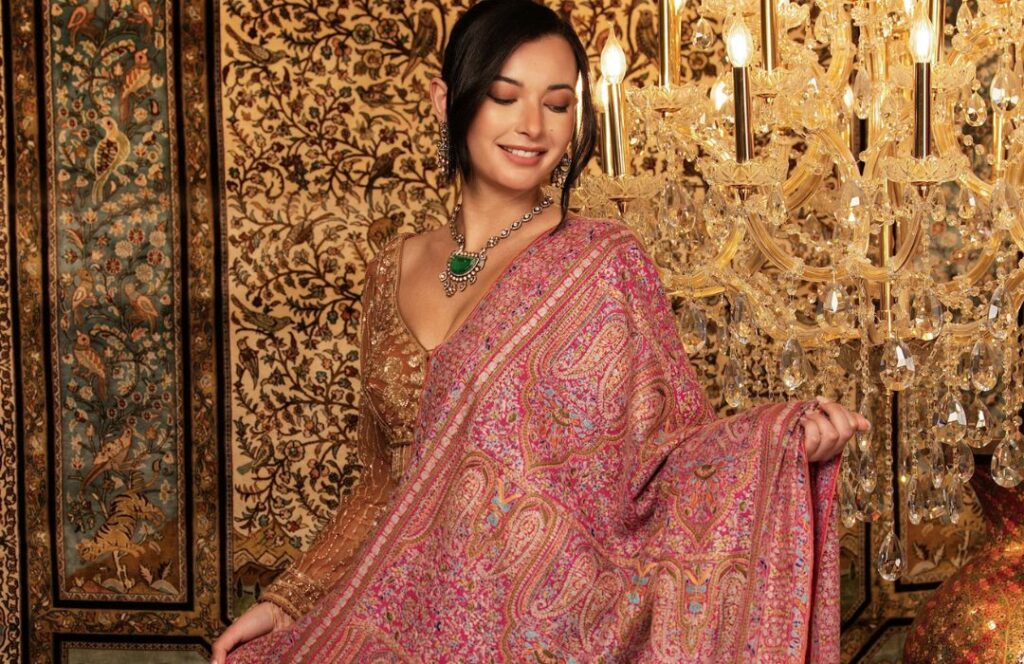
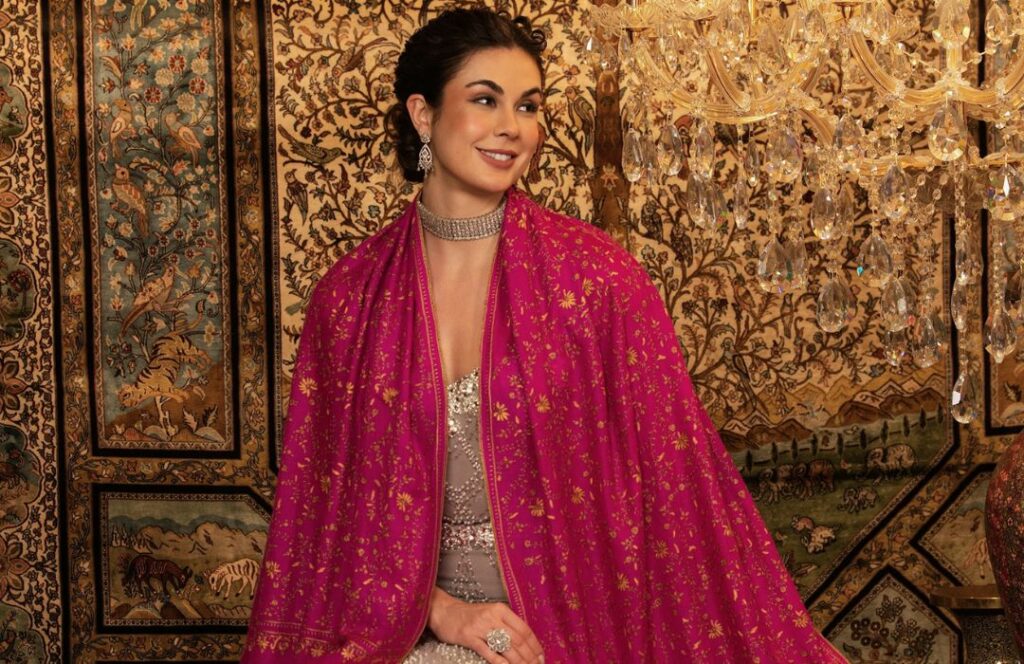
Have you ever thought of a pashmina, which is like getting two shawls in one? When you look from the front, you see soft apricot cherry blossoms, and when you turn it from behind, it shows you deep brown chinar leaves. Same shawl, two different looks. That's the magic of Aksi embroidery. Though Aksi is not a simple mirror image, the embroidery is done separately on two sides. The same fabric has two totally different designs on both sides, using totally different colors, threads, and motifs. It's like you are writing two different stories on the same sheet of paper on both sides; this way, Aksi embroidery is the most complex and rarest in the world.
Aksi means "two faces of different looks." Think of two paintings hidden in the same Pashmina. When the artisan embroiders the face side, he has to make sure the thread is not visible on the other side, then turn the shawl and do different or similar work on the back side, making sure the threads are not visible on the face side. The thinness and fineness of the Pashmina weaving itself make it very difficult to conceal double threads without making the surface thick. That is why it is a skill of a master of masters. That is also why Aksi embroidery is rare and expensive.
Doing Aksi work takes double the time, double the skill, and double the patience. Only experienced artisans with decades of work behind them can do this. One small mistake ruins both sides. Very few artisans take up Aksi today. If you own an Aksi Pashmina, you are holding history in your hands.
What is Aksi Embroidery?
Two sides of one Aksi Pashmina Shawl
Aksi embroidery is the rarest of all the Kashmiri embroideries. 'Aksi' is the absolute opposite of what a mirror is. It gives you two different shawls in one Pashmina. One side has a garden of red roses. The other side has another flower motifs. They have different colors. They have different designs. Their appearance is different. Yet it is the same Pashmina. That's what makes Aksi so special. It is only embroidered on pure Pashmina. Then the artisan starts and embroiders the Pashmina on both sides; he makes two stories. One side is bright and divine-like, and the other is subtle and everyday. With one Pashmina, you have two personalities. No other embroidery in the world can do that.
How Aksi is Different from Do-Rukha?
Aksi is different from Do-Rukha although they are often confused. In Do-Rukha, a piece of cloth is employed, and the design is drawn out. Silk threads are woven on both faces, and the designs are then created with the silk thread. The silk threads look the same on both sides, so it is called "two sides that look the same." In Do-Rukha, with one motion, the weaver makes the threads for both sides, as if an archer is hitting two targets at one time.
In Aksi, the embroiderer makes two different stitches on the two faces of the shawl individually. He first makes the design on one face, hiding the threads on its back. Then, he turns the shawl over and makes the second design on the other face, hiding the threads so that they do not become mixed up with the threads of the first side. Keeping the threads from both sides separate is very difficult!
Why is Aksi So Difficult to Master?
Both faces are adorned with two complementary hues, which combine to create a reversible beauty that honors classic craftsmanship
Aksi is the most difficult embroidery. Normal Kashmir embroidery takes 3 to 5 years to learn. Do-Rukha takes 10 to 15 years. Aksi takes 20 or more years. The artisan must first learn Do-Rukha first. Only then he can move on to Aksi. His fingers must remember the Pashmina weave. His eyes must see what other people don't see. The trick is controlling the depth of thread. Because the pashmina base is so thin, the artisan cannot push the needle too deep into the base when working on the front side. He has to be able to control the depth of each stitch. If he goes too deep, the color will show on the back. So he must pull on the thread with the lightest touch. Then he would do the same for the back side. The work is to be done on a fabric that already has embroidery on one side.
The risk of spoiling both sides and ruining months of work is very high. That is why these artisans work only in bright morning light. They work only 2 to 3 hours on Aksi. That is why Aksi is rare.
Why Are There Only a Few Aksi Pashmina Artisans Left in Kashmir?
Today you can count the real Aksi artisans on your fingers. There are less than 10 master artisans left in all of Kashmir. Because of time and money. An Aksi shawl takes 12 to 18 months to make. Sometimes even 2 years. The artisan sits for a year with no income. Young people want quick jobs. They don't want to wait so long. They shift to machine embroidery or anything else, even earning less. The second thing is lack of recognition. No buyers knew the difference between Do-Rukha and Aksi. They paid the same for both, though Aksi takes double the effort. So, the artisans stopped making them.
Moreover, art slowly started dying. Today, without a teacher, nobody wants to learn. The master artisans are old. Their children don't want to carry on. If this art is not supported now, it will be gone in 10 years.
How to Identify Real Aksi Pashmina Embroidery?
Aksi can be identified from the front side of the Pashmina shawl by simply noting down the color of the front side and also the design pattern. Now turn the shawl. If the backside differs in color from the front side and has a totally different design pattern, then it is Aksi; suppose the front side has pink flowers and the backside is brown leaves, then it is Aksi, and if both sides are the same, then it is Do-Rukha, not Aksi.
Now check its thickness. Aksi is a little heavier than do-rukha, as double stitching is done, but it should be soft and very light in weight, with no stiffness. Check whether it has any knots or loose threads. If it has knots and loose threads on either side, then it is not a good quality Aksi. Finishing should be fine on both sides. Also, the base should be pure Pashmina shawl, not having any wool or viscose.
Have you ever seen the other side of an embroidered Pashmina? Usually, the backside of any embroidery is messy. You will see knots, loose ends, and uneven thread work. But some Pashminas are so perfect that there is no front side or back side; both sides are identical! That's the magic of Do-Rukha embroidery. The name Do-Rukha has two faces. It is also called Do-Ranga in Kashmir. The beauty is in the clean finish. There are no knots at the beginning or the end. The thread is concealed perfectly inside the Pashmina weave. You can wear the shawl from both sides. The neatness and beauty are the same on either side. That's the reason for its being so highly appreciated.
Many customers question whether this could be perfectly handmade. They believe this can only be done by a machine. The actual fact is the other way round. Machine embroidery results in a messy back. It needs additional thread to hold the design. But in Do-Rukha, there are no additional threads. It is done using just one needle, one thread, and most importantly, years of experience. Only a master artisan can produce such a perfect finish.
What is Do-Rukha Embroidery?
Do-Rukha is a Kashmiri embroidery. Its name means two faces. It is also called Do Ranga. The design looks the same at the back as well as the front of the Pashmina. You will have no idea which side is front and which is back. The thread is neither knotted nor is any loose end seen. It is uncluttered, pure, and meticulous from all sides. It is done only on a pure Pashmina shawl. Thus, made with the help of a needle. The craftsman makes it so delicate that even the reverse is a mirror of the front side. The threads hide their starting as well as ending point inside the weave. Such is the miracle. It's nothing but magic with a needle.
How do the Artisans Create Identical Sides?
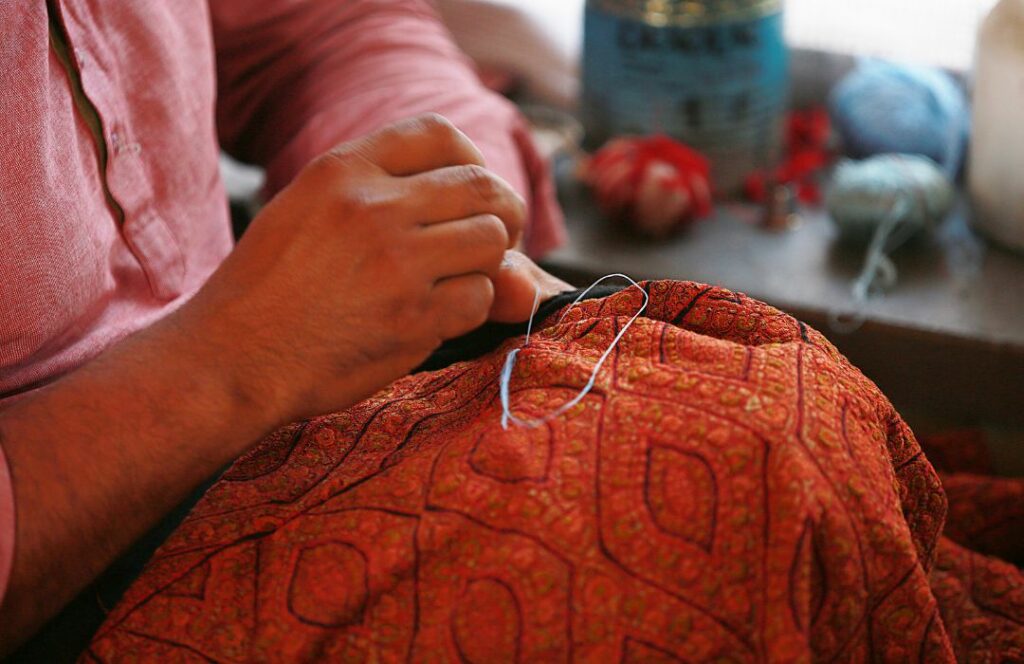
The art of Do rukha embroidery
The skill of Do Rukha is not visible. You see the final product but not the blood, sweat, and tears that went in creating it. Only master artisans do it. They spend 12 to 15 years learning this art. They cannot afford to make a mistake, or it will ruin the entire work. The needle must come out exactly where it entered. The tension must be perfect. If it is too tight, the Pashmina wrinkles. If it is too loose, the design looks awful. There are no shortcuts here. The artisan cannot hide his mistake at the back.
Normal embroidery can be messy at the back, but here the back also looks good. One mistake and the work is visible from both sides. This focus is what makes it a luxury craft. Not many artisan families are still practicing it. Young artisans do not want to learn it. It is too difficult and slow to learn. That is the reason why Do Rukha masters are actually treasures. What they have cannot be taught in a school. They have learned it only with patience and dedication.
Why Machines Cannot Make Do-Rukha Embroidery?
Many believe machine embroidery can copy Do-Rukha. But it can't. Machine embroidery always has a bobbin thread. The bobbin creates a messy bottom layer. The back is not consistent. Its extra threads and loose ends do not match the surface. So, it cannot be reversible. The machine embroidery also produces great speed. It has no feel for the tension. Without human empathy, the delicate Pashmina weave will pucker with high tension and not hang loosely with low tension. Human hands sense this feel and can control the tension as a result. Machines have no capacity for this understanding and fail. Further, Do-Rukha motifs are frequently tiny with sweeping curves.
Moreover, machines are unable to handle such small, delicate curves on the soft fabric of Cashmere. Thus, their fast action pulls the fabric and breaks the thread. Hand embroidery can preserve the softness of a Pashmina shawl. For these reasons, nothing can replace the hand. Real Do-Rukha will always be hand-made. It can't be automated.
How to Identify Real Handmade Do-Rukha Pashmina?
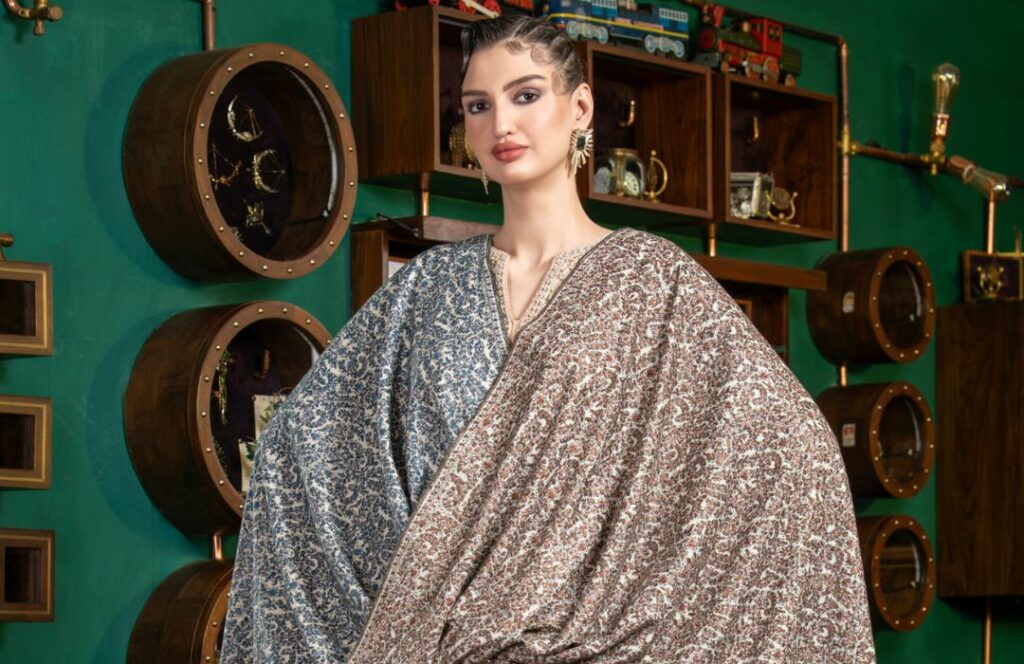
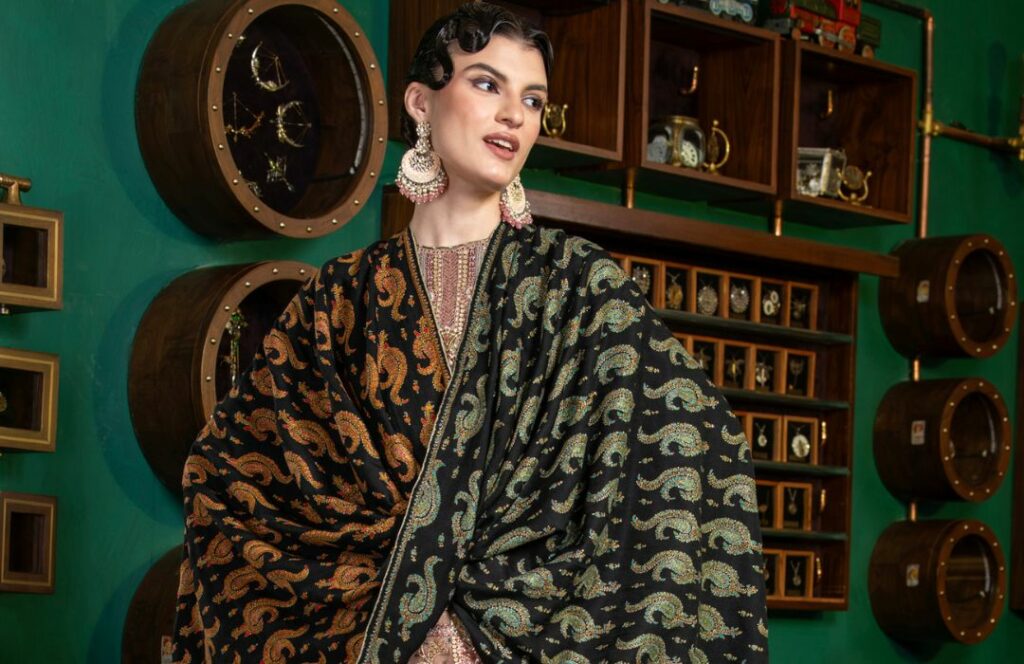
The do-rukha Pashmina Shawl showcases a cascade of floral motifs in Jamawar pattern to redefine the masterpiece as an heirloom legacy
You just need to know what to look for. First, look at both sides. It is easy to tell a real Do-Rukha apart: flip it over and compare the back to the front. Both sides are exactly the same: color-matched and clean finish. If there are many loose ends or if the back is untidy, that is not Do-Rukha. Second, look for knots or loose ends. Run your hand over the embroidery, and it should feel beautiful and smooth on both sides, with no knots or bumps. Look closely at the edge of motifs. Handmade Do-Rukha has small irregularities and slight asymmetry in the stitch work. That human element ensures it is handmade, whereas machine work is stiff and machine-perfect.
Third, feel the fabric. Real Do-Rukha is only done on pure Cashmere, which is a warm, fine, soft wool. Therefore, fake shawls use viscose or wool blends and feel either slippery or heavy. Thus, you can also hold the shawl up to the light and see if the fabric has an uneven weave or looks too perfect. Make sure you buy from a trusted seller like pashmina.com and you always get a certificate of purity.
How Long Does It Take to Make One Handmade Do-Rukha Pashmina Shawl?
Time is the greatest evidence of handmade luxury. Creating a Do-Rukha Pashmina needs several months. A simple border with small motifs takes between 4 and 6 months. A medium Jaama design takes 12 to 18 months. A full, heavy Jaal design can take 18 to 24 months, and sometimes more than a year. The artisan works 6 to 8 hours each day, but can embroider only one inch daily, and sometimes even less. Maintaining perfect symmetry is essential, so the work cannot be rushed.
Good daylight is necessary to see the fine stitches, so the artisan does not work at night. This slow process ensures precision. Every hour spent increases the value of the shawl. A Do-Rukha is so luxurious because you are not just buying a shawl, you are buying one full year of an artisan's life. Every hour of his patience, every day of his hard work is woven into it.
You've never seen a Pashmina shawl shine like real jewelry; we assure you. That's the magic of Tilla Dozi. It is the most majestic form of embroidery from Kashmir. It has been loved by queens and brides for ages. It's not a common embroidery. It's meant for weddings, festivals, and special occasions. But now, the market is flooded with fakes. Many vendors sell plastic Tilla as pure Tilla. It appears to be exactly the same in pictures. But it wears out very quickly. That's why knowing about authenticity is very important.
We will tell you how to tell what real Tilla Dozi is. You do not have to be an artist. You just have to understand what to look for. We will cover thread quality, back finishing, shine, and weight. We will also tell you quick tests to do at home. So after reading this, you will be able to buy with confidence. And never waste money on fake Tilla again.
What is Authentic Tilla Dozi Pashmina, and why is it so special?
Authentic Tilla Dozi is a traditional royal embroidery of Kashmir. Today, metallic threads are used in Tilla Dozi embroidery. Tilla Dozi is a costly embroidery that calls for a lot of effort. It is hand embroidered with a special needle, piercing the fabric repeatedly and carefully with patience to achieve the desired design. The finished work appears like jewelry on a soft Pashmina shawl. Tilla Dozi is a timeless classic of embroidery. Tilla shawls remain shiny for years without fading or turning black. It adds weight to the shawls and makes them drape like royal attire without looking over the top. This is one of the reasons why most brides choose to wear it at their weddings. An authentic Tilla Dozi shawl can last for decades without any issue of fading or blackening, but a fake Tilla Dozi will not give you the real feel of hand-embroidery.
Real Zari vs Fake Plastic Tilla
The main difference is the actual thread. Genuine Tilla thread is made of fine metal. It is thinner, more delicate, and much softer. You can feel it being soft against your skin. It does not scratch or irritate the skin. The color is antique gold or silver, and it does not shine brightly like gold but has a softer, earthy glow, which shines subtly in sunlight. This is the sign of genuine Tilla. Fake Tilla is Lurex or plastic thread. Sellers call it Tilla, but it is nothing but chromed, synthetic thread. It is extremely shiny in the photos but looks cheap, shiny, and gaudy in real life. Touch the thread, and you will feel it's hard, with rough edges. It also has a chemical smell. It peels off in a few month's time or turns black or green quickly. If it looks extremely glittery or shines too much, it is fake.
The Most Honest Way to Spot Real Tilla Dozi Pashmina
The back side never lies. This is the first lesson in identifying whether a shawl is fake or not. Turn the shawl and study the back of the embroidery. In authentic Tilla Dozi, you will always see a clean, well-finished backing with no white glue patches, no loose ends, and neat, tight stitching. The back should look identical to the front, with the pattern visible and no loose threads sticking out. Achieving this neatness takes months for master artisans. In fake Tilla shawls, the back will be messy, with plenty of loose ends and white glue patches. Some sellers even paste Tilla with glue instead of stitching, and that will come off after one dry cleaning. So always check the back side; if the seller cannot show it to you, then do not buy it.
Shine, Weight, and Fall
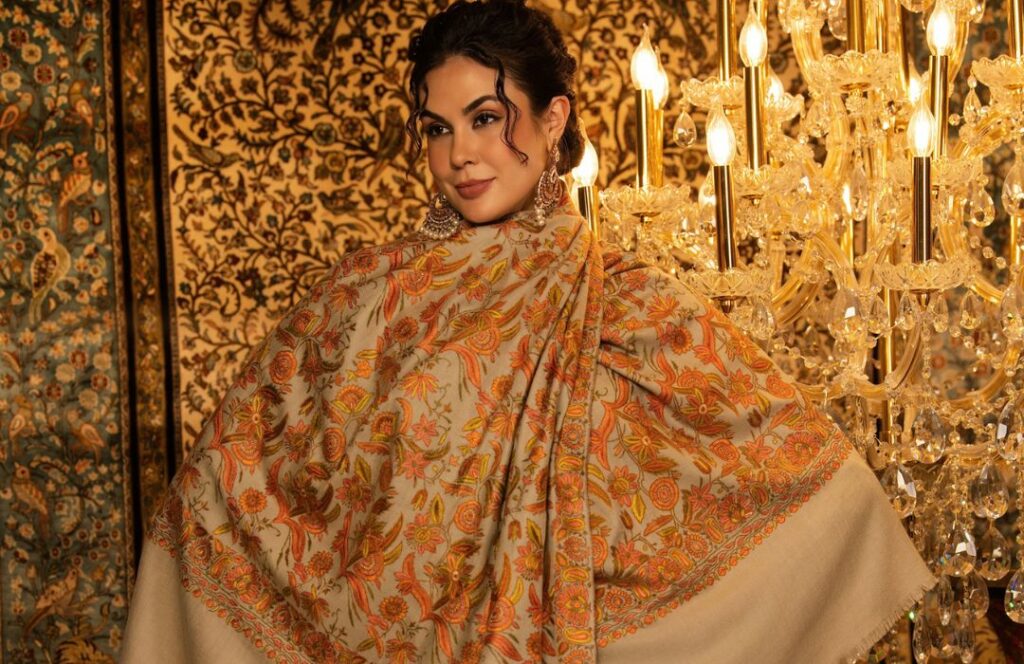
The authentic art of Tilla dozi on a Pashmina Shawl
It takes just three seconds to identify real Tilla. Firstly, real Tilla shines softly and is just like old gold there's no glare or disco-ball effect. Fake Tilla is shiny and very bright just like a disco ball. Second, feel its weight. Real Tilla will impart Pashmina with a pleasing weight so the Pashmina will hang properly and will feel luxurious when worn. Fake Tilla will be much lighter and stiffer, so the Pashmina will stand away from the body and not hang correctly. Third, give the Tilla a test. Gently crush the embroidered surface in your hand and see if it bounces back and does not break or crack. Fake plastic Tilla will produce a crackling noise, the threads will snap and it will leave creases. With these three simple tests, you can be sure you're buying real Tilla without any special equipment or technical know-how.
Common Tricks Sellers Use and How to Avoid Fake Tilla
Many sellers cheat buyers with smart techniques. The first trick is Mixed Tilla. They put genuine Tilla on the border and fake Tilla inside the main pattern. At first glance, it looks genuine. Always check the entire shawl, not just the border. The second trick is a low-quality Pashmina shawl. Real Tilla can only be put on pure Pashmina. Some sellers put it on viscose or poly-wool. The shawl will look shiny, but it will not be warm or soft.
To keep yourself safe, buy only from trusted sources. Ask if the Tilla is pure zari and hand-done. Ask for a guarantee card for pure Pashmina. A genuine seller will show you the back side happily. They will also tell you the difference himself. Avoid very cheap prices. Pure hand-done Tilla Dozi cannot be cheap. It takes months of hard work. If a deal looks too good to be true, it is fake, Tilla.
Invest in Heritage, Not Just a Shawl
When you buy a Tilla Dozi Pashmina don't just buy, value it! It's a cultural investment when you buy genuine Tilla Dozi Pashmina from Pashmina.com; you're buying Kashmir's past. Buying genuine Tilla Dozi is paying for the artisans and their craft; they spend months working on what they do. It's real, it lives with you forever, it gets better with age, and it will never go out of fashion. Feel the thread, look at the back, see the shine. Opt for the real one that keeps the shine as the thread. When you wear the real Tilla Dozi, you are not just wearing embroidery, you are wearing history, royalty, and true craftsmanship!
Have you come across a Pashmina shawl and thought that it looks like a painting? That is Kani Pashmina. It is neither printed nor embroidered. It is woven so intricately and perfectly that it appears to be nothing but a work of art on fabric. With hordes of machine-made look-alikes in the market, we truly get that you are confused. Well, the fact remains much glorified. Yes, Authentic Kani Pashmina is a 100% hand-woven textile. It is one of the most sophisticated handloom crafts involving patience, skill, and a lot of time. It takes months or sometimes years to complete a Kani Pashmina. Thus, it is not machine-manufactured but handcrafted with love from Kashmiri hands and eyes.
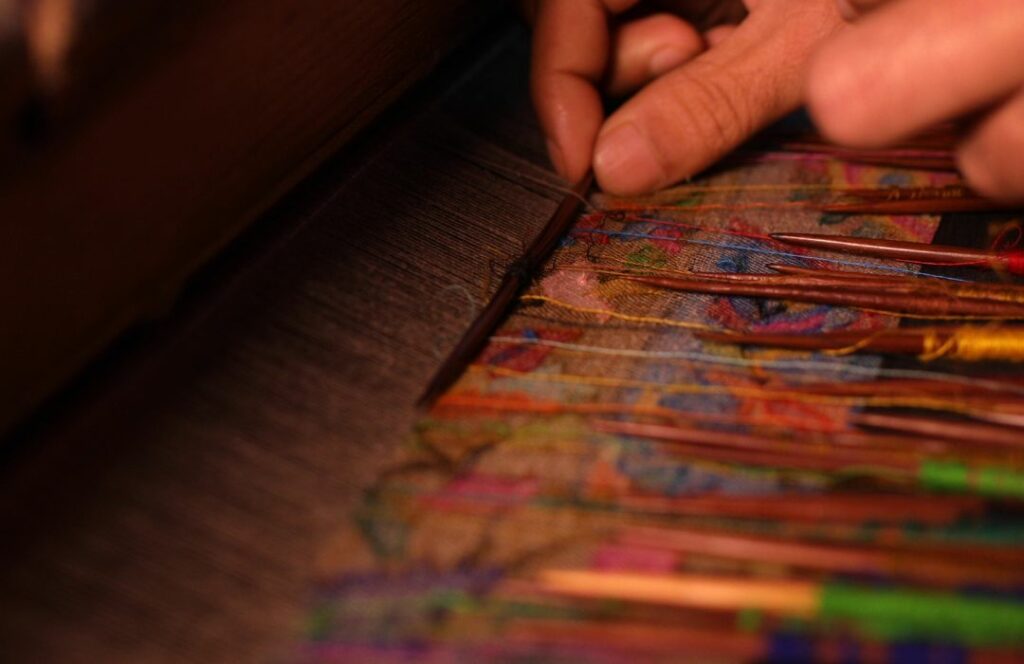
Moreover, every thread in Kani Pashmina is hand-guided. Artisans were aided by wooden sticks, which they held with one hand and used with the other, like painting while weaving. They followed a design in a script called Talim. Different colors had different codes and patterns, which is why it took so long to make even a small piece. No machine can replicate a human hand's precision and patience, and that is exactly what makes Kani different from Pashmina shawls with embroidery. Other shawls are embroidered after they are woven, but in Kani, the work is infused into the fabric. The design is part of the shawl, not just a decoration atop it, which is why it is velvety to the touch on both sides. It is not just a shawl but a handwoven inheritor of Kashmiri living.
What is Kani Weaving?
The weaving of Kani Pashmina
Kani weaving is a 500-year-old Kashmiri craft whose origin lies in a small town called Kanihama, where the craft was born and drew its name from. The Kashmiri word "Kani" means "a small piece of wood." Wooden sticks called Kanis replace shuttles and come dyed with a different color of thread to give the appearance of a paintbrush. Thousands of Kanis are used at the same time by the artisan to weave designs on the loom. Unlike embroidery, the design is not stitched onto the wool but rather woven right into the fabric, which is made of fine Cashmere, a very delicate wool that can only be woven by hand. The weaver uses a drawing, or Talim, made by an experienced master designer, which is coded like a language. Machines cannot decipher Talim, and each true Kani Pashmina is purely handmade.
How Long Does It Take to Make One Kani Pashmina?
Further, a Kani Pashmina is made very slowly. This is slow music, slow work. It needs patience, skill, and dedication. A single Kani shawl can take 5-8months. A thick, all-over design can take 12-18 months. Some royal Jamawars take more than 2 years! Only one artisan works on a shawl at a time. The artisan weaves only one inch per day. According to the design and size, a single shawl can take years to complete.
More colors, more Kanis. Thus, more Kanis, slower weaves. A shawl with 60 colors will have 60 kanis. The artisan will change Kanis hundreds of times, by hand, daily. His eyes will see, his fingers will know, no rest. This is artisan work. It is a meditation. That is why handmade Kani Pashmina is so rare. Decades of work mean it cannot be cheap. You pay not just for Pashmina but for human dedication. You are not just paying for wool; thus, you are paying for the art and tradition that this carries. Machine-made copies can be made in 1 hour. But they can never match the soul of handmade Kani.
Handmade Kani vs Machine-Made Jacquard
A family heirloom
The market features many Jacquard loom shawls. Many sellers describe these as Kani, but they are not authentic. Machine-made Jacquard shawls are manufactured rapidly in factories. They use computers to copy Kani patterns. From a distance, they look similar. Still, the difference can be felt by touch. Genuine handmade Kani shawls are very soft and light. Both sides feel almost the same. The design is slightly raised but remains smooth. In comparison, machine-made shawls just feel hard and stiff. The reverse side has weak, loose floating threads, which are very visible. The front view is printed and feels very flat and dull. Authentic and original Kani shawls have minor mistakes; this is a human craft, while machine-made shawls are so artificial that they seem uniform, dull, and cold.
Moreover, handmade Kani shawls can last several decades; their colors never fade, while Jacquard machine-made shawls lose their color after the first couple of washes, and their silky threads tend to stick out. Handmade authentic Kani shawls become softer and more beautiful the older they get and are made as family heirloom pieces, while the counterfeit Jacquard shawls wear out and go into the trash.
How to Identify a Genuine Handmade Kani Pashmina?
You can easily spot a real handmade Kani Pashmina. First, check both sides of the shawl. In handmade Kani, both sides are clean and finished. The pattern is visible on the back too. In machine-made, the back is messy with long floats. Second, look for the Moir effect. Real Kani has slight color blending where two colors meet. This happens due to hand weaving. Machines cannot create this effect. Third, check for small irregularities. Handmade Kani will have tiny knots and joins. These are signs of human hands. Fourth, always feel the texture.
Moreover, real Pashmina with Kani work is warm, light, and breathable. It is soft like a cloud. Fake shawls feel synthetic or too slippery. Always ask about the weave time. A genuine seller will proudly tell you how many months it took. Do not fall for low prices. A real handmade Kani pashmina can never be cheap. Pure cashmere with added wool itself is costly. Adding months of work, the price must be high. Beyond the time you spend, expect to pay a lot. Buy only from trusted platforms like Pashmina.com who offer authenticity proofs and luxury.
Why a Handmade Kani Pashmina is Worth the Investment?
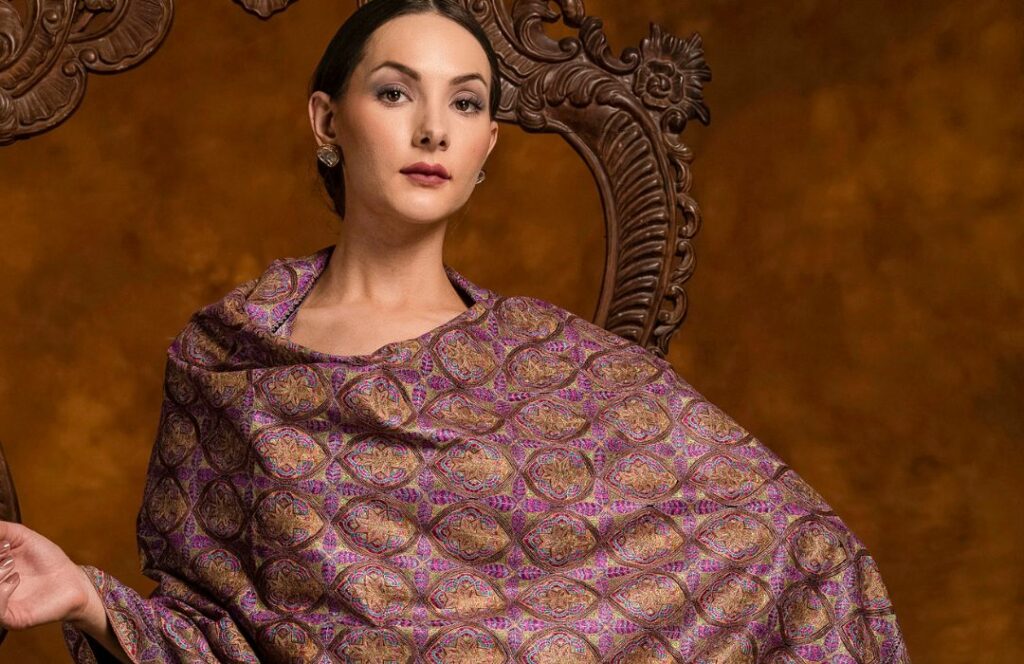
Hand-Crafted and hand-woven with precision, this shawl offers an elegance of multicolor weaves with hues of vivid shades across the fine Cashmere
A handmade Kani Pashmina is more than a shawl. It is wearable art. It carries 500 years of Kashmiri culture. Each piece tells a story of its weaver. When you buy it, you support artisan families. You help keep this dying art alive. Very few master weavers are left today. The younger generation is leaving this hard work. Your purchase gives them respect and livelihood. It is also a smart investment. Fashion changes every year. But Kani Pashmina never goes out of style. Its value increases with time. It can be passed down to your daughter or granddaughter. It never loses its charm.
Unlike machine-made shawls, it does not get wasted. Finally, it feels different. When you drape a real Kani, you feel royal. It is light, warm, and incredibly elegant. It goes with Indian and Western outfits. You can wear it at a wedding or a formal dinner. It makes you stand out quietly. People will notice the art, not just the shawl. That is the power of authentic handmade craft.
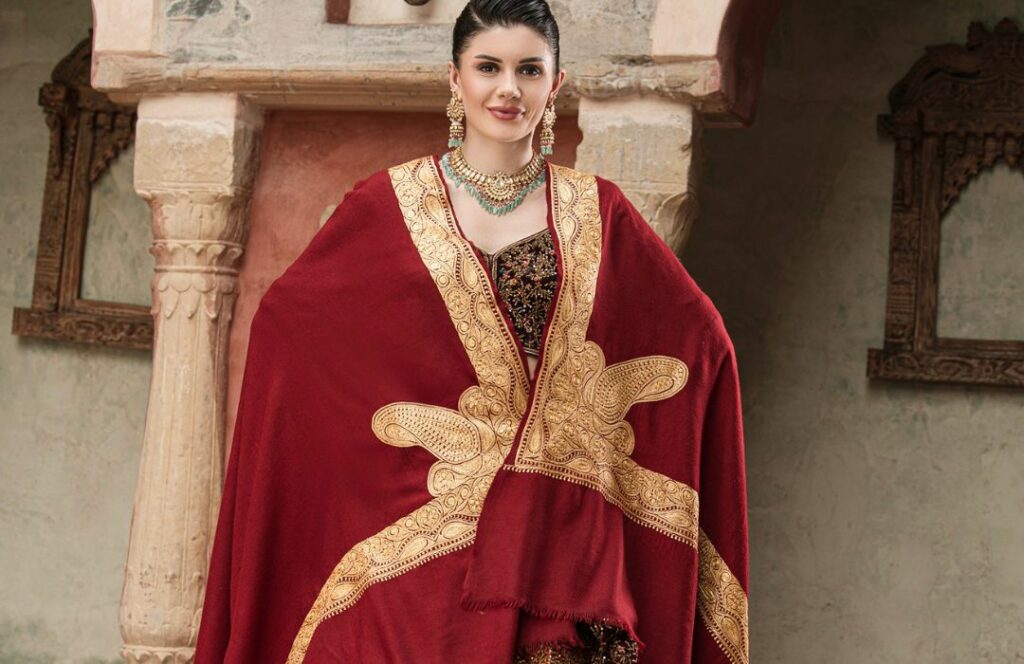
A Pashmina Shawl already is a miracle in itself- woven with the world's softest cashmere wool, breezy like a feather, and comforting like a warm hug. But when a Pashmina Shawl is combined with Aksi embroidery, it becomes a legend. Aksi is the most challenging and the most prestigious form of Sozni embroidery ever crafted in Kashmir.
Aksi differs from ordinary embroidery in the sense that the embroidery on the front and the back of the Pashmina. Artisans do embroidery individually on both sides with distinguised pattern and colors. Thus, no telltale knots to hide behind, and it remains impeccable, making it perfectly reversible and intricate from both sides. It is difficult to look at an Aksi embroidery and not be in awe of the human hand that can create such exquisite precision. A genuine Pashmina Shawl is not only woven but also needle-embroidered. Of all the embroideries of Kashmir, Aksi is the most extraordinary and most exacting.
What is Aksi Embroidery? The Art With No Wrong Side
Aksi is literally defined as the form of hand embroidery done individually on both sides of a Pashmina Shawl. And because of this, it is the most difficult and revered form of Sozni embroidery. Normally in Sozni, a pashmina shawl has the embroidery on the front side only, and on its backside, tiny knots are seen with floating threads. But Aksi is different as there is no backside at all. The front is embroidered as well as the backside is embroidered individually. And both are equally immaculate and beautiful till it is reversed. Thus, you can't tell which side is the front. It's this remarkable intricacy that makes Aksi special. It is embroidered on the front and back simultaneously.
Aksi takes twice the time, twice the thread, and more concentration. Thus, it is a skill that very few artisans are able to perform, even in all of Kashmir. It is not just embroidery but also a test of patience and eyesight.
The Canvas: Why Only Pure Pashmina Can Hold Aksi?
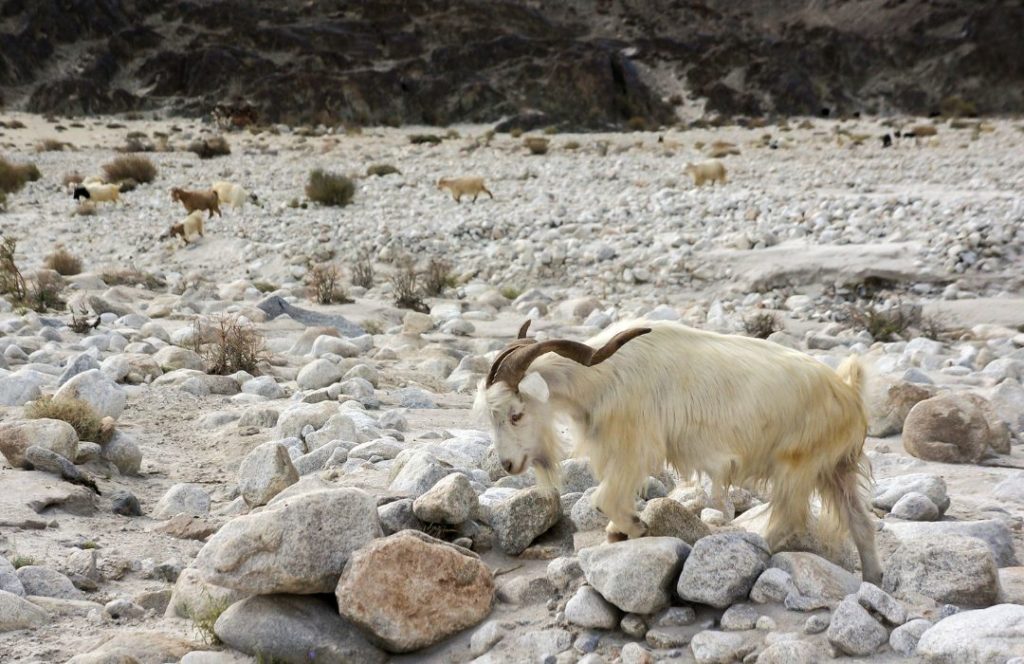
You can't do Aksi on just any fabric. Aksi demands a 100% pure pashmina shawl, woven from the finest cashmere gathered from the Changthangi goats of Ladakh. A pure Pashmina weave has the tensile strength to support thousands of tiny stitches on both sides, plus a fine, tight weave needle pierces cleanly. Blended or machine-made shawls will pucker, break, and develop holes. Pure Pashmina shawl remains featherlight, breathable, and remarkably resilient.
Begin by washing, stretching, and mounting the Pashmina Shawl on a traditional wooden frame called a Woshun. Then, sketch the design onto the fabric, not with a viscin or ink, but with a rough charcoal outline, from memory or subtle thought. The base color, is crucial because, in the finished Aksi, the Pashmina itself becomes an integral part of the design, the unobtrusive but vital background image peering through the embroidery like a serene sea.
The Tools of a Master Craftsman
No machine lives in the Aksi workshop. There are only three implements: a super-sharp needle, delicate silk or pashmina thread, and the artisan's memory. The super-sharp needle is used and does not tug or leave a hole in the sutured cashmere. The ultra-fine silk thread, often in dozens of different shades, can be found in an Aksi design that offers the signature sheen to each Aksi piece. And, of course, it's the artisan's mind that matters most. An expert Aksi artisan can work without a printed pattern on the shawl: he remembers countless traditional motifs, whether they're paisley or buta, chinar, or flower, as dictated by the style of the artisan. Sitting for 7 to 8 hours a day in mostly complete silence, only working in natural daylight. Only the finest senior craftsmen, who have mastered Sozni for years, can render the intense detail of Aksi.
How Aksi is Done on Both Sides Individually?
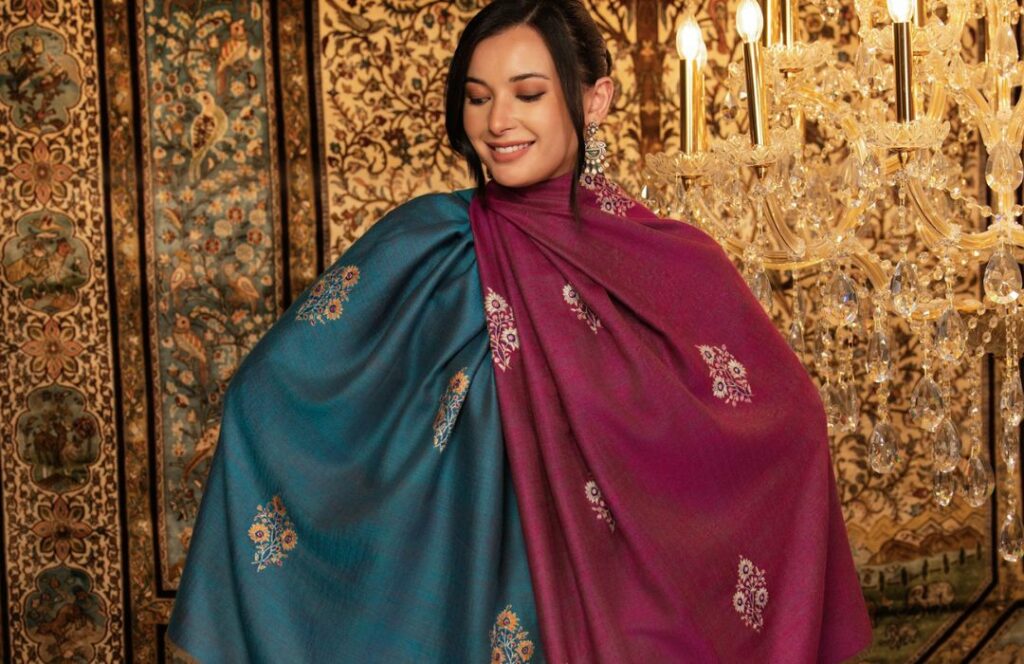
Handcrafted from fine Cashmere wool, hand-woven across the handlooms, adding a touch of culture on each side of the shawl by hand embroidery in a specific way, making it a luxury worn on both sides
It is a meditative process. He begins by making one single stitch on the front side of the Pashmina. Instead of taking the thread back to the left and leaving a knot, he then carefully pushes the needle through the fabric to the back of the Pashmina in the precise same spot; he locks the thread. When you closely observe the shawl, you notice no thread jumping from one motif to the next on either side, and each motif is embroidered individually one by one, color by color. He works the motifs one by one, color by color on each side of the shawl.
One flower with five colors, for example, one by one just on one side of the shawl, then on the second side. One by one on one color, then on the second color, and so on; this way, the tension becomes balanced, and the shawl does not necessarily feel heavy on one side and difficult to wear. A small Aksi Pashmina Shawl with light embroidery takes 3 or 4 months to make; a heavily embroidered bridal shawl takes more than a year. The finished product is a Pashmina that is reversible, feather-light, and so neat that you can use it from both ends.
How to Identify a Real Aksi Pashmina Shawl?
Because Aksi is so precious, many machine-made copies have appeared on the market. A real Aksi Pashmina Shawl should have three unmistakable identifying features. First, examine the reverse. Fake shawls have knots and long floating threads all over the back, while the reverse of a genuine Aksi can be admired in all its glory; you will not be able to distinguish it from the right side. Second, feel its weight. A real Aksi Pashmina, despite the amount of elaborate different embroidery on both sides, is feather-light and silky-soft because the base is pure cashmere and the embroidery is micro-fine. Third, look at how fine the stitches are; they are tiny, almost to the point of being painted.
Besides that, as you study the motifs, you will notice that they have smooth, rounded shapes and soft, flowing lines rather than the jagged, machine-like stitchwork of inferior craftsmanship, and they have rounder, more natural shapes that look as if they could be modeled in clay. Finally, look at the price: there is no such thing as cheap genuine Aksi Pashmina; what you are really paying for is 6 months to 12 months of time in the life of the master artisan. If the price is unbelievably low and the scarf was supposedly completed in 15 days, then it's not Aksi.
Aksi Pashmina Is More Than a Shawl - It's an Heirloom
With exquisite hues that evoke sophistication, each face of the shawl has a unique charm
An Aksi Pashmina is not a wedding gift that comes and goes. It represents the everlasting. The time required to make an Aksi Pashmina is very long to achieve the demanded perfection of pashmina. The patterns are inspired by Persian gardens and royal courts. The pure cashmere will get softer every year, unlike a new one. That is the reason it represents culture, grace, and continuity. It's a Kashmiri soul that you drape over her. She is going to wear it on her first wedding anniversary. And for all the other special moments.
Do-rukha means two faces. One shawl, two identical sides. It is the highest form of Kashmiri embroidery work on a Pashmina Shawl. The front and back look exactly the same. No knots. No loose ends. Thus, no wrong side. You can wear either side, and it feels like magic. The artisan uses a single thread for two-sided hand embroidery. He works so meticulously that he reflects the same perfect design on the other side. If one side is the original, the other side is the twin. So, master artisans spend months finishing one Do-rukha Pashmina Shawl.
A real Do-rukha pashmina shawl is very rare and costly. Only a few master Kashmiri artisans can do this magical stitching today. It takes exceptional skill, patience, and keen vision to do this stitching. A mirror effect should be put on both sides at the same time, but if one accidental loose thread were to be missed on either side, the mirror effect would vanish forever. That is why it takes 12-24 months for one shawl. It is not just a luxury Pashmina Shawl. It is a living legacy for generations.
What Does "Do-Rukha" Really Mean?
Do-rukha literally means two-faced. In Pashmina, it refers to a perfect shawl with no wrong side. The front and back are identical; every flower, paisley, and thread looks the same on both sides. You can flip it, and no one can tell. This is why it is called the mirror image shawl. This art is considered the Koh-i-Noor of Kashmiri shawls. It is not double-sided fabric, but single-layer embroidery is done so skillfully that both sides are clean, with no knots, shadows, or hanging threads. Therefore, when you hold it against the light, you see only art. That is true, Do-rukha.
How Is A Do-Rukha Pashmina Shawl Made?
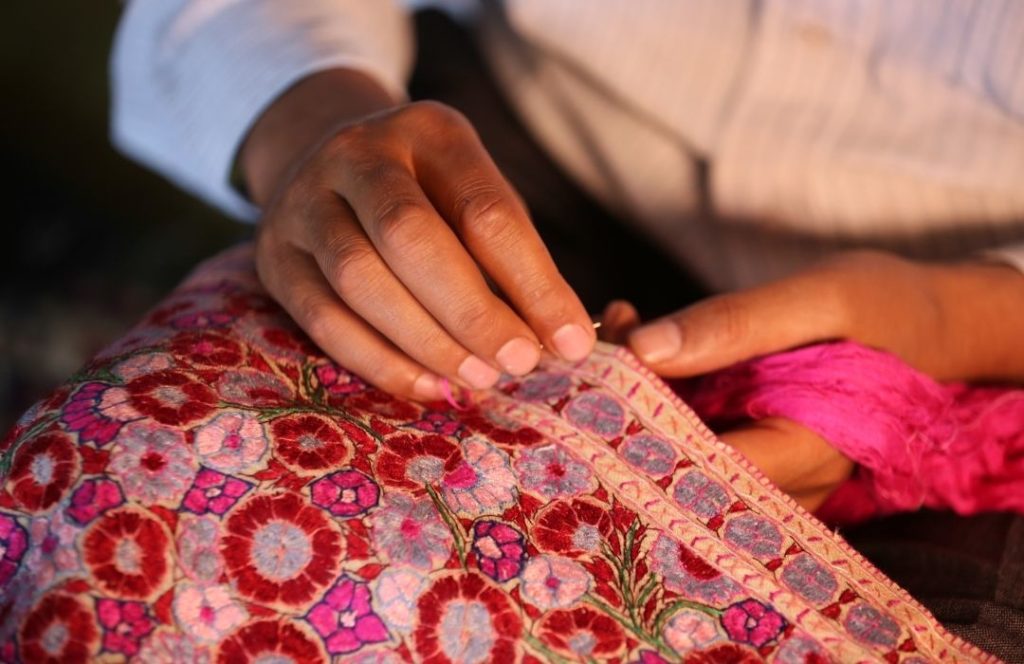
Artisan hand embroidering Pashmina with perfection
A Do-rukha pashmina shawl is not made. It is meditated upon. First, the base is pure handwoven Cashmere wool from Ladakh. It is incredibly soft, light, and warm. Then the master artisan begins the embroidery. He uses a very fine needle and a single thread for both sides. He counts every weave and hides every knot inside the yarn itself. The artisan works without a frame, sitting for hours and stitching only a few inches a day, with his eyes and hands moving in perfect harmony. If his tension is slightly loose on one side, the mirror breaks. Thus, one shawl can take 10 to 18 months to finish. That is why a single Do-rukha shawl is a lifetime masterpiece.
How To Identify Real Do-Rukha?
A majority of the shawls being sold as Do-rukha are fake. Be aware of the difference. In a fake shawl, one side is clean and the other is messy. You will see knots, extra threads, and a dull design on the back. In an authentic Do-rukha, neither side is messy. Both sides are equally clean, vibrant, and finished. Here is a simple test you can do. Turn the shawl in your hand. Check the embroidery base for any knots or loose ends. Now look at the colors. Moreover, an authentic Do-rukha has equally bright colors on both sides. A fake one will have a dull back. An authentic Do-rukha will never have any printed outlines on the design. All the embroidery is purely done by hand needlework.
Why Is Do-Rukha So Expensive And Rare?
Defining the miracle of Pashmina craft, the Rafiiush Shaan Do-Rukha Pashmina Shawl is a magnificent creation by the artisans
A Do-rukha pashmina shawl is pricey because it is pure human brilliance. There's no machine that can make it. There's no technology that can beat the mirror sheen on a pure Pashmina shawl. There are only a handful of artisans in a few villages of Kashmir who know this secret art today. They learned it from their fathers, who learned it from theirs. Second, time is the biggest cost. An artisan can produce ten single-sided shawls in the time it takes to make a single Do-rukha. He is giving you almost a year of his life, eyesight, and patience. And the base is quite costly. There's only one place for a real Do-rukha 100% pure Pashmina shawl, never wool blend or viscose. That perfect trio of rare skill, time, and material makes it a true luxury investment.
How To Style And Care For Your Do-Rukha Shawl For Life?
Since a Do-rukha Pashmina Shawl can be worn on both sides, you get two looks in one. Drape it over a saree for a wedding, wrap it over a gown for dinner, or pair it with a basic casual dress for everyday royalty. Its timeless quality means that it will never go out of fashion and, with every wear, will become softer and softer. To keep your Do-rukha for generations, under all circumstances, never wash in water; never machine wash. Just get it dry cleaned by a trusted Pashmina expert! Keep it in a muslin cloth, and do not spray it directly with perfume or expose it to the sun. Air the Do-rukha in the shade once a year, and you will create a family heirloom!
Is the Do-Rukha Pashmina Shawl a Good Investment for the Future?
Owning a Do-rukha pashmina shawl can be a great luxury investment. Do-Rukha remains something you will cherish and pass down to future generations. Unlike fashionware, which quickly goes out of style, a real Do-rukha only appreciates in value year after year. The demand for authentic Pashminas is still high in the global market, and not enough artisans are out there to fill that demand. Today's purchase is tomorrow's treasure, a buy of pure gold you can wear!
Further, a Do-rukha is an heirloom you can pass on to your children. It is not made in a factory but carries the blessings and hard work of a Kashmiri family. When it is handed over to your daughter, you are gifting her more than just a piece of cloth; you are handing her down a part of history, tradition, and an ageless art. That's why a wise woman chooses one perfect Do-rukha over ten faddish additions to her wardrobe!
Pure Pashmina is a mild experience of warmth on your skin. It is feather-light but wraps you in the timeless warmth of the Changthangi. Handmade Tilla Dozi adds a royal gold sheen to this softness. This is not an average thread; it is hammered metallic gold. Thus, a one-of-a-kind luxury is crafted.
A Tilla Dozi Pashmina Shawl is not some garment you wear once and forget. It is built to last generations, passed down from mother to daughter. Fast fashion loses its pull within months. Eight months of one master artisan's life go into every stitch. Each shawl keeps alive the lineage of Kashmiri royalty. That is why women call it wearable gold, not a shawl.
What is Tilla Dozi?
Tilla Dozi is the most regal and ancient embroidery of Kashmir. The word 'Tilla' means 'gold,' and 'Dozi' means 'embroidery.'Thus, real Tilla is a thin metallic wire, hammered thin enough to bend like a ribbon. This flat ribbon is couched onto the Pashmina Shawl with an invisible cotton stitch. Metal never pricks the Pashmina; it merely rests on it. This allows the Pashmina to be cushioned in jewel-like brilliance that gleams in a soft glow from all directions. This is the reason the base must always be 100% pure Pashmina Shawl.
Only a hand-woven Pashmina of the finest quality, obtained from the under-fleece of the Changthangi goat in Ladakh. It has the natural strength and elasticity to support such heavy gold work for generations without sagging or tearing. A blend of wool or viscose will go lumpy and itchy and break like a leaf under the weight of Tilla. But a pure Pashmina Shawl is, as it should be, cloud-light, enveloping, warm, and strong enough to give shape to a painting of gold. That is the luxury base of its making.
How is Tilla Dozi done by hand?
The shimmering metallic threads of the Tilla work beautifully contrast the lush base, adding an element of opulence and sophistication
The embroidery work begins a long time before the actual embroidery. First, the true Pashmina is woven by hand on a traditional wooden handloom in Kashmir. Then it is washed in the cold, mineral water of the Jhelum River to soften it and make it more receptive to dye and embroidery. Then the soft Pashmina is stretched on a large wooden. The master designer, or 'Naqash,' draws Mughal motifs, chinar leaves, paisleys, and intricate Jamawar jaal designs onto tracing paper, which is then perforated. The design is then transferred onto the Pashmina using a smear of charcoal dust. This is a 'work of art' itself.
The artisan works under the frame for 6 to 10 hours a day and in natural daylight to accurately reveal the actual luster of the gold. Using a very fine hook, he punches the flat. Tilla wires on the outline of the design. Thus, holds it in place with a hundred or more invisible couching stitches per inch; over 300 stitches per inch for dense bridal Tilla works off an inch! To make a full-size, all-over bridal Pashmina Shawl with a heavy Tilla jaal pattern, two master artisans work together for 14 to 18 months. An error on one stitch means losing months of work, and there is no hurrying. This isn't being made; this is being meditated into existence, and that slowness is what makes it luxuriously so.
Handmade vs. Machine Tilla
Today there are far too many cheap, machine-made Tilla shawls, which look similar in photos but are zero worth investment. The difference is tangible once you know what to look for. Handmade Tilla Dozi has a plump, elevated, textured 3D touch and feel of gold. The artisan layers gold to give the motif depth, so everything literally jumps off the pashmina shawl and sparkles differently from every angle. There is hardly any glow in machine Tilla looks like a plastic sticker pasted on the fabric, and it shines with a loud, cheap shine of glitter. Handmade glows, machine shouts. The other and biggest difference is the durability and fabric.
In handmade Tilla, the gold is wrought on pure cotton thread, which will stay with you for 50 years, and the real metallic Tilla never blacks. In machine Tilla, the synthetic plastic thread pasted to the fabric starts peeling and blackening after two or three dry cleans, and most importantly, the handmade Tilla is always done on 100% pure Pashmina Shawl that is soft, warm, and light and passes the ring test. Tilla made on a machine, Tilla, machine-made, is done on a usually fake, poly-wool, or viscose base that is stiff, papery, and itchy. One is an heirloom; one is a costume.
4 Reasons Why Tilla Dozi Pashmina Shawls Appreciate Like Gold
A handmade Tilla Dozi Pashmina Shawl is not an expense; it is an asset that appreciates, and there are four clear reasons why.
Cashmere goat in the extreme winters of the Himalayas
First, the raw materials are getting rarer every year. Authentic Cashmere wool is limited by nature, and the number of master Tilla artisans in Srinagar is now less than 50 families. Second, it is timeless. Fashion trends change every season, but a bridal Tilla Pashmina has been worn by Kashmiri brides since the Mughal era in the 16th century. Thus, it will still be the most coveted bridal heirloom in 2026. It never goes out of style. Third, it is wearable wealth. In Kashmir, women call it a wearable bank locker because both the pure Pashmina and the real Tilla has intrinsic value and can be resold at a high price even decades later. Fourth, it is the most sustainable luxury. It supports goat herders in Ladakh, spinners, weavers, and embroiderers in Kashmir, uses zero electricity, and creates zero waste, unlike designer bags that use chemicals and factories.
How to Identify and Care for Your Heirloom Tilla Pashmina Shawl?
First, do the backside test. Flip the pashmina shawl and see if the back of the handmade piece is as tidy as the front. In a real handmade piece, the tiny white couching stitches will be evenly spread across the gold, and the pattern will be visible through the lace-like weave of the Pashmina. In a machine-made fake, the back will be sloppy, stiff, and coated in white glue with loose plastic strands. Then do the touch test. Real Tilla will be slightly cold like metal, while fake will be warm and plasticky. Real Pashmina will be warm, soft, and light, while fake will be heavy and itchy.
Caring for your heirloom is easy. Never hang the Tilla Dozi Pashmina Shawl (as it can stretch the weight of the gold out of shape and weaken the cashmere. Always fold the Tilla Dozi Pashmina and keep it in a pure cotton or muslin bag for the Pashmina to breathe. Always keep away from perfumes and water. Only dry clean once a year and only from good, reliable dry cleaners who take care of pure Pashmina and real Tilla. Treat it with love and care and you will be able to pass it on to your daughter and granddaughter on their most special days for 50 years to come.
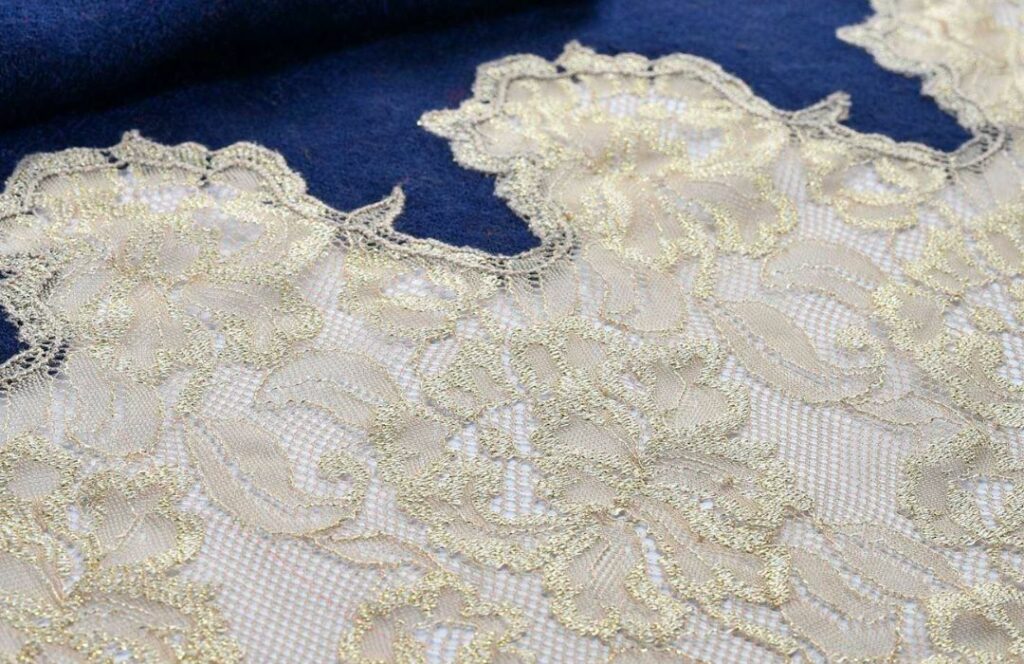
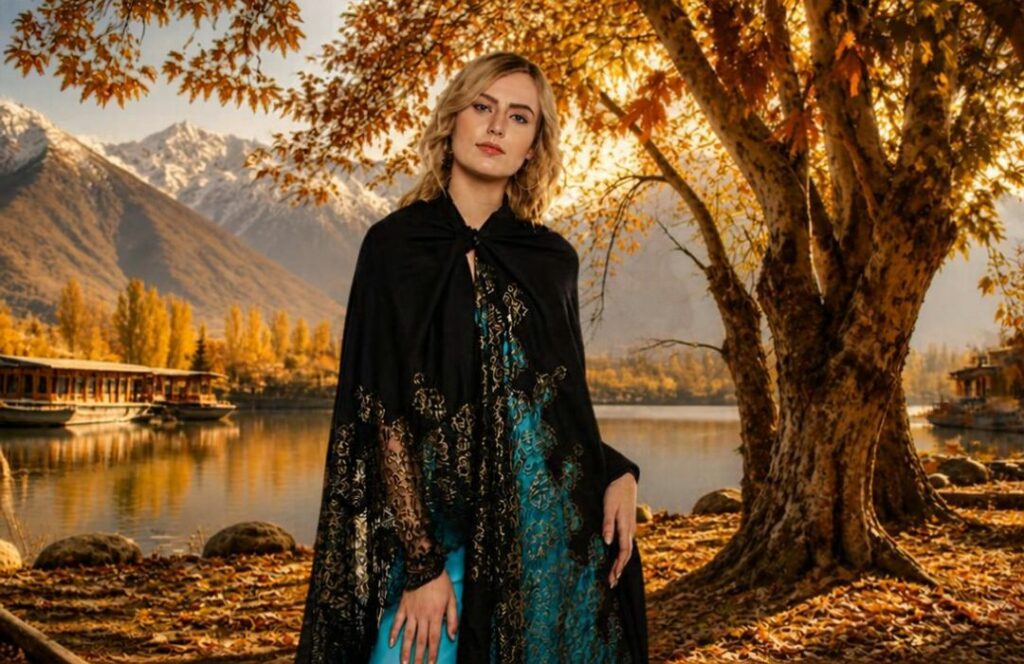
Pure pashmina shawls are soft at their best. By combining it with French Chantilly lace it becomes a piece of art. French Chantilly lace is famous for its intricate design, complex flower patterns, less weight, and transparent quality. When the artisans set it upon pure pashmina the results are simply stunning. The cozy, handwoven foundation paired with the sophisticated and chilled out nature of the French lace. Every border of the patch is hand-stiched. Every design is applicated with such imagination. It may seem to be easy, but it is a matter of a long time. Thus, creating an intricate Lace Pashmina Shawl.
Moreover, this pairing is almost the perfect balance. The Cashmere is pure warmth and tradition. The French Chantilly lace is pure romance and sophistication. They reconcile with love. The lace isn't an anchor. It's a supporter, a softening frame that makes the shawl contemporary, sensuous, and eternally beautiful. When you wear the shawl, you wear two worlds. This is why a French Chantilly pashmina shawl defines detail and intricacy.
What Makes French Chantilly Lace So Special?
French Chantilly lace is not just any lace. It is soft, light, and extremely elaborate. It is best known for its intricate floral designs against a sheer net. The design appears fragile but is infact, very difficult to produce.
Used to be made exclusively for kings, queens, and fashion designers. Even today, it continues to be the mark of absolute richness and opulence. Its beauty lies in its fineness, elegance, romance, and lightness. These are reasons why pashmina shawl is just the right textile.
The Purity of Real Pashmina Shawl
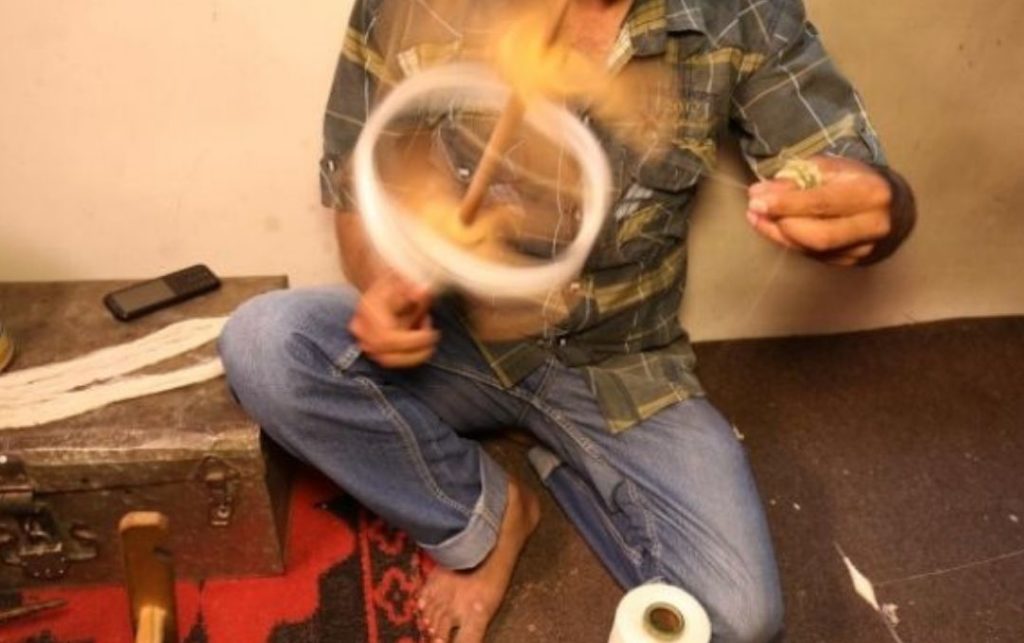
Pure pashmina shawl comes from the Changthangi goat, and Cashmere is a rare warm but feather-light fibre. It is handspun and handwoven in Kashmir by artisans, making it very soft, light, and breathable as well as strong.
Moreover, this solid background is the perfect base for the lace. It does not compete. It supports. Thus, allows the lace to shine and keeps you warm. Without solid pashmina, the lace is free of soul.
The Work Behind Every Inch of Lace
Making of Laced Pashmina
This shawl is a crossover. It is a connection. First, it is a Kashmiri connection. Strong, steady, and dedicated craftsmanship of centuries on centuries. Moreover, it is a French connection.
Putting them together, you get something special. It is something that is not Indian, it is not French. It is about this piece, embracing the two cultures, while celebrating the beauty of good craftsmanship.
How Lace Transforms a Pashmina Shawl Into a Statement?
A simple pashmina shawl is very beautiful. The lace border added makes it memorable. A perfect framing of the shawl, the Chantilly border turns the shawl into a piece of art. The border not only adds texture and dimension but also a delicate feminine touch.
Thus, it transforms an ordinary day into an heirloom gift. It may be worn to a wedding, over black-tie or you're welcome to simply throw the shawl over your shoulders. The light shimmering of the fine lace is bound to turn heads. Simple just got special.
Styling Your Chantilly Lace Pashmina Shawl for Timeless Elegance
A shawl has its own way of dressing up an outfit. This one doesn't need any heavy styling! Just enjoy it as a star, add it to a solid-colored dress, and admire the lace border showing. The contrast will be simply chic.
Further, for the traditional look, just drape it and fold over your arms. For the contemporary, simply toss it around your neck as a scarf, the lace in front. Either way it is gorgeous. And a family heirloom!
Why Chantilly Lace and Pashmina Are a Perfect Match?
They both are light. They are both known for softness. Pashmina shawl is warm but never weighty. Chantilly lace is intricate but never stiff. When combined together, they make a piece of luxury.
The pashmina off sets the lightness of the lace while the lace defines the simplicity of the pashmina neither dominates other. We seldom find harmony like this. This is what makes this shawl so elegant.
How to Identify an Authentic Lace Pashmina Shawl?
A genuine piece is a different feel. Authentic Lace Pashmina shawl is warm to touch, not slippery. It is slight uneven in appearance because it is handwoven. A fake pashmina feels synthetic and too shiny.
Real French Chantilly lace will be soft, not stiff. The flower design will be delicate and clean. When joining the lace to pashmina, quality will be handmade, neat, and finished. Check the feel, the finish and the lay.
Caring for Your Lace Pashmina
Such precious family treasure. Here's a fragile heirloom, a very delicate piece. Always think lightening care. Don't machine wash. Gently dry clean, as is necessary, and be store it in folded muslin cloth or butter paper.
Moreover, they have to be away from direct perfume and jewelry, which might pull the lace and make it snag. If the item is creased, then use a light steam at a distance. With a little bit of loving care your Chantilly lace pashmina should last you for many years to come.
Why every woman should own a Chantilly Lace Pashmina?
Displaying the proficiency of the golden hands, which never tire of transforming a simple fabric into a masterpiece, here is the grand Kashmiri Pashmina shawl with a modish tryst
All wardrobes have trend items. But all women need a classic item. A French Chantilly lace Pashmina shawl will always be in fashion. It doesn't matter what you age or occasion this Pashmina will always be appropriate.
Also, it's an investment not an expense. It's your forever piece. It can be your family heirloom. It only gets more valuable as the years go by because genuine pashmina and authentic chantilly lace are becoming increasingly scarce.
Moreover, it makes you feel special. Thus, it feels good on your skin, it looks good on your style. It gives you discreet confidence. That feeling is real luxury. And this is why you must have one.
A wedding present has to be something timeless, a lasting symbol of the day beyond the celebration. It is essentially a gesture filled with elegance and meaning, one full of significance rather than just a nice, trimmed thing. In fact, most remarkable arts and gifts of nature express not only the sight but also the feeling of love, warmth, beauty, and everlasting shelter. Genuine Pashmina shawls are those personal and elegant items that have been carefully selected to celebrate such an important milestone.
Similarly, an ideal wedding present should have the potential to become everyone's favorite. And be practical enough to be a part of everyday life. It should be able to change smoothly from being a special thing for the couple. To becoming a regular day-to-day thing in the house. Always reminding the couple of the happy day. The result when you combine thoughtfulness with quality and elegance with utility is a gift. That will neither be relegated to a store nor forgotten. It will be treasured, used, and appreciated over time. Moreover, gifts given to the newlyweds should communicate the same idea. In the first place, they should be a symbol of comfort in hard times. Secondly, the couple should be able to use them to express their joy when celebrating.
1. Sargam Pink Pashmina Shawl
This exquisite shawl features intricate Tilla embroidery, adorning its soft Cashmere base
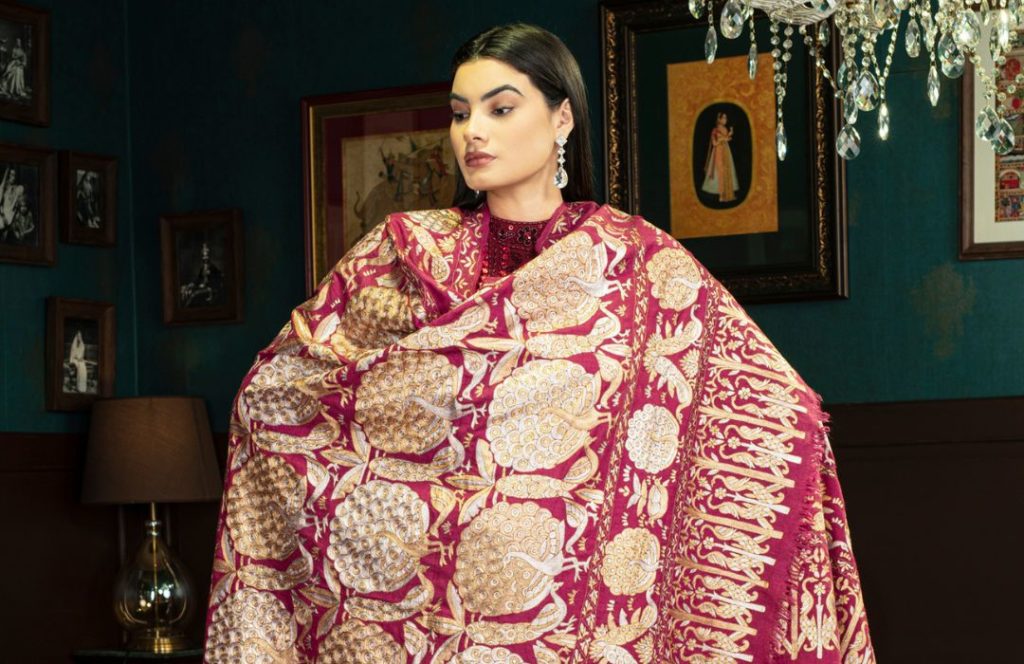
For those who want their present to make the bride feel like a queen, the Sargam Pink Pashmina Shawl is the perfect choice. This is a pure Pashmina shawl with intricate work of dense all-over golden Tilla Dozi, where huge motifs and peacock motifs sparkle like the opulence of jewelry on a luxurious raspberry pink. Tilla is an embroidery of celebration, and this shawl is something that truly represents that regal feel.
Pink and gold - the most auspicious colors of love, wealth, and celebration in an Indian wedding. The sweetest way to gift her a little golden love is a beautiful wrap of pure Pashmina. Draped in gleaming gold tilla. A new marriage never looks so good! The luxurious warmth of a pashmina and gleaming gold tilla make it the perfect gift. For her wedding reception or any celebration afterward. A blessing of style, warmth, and love forever.
The confections are forgotten and the money spent, but a classic like this shawl is treasured by the generations. Every one of those luxury shawls takes months of tedious, painstaking handwork on a wooden frame to produce that raised, gilded embroidery. Wrapped and presented with love, it is a meaningful gift. Give her a gift to remember, wear, and carry close to her heart, and one day it will be passed down as a family symbol and heirloom of your true love.
2. Ibaad Yellow Pashmina Shawl
Ibaad, a testament to exquisite craftsmanship, is a resplendent Yellow Pashmina Shawl that defines versatility and royal charm
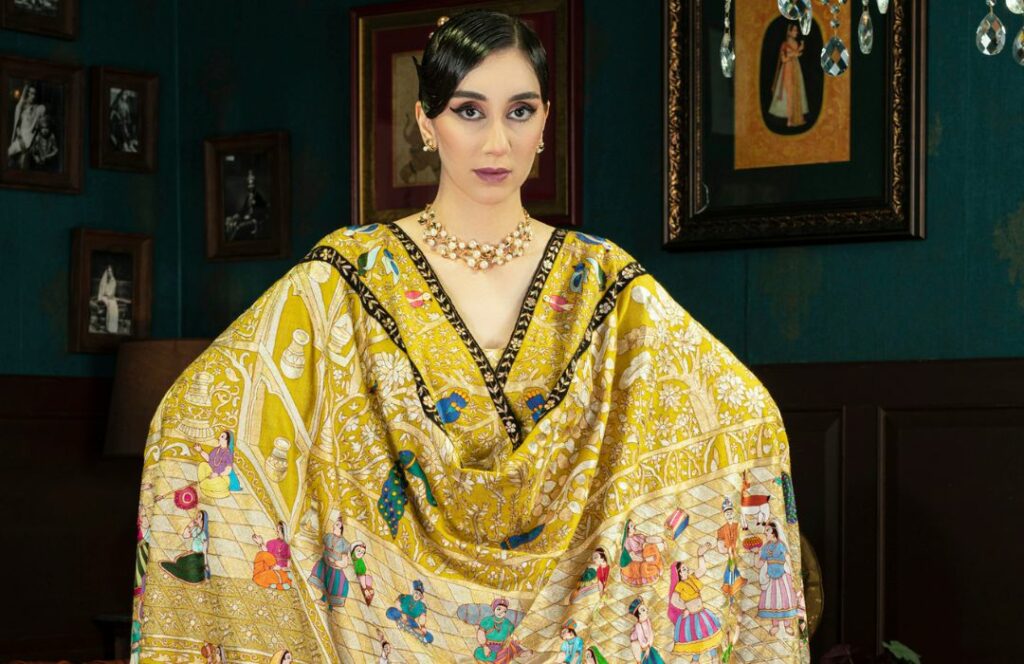
The Ibaad Yellow isn't just a Pashmina shawl; it is a masterpiece from the royal Darbar brought into existence. Hand-embroidered it in the scarcest of all earlier-done styles Tilla Dozi and replete with a celebrator Mughal scene of women making merry, peacocks, florals, and life in summertime around. On a glowing mustard yellow base with a chunky red pallu, this shawl is as much a painting as they could get. As a wedding gift, it sets itself far apart from anything common; it dictates that you've gifted a story.
Yellow is the color of happiness, new beginnings, it is one of the most propitious shades for a wedding blessing. This Pashmina shawl, bearing a lively celebration theme, is emblematic of the joy you wish to bring to the bride. She could wear the blessing for her mehendi or post-wedding celebrations or keep it as a treasured keepsake. In pure Pashmina, this soft, warm, and sumptuously luxurious blessing will be felt in every epoch when worn.
Most people give jewelry or money. But, to give an Ibaad Tilla Pashmina is a gift that will be treasured for generations to come. Specializing in Tilla Dozi, it takes months to complete a design of this quality. A Pashmina.com exclusive, packed in our signature box, it is sure to wow. The perfect gift to hand down through the family at every wedding.
3. Guldasta Kani Pashmina Shawl
resh blossoms picked from the Mughal gardens of Kashmir, as they flourish in the onset of spring, and scattered all over the gossamer Cashmere base of this Pashmina shawl
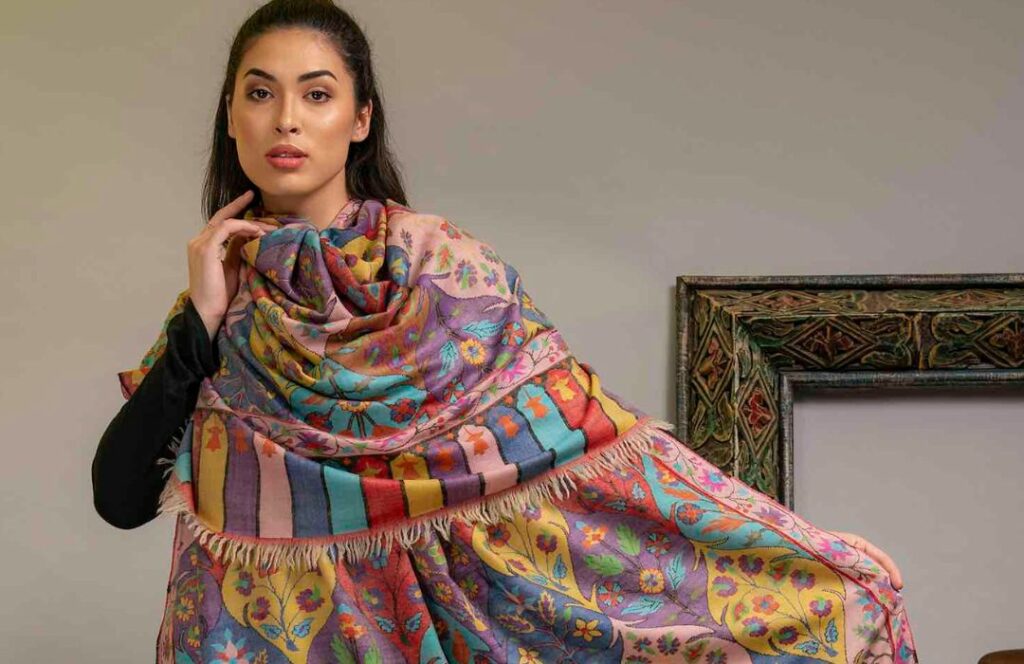
The name 'Guldasta' translates as 'bouquet of flowers,' and that means this Kani Pashmina truly is just that. Created by the 300-year-old Kani weaving technique, which uses tiny wooden sticks known as 'Kanis'. This shawl is just like a blooming garden - every inch is like a blooming flower. In multi-colored shades of pastel blues, yellows, and reds, this Kani Pashmina is lively, bright, and cheerful. When given as a wedding present, it is highly symbolic, as you are giving a bouquet of flowers that will always be fresh.
A Kani Pashmina is the most complicated shawl to produce in Kashmir; it can take from twelve to eighteen months to weave. And this is why it makes such a beautiful present for someone's wedding. It's not just something that has been produced on a big machine on a large scale. But slow, calm craftsmanship that has used only the purest Pashmina. It is the perfect bridal accessory—not too heavy for a morning brunch. Warm enough to be comfortable while out in the cold. And bold enough to add a splash of color to an outfit. This well-woven Pashmina shawl is a wish for a warm and colorful married life ahead.
Unlike the other jewelry that is permanently locked up in the lockers, this is a gift that she will actually use and remember for the rest of her life. The Guldasta Kani is both contemporary and traditional, so a young bride can wear it and keep it as a family treasure for decades to come. In the elegant Pashmina.com, it feels just as exclusive as it looks. Give her a gift that there is no one else in the world who has: a Kani masterpiece that can be passed down through the generations.
4. Dilgusha Blue Jamawar Pashmina Shawl
With the rich shade of riverside blue as a base, this masterpiece reflects an endless harmony of paisleys across the Dilgusha Pashmina Shawl
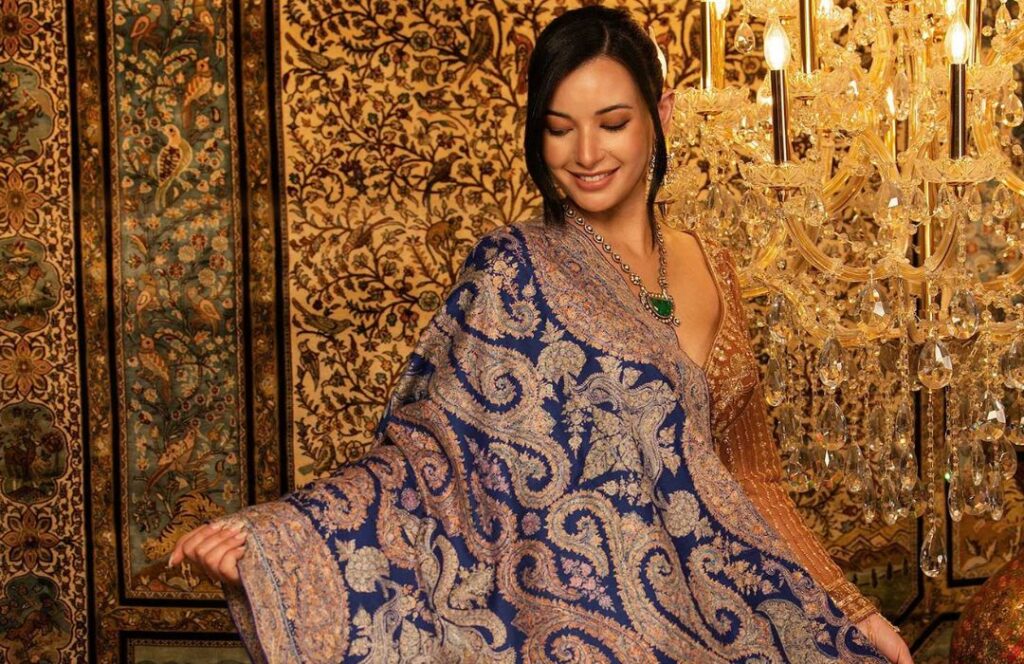
A wedding is two souls becoming one, and the Dilgusha Jamawar Pashmina Shawl is a gift worthy of that sacred union. This regal blue shawl woven in the purest cashmere is rimmed with the finest antique-gold Jamawar - the timeless Mughal artistry of paisleys and floral butas and delicately chiseled bells. As soon as you wrap it around, it moves like poetry plays with the light in every fold and turns the bride into complete and comfortable elegance. Culture. Warmth. Art from generations gone by.
Jamawar is not a wedding present that comes and goes; rather, it is a symbol of the everlasting. The time taken to make it may be several months. The designs are reminiscent of Persian gardens and royal courts. And the cashmere becomes softer with each year that passes. This gesture represents culture, elegance, and continuity. She is going to wear it for her first wedding anniversary and all other significant occasions. Remembering each time the one who gave it to her as something so special. By choosing the Dilgusha Jamawar, you offer her more than just a shawl. You offer her an heirloom, a blessing, and a piece of history that she can cherish forever.
5. Royal Red Papier Mache Pashmina Shawl
A royal revelation of your glorious culture - handwoven in the finest warps and wefts is a Kashmiri Pashmina dyed in the colour of love - Red
For a union that honors heritage yet is a reflection of the two bride and groom, the Papier Mache Pashmina Shawl is a gift that is both rare and heartfelt. It is based on the celebrated papier mache of Kashmir, and the artisanship of this 100% cashmere is a reflection of that time-honored craft on the cloth. Its deep red background vividly features large kalka paisleys plus small butis and jaal work in harmonious shades of blue, green, and ivory. Each element is painstakingly embroidered by hand, with close attention given to the detail as in a miniature painting. The finished work is artistic and sumptuous, richly decorated but at the same time extremely light, transforming the bride and any other members of the family into walking works of art.
This is a piece of great love - not only the gift of your time. But also the cashmere, which grows softer with time. The colors that fade like old-world frescoes. And memory unfolds through the shawl: The taking of vows, the receiving of blessings, and the joining of families. It's not only for a winter wedding but may also be used for an anniversary or a naming ceremony. Or any other milestone when one decides to be elegant. When you give a papier-mache pashmina shawl, you give her a piece of Kashmiri soul, a wearable heirloom. And a promise that beauty, like marriage, only grows deeper with time.
6. Dwarka Deepti Kalamkari Pashmina Shawl
Hand-woven Cashmere, hand-painted with accuracy, the scenes of Lord Krishna's life
When a wedding happens, it is a tale, and Dwarka Deepti Kalamkari Pashmina Shawl narrates the wedding story in colors, myths, and stunning details. These beautiful pure cashmere shawls are made in the Kalamkari style, with hand-drawn and hand-painted narrative panels in rich teal and ochre. Also, bordered with courtly processions, elephants, dancers, and divine leelas at the center. Get a wedding gift that will speak for your love story, virtues, festivities, and auspicious beginnings. The couple could have a shawl as a symbol of their new journey while the bride wears the Dwarka Deepti throughout the ceremony. Thus, it finally adds warmth, beauty, and spiritual depth to each ritual.
This is not just another gift because it takes weeks to be patiently kalam executed, the pen literally breathing life into the cloth. Thus, making it the labor of love you freely give. The wool is light as a feather, and at the same time it keeps warmth amazingly; the dyes take on a beautiful old look with time while the shawl turns into a family legacy: It will be worn on anniversaries, displayed as a piece of wall art, and eventually passed down as family heritage. To celebrate the union of two individual lives, choose the Dwarka Deepti Kalamkari. After all, some weddings are not only deserving of gold; they are worthy of a collection of gods, kings, and everlasting light wrapped in the softest wool on earth.
7. Faryab Pink Jamawar Pashmina Shawl
Witnessing the intricate dance of paisleys on the Faryab Pashmina Shawl showcases the rich symphony of traditional paisleys in the paneled pattern
The wedding gift has to be memorable, and the Faryab Pink Jamawar is just that. This is not one of those shawls that you wear and remember; it's an heirloom. Dense Jamawar work of paisleys and Mughal motifs covers this dramatic fuchsia pink, making it truly fit for Kashmiri royalty. Every bride deserves that one piece that makes her feel like a queen on her wedding day and for every day after.
If you give this, you are noting not only how much you paid but also how much you respect the bride's art, tradition, and the intangibles of time.
Worn draped on a golden lehenga or over a beach bag on her first festival, this pure Pashmina Jamawar is a guaranteed instant bridal glow. With its warm, soft touch and regal pink, it represents love and prosperity- all new beginnings. What more auspicious and practical blessing to give! The pashmina she will be wearing at every wedding she attends, every dinner party she enters- and the one she will one day be passing on.
Moreover, an expensive Pashmina Jamawar is something that will only increase in value as the years go by. As this shawl is woven by talented craftsmen over several months, Faryab is a truly timeless article of art. Faryab comes in a lustrous presentation box, ready to be presented. Also, a truly respectable and coveted gift for the family. Present her with this luxury, she can wear.
Fast fashion is coming to an end. Consumers have more questions to ask. Where was this produced? Who produced it? How soon will it end up in a landfill? They don't want to have massive wardrobes filled with things they only wear once. They want fewer, better things. This market shift is known as slow fashion, and it is shaping the future of luxury. Consumers are demanding sustainable cashmere. You don't buy the same cashmere for everyone; it's the durability of a product that can bring a lifetime of love and comfort with it, a product that respects the animal, the artisan, and the planet. Cashmere is transparently traceable, made ethically, and made to last decades, not seasons. This is what consumers around the globe are demanding now, and why your collection should be too.
What is slow fashion and why does it matter now?
Slow fashion is not a trend; it is an approach. It is the antithesis of fast fashion, the cheap, mass-produced clothing that quickly spirals out of style. Slow fashion is considered a purchase with intention. It encourages timeless, good-quality clothing that you will enjoy for many years. It is equal parts the maker, the materials, and the planet. Thus, it is choosing to empower yourself that a story accompanies every item. This is mainly relevant at present when the industry is considered one of the most polluting industries in the world. Landfills are piling up with discarded clothing. Consumers, both in India and the world over, are becoming more and more conscious. We all want transparency; we all want to be able to put our money into something that is consistent with our values. Slow fashion can provide this.
The Promise of Sustainable Cashmere
While the word "cashmere" sounds luxurious, not all cashmere is created equal. But at the other end of the spectrum lies fast cashmere. This is often the result of overbreeding goats for the making of cashmere and is responsible for the overgrazing and desertification of grasslands. To save costs, goats are shorn unkindly, and the fibres themselves are mixed with synthetic yarns or subjected to chemical treatment. This produces a product that may initially feel soft but pills, thins, and deforms within just a few months.
Sustainable cashmere is a very different proposition. It is sourced from a small number of goats grazing calmly in ecologically friendly environments in Changthang. The process of fibre collection is by hand-combing in the spring, when goats naturally shed their winter coat, and is completely painless. Once separated, the fibres are never mixed with other fibres and are treated without the use of chemical products. The end result is a finer, stronger product, which lasts for a lifetime—a luxury 'that does not harm.'
How Sustainable Cashmere Is Ethically Sourced?
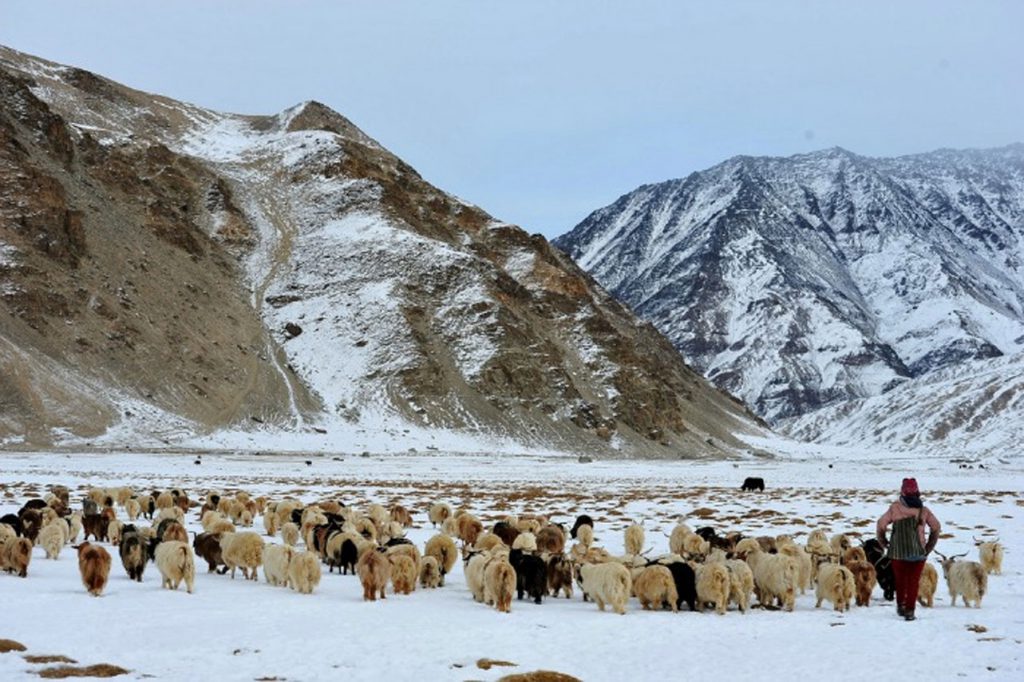
The Changra goats in the Himalayas with the herder
Truly sustainable cashmere can be traced to its very beginning. It starts high in the Himalayas with the Changthangi goat or Changra goat. The goats grow a super-fine undercoat to survive the -40 temperatures, and the fibre is harvested by traditional herders rather than shearing machines. The herders know their goats and respect them and will only collect the fibre when they naturally shed. This raw fibre is then cleaned by hand before being spun into yarn by hand. The yarn is woven into textiles by artisans on traditional hand looms. Due to the small scale, slow nature, and human touch of each stage of the process, it is easy to trace ethics and quality throughout the chain, and when you buy sustainable cashmere, you can trace it to the source and the individual. That traceability is the future of fashion.
Buy Less, Wear Longer
Fast fashion offers you 50 different scarves. Slow fashion offers you 2 rather fabulous ones. That is longevity. A natural cashmere scarf is not designed to be worn just through one season. It is designed to be worn for maybe 20 years, possibly 30. The fibre naturally is 3 times warmer than usual wool, is incredibly light, is incredibly soft, and only gets better the more you wear it. It is virtually impossible to pill if it is pure grade-A cashmere. That level of longevity is the very definition of true luxury and true sustainability.
If you do the math, a cashmere wrap will probably be in your wardrobe for about 20 years. That's 20 cheap synthetics that don't go to the landfill. And saving you a huge amount of money that you don't even notice you are saving. It is a wise investment in the cost-per-wear of this most luxurious of materials, the perfect example of buying less but wearing longer, the heart and soul of slow fashion.
How Sustainable Cashmere Supports Artisans and Communities?
Artisan at work using traditional techniques to check the fineness of the fibre
Choosing to buy slow fashion means you are endorsing a skilled artisan, not a factory machine. When you buy sustainable cashmere you are supporting a family, not a factory. There are no huge factories processing authentic cashmere. Instead, they are able to be processed in tiny artisan clusters in Kashmir and Ladakh. Everything from spinning to weaving, to finishing is handed down over generations. For these communities, your purchase is more than a sale; it's a contribution to the preservation of their culture. Sustainable brands like pashmina.com will guarantee that artisans earn fair wages, work comfortably, and are credited for their talents. For most of these communities, your purchase is the only way to sustain the dying art of traditional craft. You are essentially donating to a community of artisans. This human element gives slow fashion an essence that the mass-produced business cannot replicate.
How to Build a Conscious Wardrobe With Sustainable Cashmere?
Drape this luxury of elegance with your attire to show off the glamour of boldness
You do not need to throw your entire wardrobe away; you simply need to begin to consider your purchases consciously. Introduce just one masterpiece. This winter, do not buy five ephemeral stoles, but instead invest in an elegant pure cashmere scarf. You will be able to pair it with everything Indian and Western, and it will last forever. When you buy, check for traceability and handloom tags. Maintain it well, and it will last a lifetime. Wrap in muslin or butter paper. Dry clean only when needed. This one purchase will change your outlook, and you will realize that real style is not about higher quantity but better quality. Once you experience the feeling of sustainable cashmere, you will never wish to settle for less. And that, without a doubt, is the journey towards the future.